



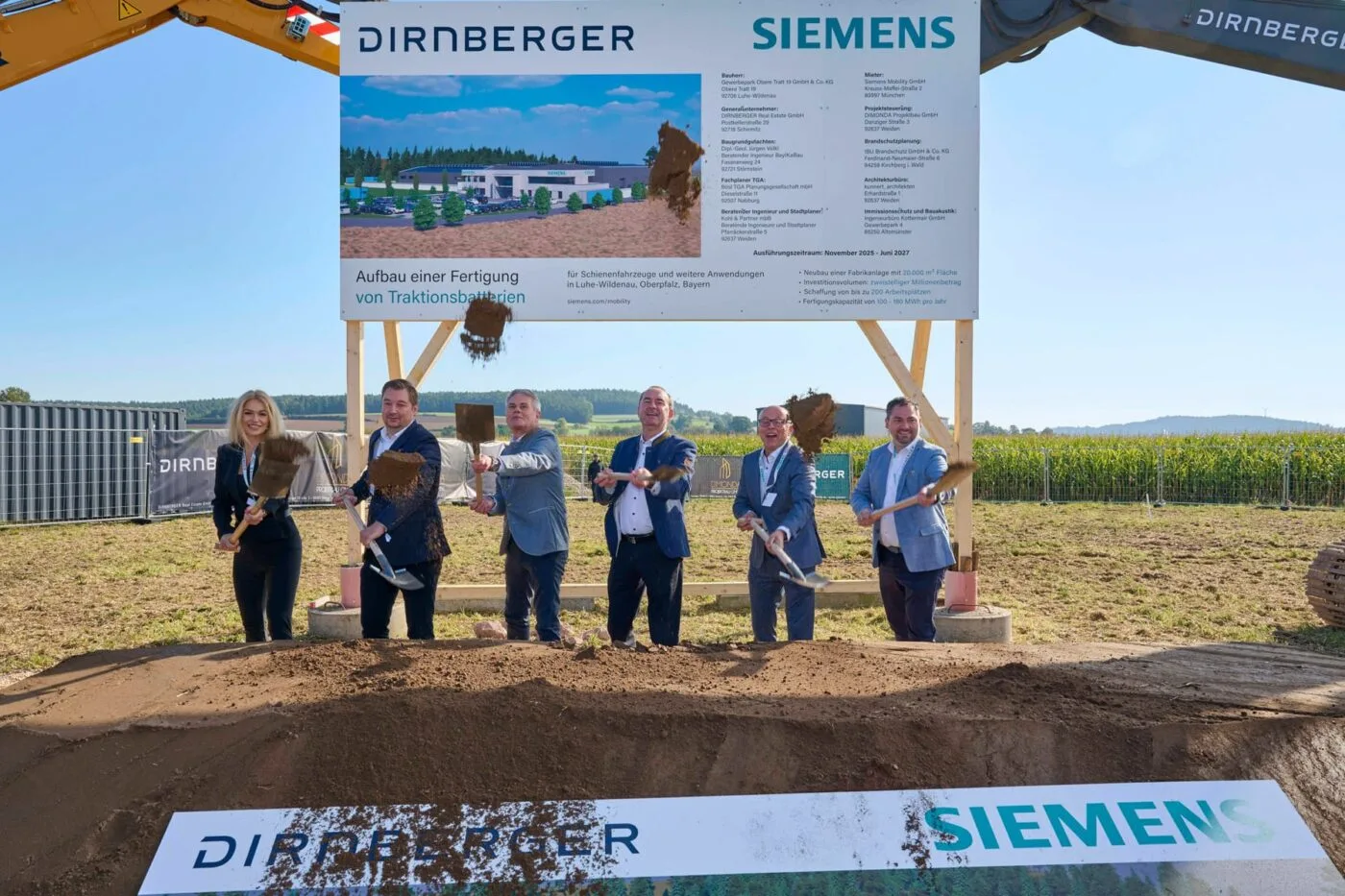
Siemens Mobility and its partners have started construction on a new rail battery system production facility in Luhe-Wildenau, Bavaria, with operations scheduled to begin in October 2027.
The €35 million project will cover around 20,000 square meters and employ up to 200 staff. Siemens said the plant will produce complete battery systems for regional trains, locomotives, and external customers, including a new battery management system developed with Munich-based Stercom. Battery cells will be supplied by manufacturers such as Toshiba, with integration handled by Siemens Mobility.
See also: Monash Researchers Develop Zinc Battery With Record Energy Density and 74-Day Performance
“Building on this long-standing expertise, Siemens Mobility is now establishing full-scale system production at the site,” the company said. Capacities for the new systems will reach about 500 kilowatt hours for regional trains and up to 2,000 kWh for locomotives, with annual output of 120 megawatt hours possible in three-shift operations.
Karl Blaim, CFO of Siemens Mobility, said: “With the new battery system production facility in Luhe-Wildenau, we are making a clear commitment to Germany as a production and innovation hub. We are investing specifically in key technologies, creating high-quality jobs in the region, and strengthening the competitiveness of the domestic rail industry.”
See also: Indian Researchers Use Amorphous Materials to Boost Magnesium Battery Performance
Of the €35 million cost, Siemens will contribute €22 million, supported by €2.7 million in Bavarian subsidies. Regional developers Dirnberger Real Estate GmbH and DIMONDA Projektbau GmbH are also investors. Bavaria’s economy minister Hubert Aiwanger attended the groundbreaking, presenting the subsidy approval.
Siemens Mobility said it has been the market leader in battery-electric regional trains since 2017 and is also preparing to build battery-electric locomotives for freight transport.


