



SEAT and its performance brand Cupra have begun the final preparations for series production of the all-electric Cupra Raval at the Martorell plant near Barcelona, the company said, as the facility transitions toward large-scale electric vehicle manufacturing.
The project has entered the pre-series industrialisation phase, during which production processes, logistics and quality standards are validated under conditions close to full-scale manufacturing. The company described the development as the start of the “countdown to series production.”
The Raval will be the first electric vehicle built at Martorell, followed shortly by the Volkswagen ID. Polo, a key model in the Volkswagen Group’s plan to expand into the affordable battery-electric compact segment.
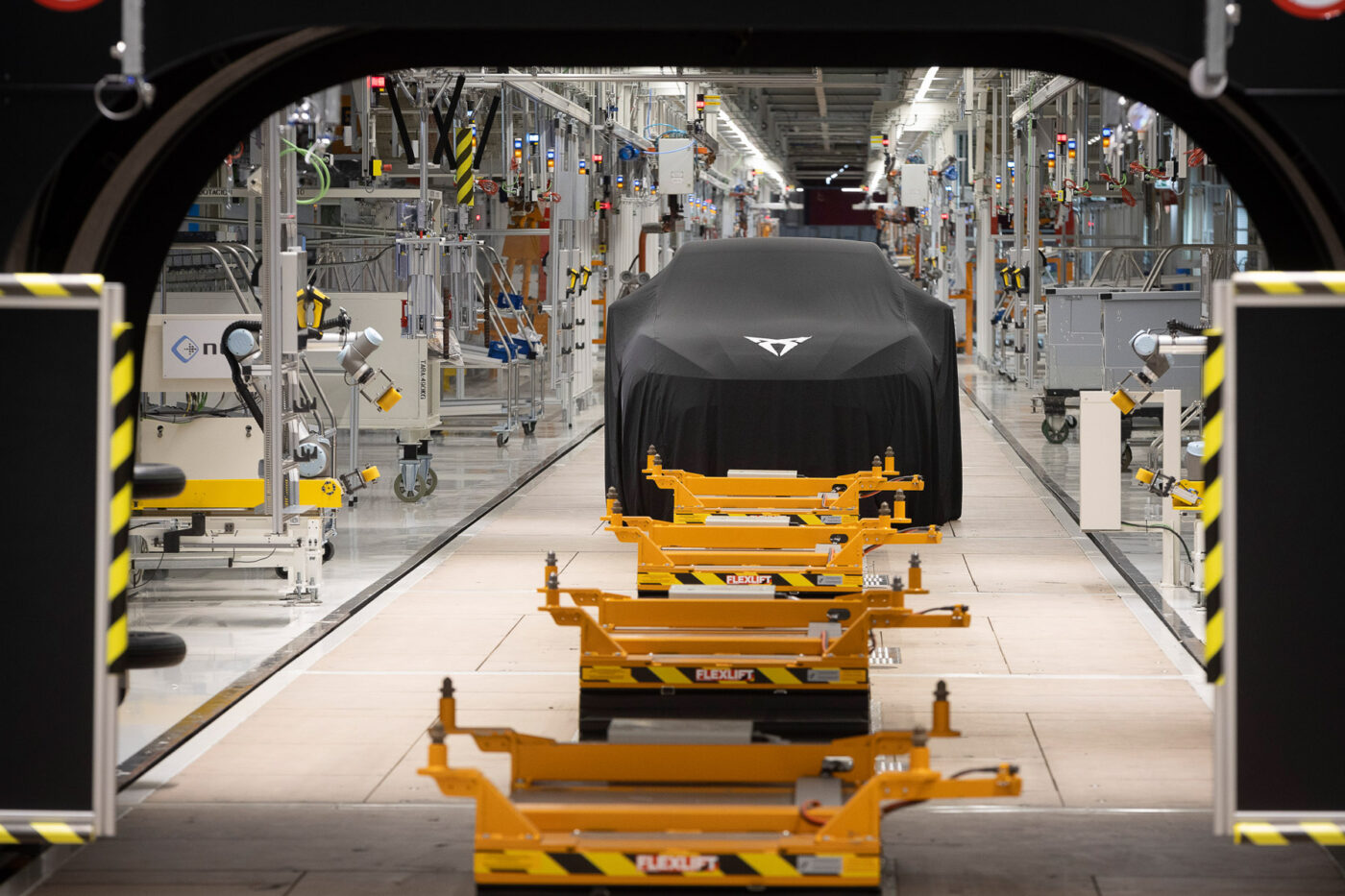
To prepare for EV production, SEAT has carried out a major overhaul of the site. About 160,000 square meters of the plant have been adapted for electric vehicle assembly, including the installation of 1,000 new robots in the body shop and 60 new stamping tools. A newly built 600-meter automated bridge now connects the battery assembly facility—opened in December—with the main production line, improving logistics between battery production and vehicle assembly.
“We are entering a historic year,” said Markus Haupt, chief executive of SEAT and Cupra. “In Martorell, the epicentre of future mobility, we are in the final phase of series production of the Cupra Raval, the car that will mark the beginning of a new era for the brand.” He added that the company has modernised facilities, trained employees and optimised processes to support the transition to electric mobility.
SEAT/Cupra is also coordinating development of other models within the Volkswagen Group’s compact electric car family, including the ID. Cross and Škoda Epiq, which will be produced at the Navarra plant in Spain. According to the company, teams across the region have completed more than 560,000 hours of training to prepare for the new vehicles, while local suppliers are expected to account for about 70% of material costs.
André Kleb, head of production for the Iberian Peninsula within Volkswagen Group’s Core brand cluster, said the transformation positions Martorell as a flexible facility capable of producing electric, hybrid and combustion-engine vehicles for multiple brands. “We are in the final stages of our industrial transformation,” he said, noting that the plant aims to remain competitive as the industry shifts toward electrification.
Under Volkswagen Group’s revised production structure introduced in late 2025, factories are now organised by regional networks rather than individual brands. Kleb oversees production not only at Martorell and Navarra but also at the Setúbal plant in Portugal, where another small electric model—expected to be the production version of the ID.EVERY1—will be built.
The Cupra Raval project is seen as central to the group’s strategy to deliver lower-cost electric vehicles manufactured in Europe, as competition intensifies in the entry-level EV segment.