



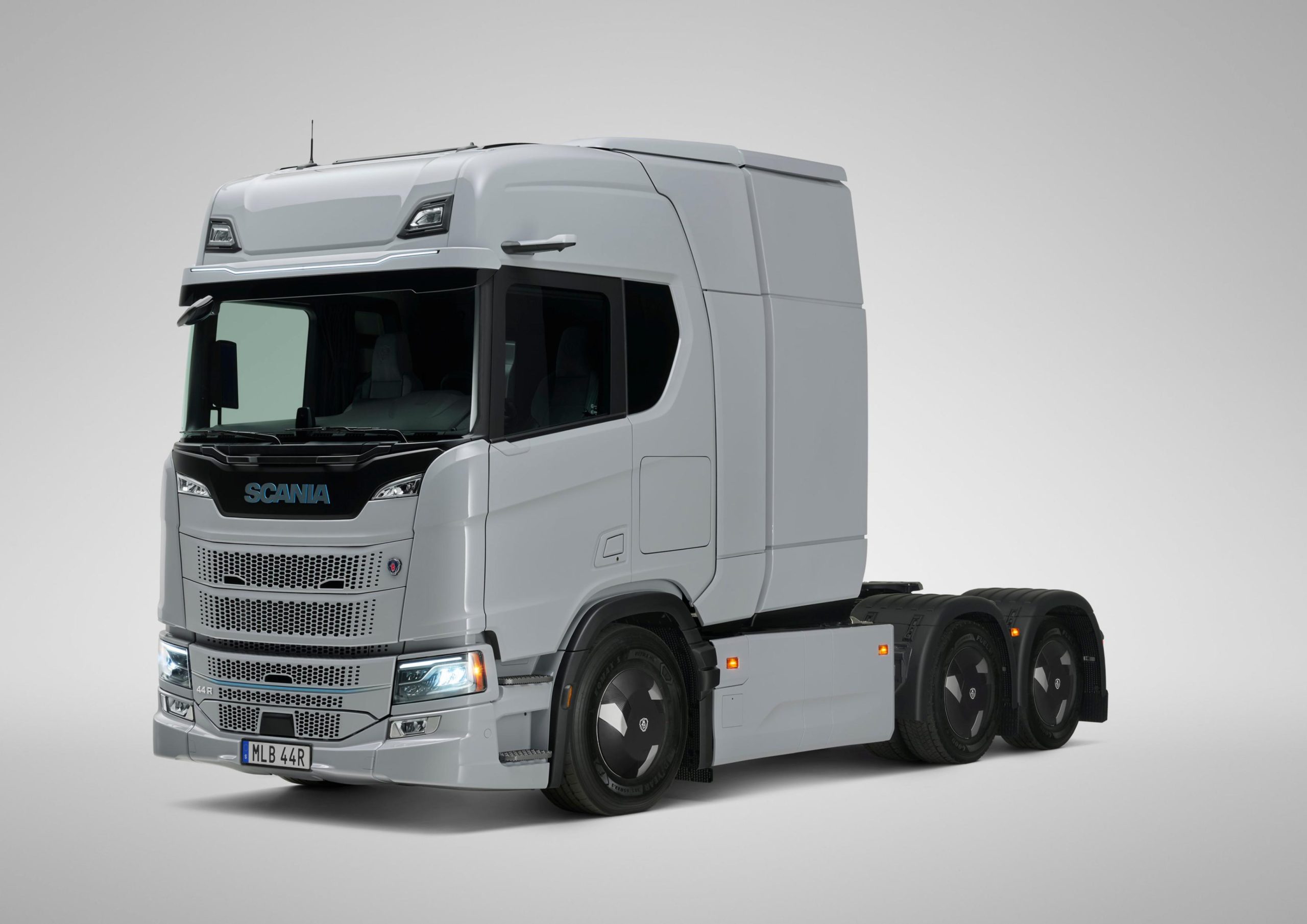
Scania is introducing a new battery configuration for its electric trucks that places additional battery packs behind the cab, increasing installed capacity and enabling ranges of up to 720 kilometres depending on configuration and operating conditions.
The new “Battery Behind Cab” solution is designed for selected long-haul 6×2*4 tractor configurations and combines additional batteries with Scania’s chassis-mounted battery packs. In a typical configuration, two MP20 battery packs can be installed behind the cab, adding approximately 356 kWh of installed capacity.
Additional Battery Capacity For Long-Haul Operations
The new arrangement is intended to give operators greater range while retaining the flexibility required for European long-distance transport.
Scania says the system can be used alongside its Increased Vehicle Dimension (IVD) front, which extends the truck’s front slightly and incorporates aerodynamic optimisation. This combination allows the vehicle’s total length to exceed 16.5 metres, enabling the additional battery capacity without being limited by the standard vehicle dimensions.
The solution is aimed at European tractor-trailer combinations using standard trailer configurations, with the additional batteries providing greater energy storage for demanding long-haul routes.
“Electric trucks are already part of the transport system, but long-haul operations place very different demands on range, payload and charging. With this solution, Scania is showing how those pieces can come together in a practical way for customers who want to electrify demanding long-distance routes,” said Lars Gustafsson, Senior Vice President and Head of Solutions Management at Scania.
IVD Front Reduces Energy Consumption
The Battery Behind Cab solution is offered together with Scania’s IVD front, which the company says can reduce energy consumption by up to 3% on battery-electric vehicles, depending on specification and operation.
Aerodynamics have a greater influence on overall energy consumption in electric trucks, according to Scania, making reductions in air resistance particularly relevant for long-distance applications.
The combination of the extended front and additional batteries therefore addresses both vehicle efficiency and available range for long-haul operations.
Seven-Battery Configuration And MCS Charging
The new solution follows Scania’s announcement in May that it would increase the maximum number of battery packs from six to seven and introduce Megawatt Charging System (MCS) capability.
The batteries are manufactured by MAN in Nuremberg. Scania and MAN are sister companies within the Traton Group, and MAN has also announced a seven-battery configuration for its eTGX electric tractor.
At IAA Transportation 2026, MAN said its electric flagship tractor will be able to achieve up to 720 kilometres of range with seven battery packs. Scania now cites the same maximum range for its corresponding configuration, subject to vehicle specification and operating conditions.
The Scania system is also designed to support MCS charging, allowing higher-power charging intended to reduce charging stops and improve vehicle utilisation on long-haul routes.
Range, Payload And Charging
Scania says the new configuration is intended to address the combination of range, payload and charging requirements that can make long-distance trucking more difficult to electrify.
The Battery Behind Cab system supports selected 6×2*4 tractor configurations and is designed to work with standard European trailer combinations. The company has not provided a single range figure applicable to every configuration, noting that the maximum 720-kilometre figure depends on specification and operating conditions.
“This is not only about placing batteries in a new position on the vehicle. The larger point is what it enables: electric transport over distances that have traditionally been among the hardest to electrify, with range, payload and charging considered together from the start,” Gustafsson said.


