




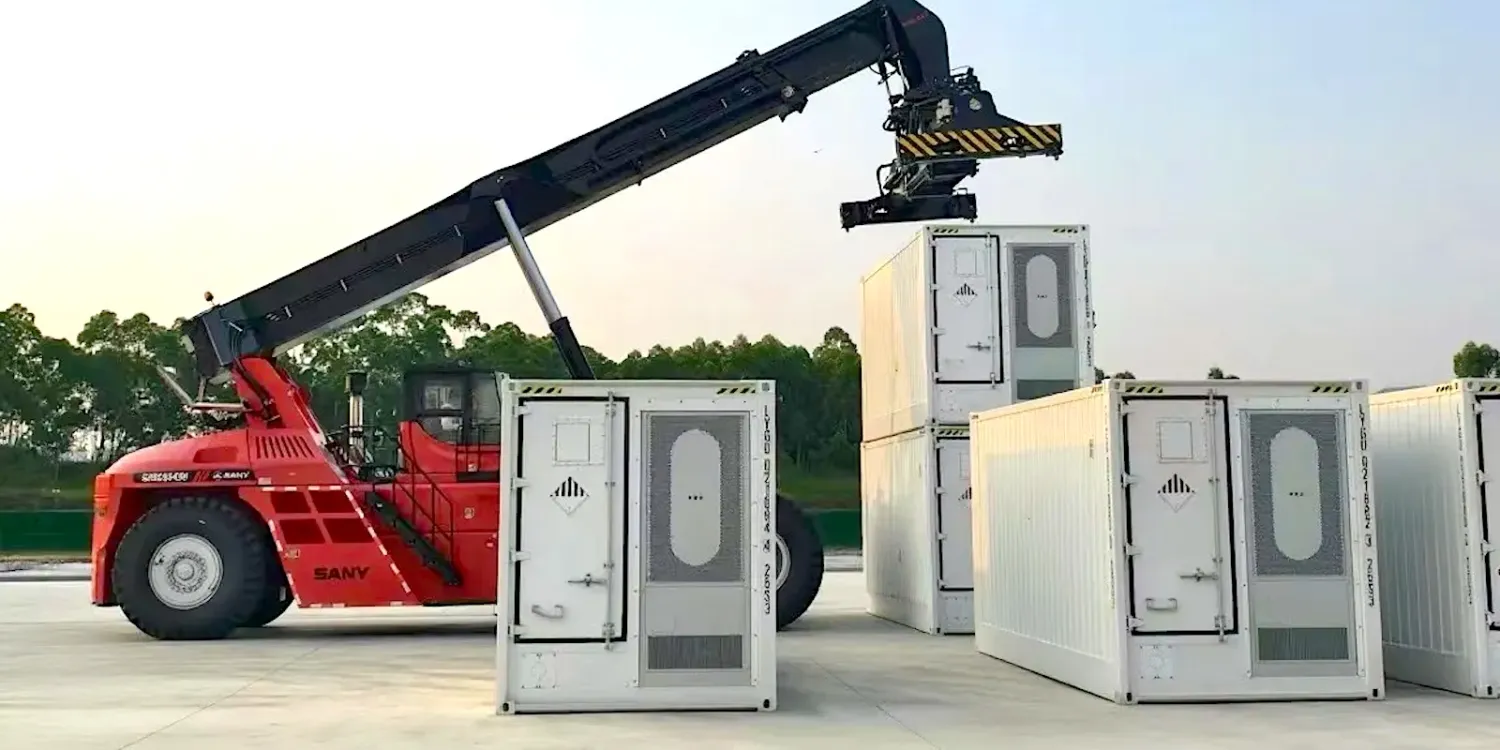
Multinational equipment manufacturer SANY has introduced a 50-ton electric reach stacker that incorporates an energy recovery system modeled on Formula 1’s KERS (Kinetic Energy Recovery System), aiming to improve efficiency and reduce costs for logistics and energy storage operators. The first units are expected to be delivered to customers building utility-scale energy storage projects by the end of this month.
KERS, widely used in Formula 1 during the late 2000s and 2010s, converts the kinetic energy lost during braking into electricity, which is then stored in a battery or flywheel. SANY has adapted the principle for heavy lifting operations, feeding recovered energy back into the machine’s electric hydraulic system. The company says the design reduces hydraulic pressure losses by 50% and lowers overall energy consumption by more than 60%.
SANY reports that the system recovers more than 65% of the potential energy generated during the boom’s descent. In practical terms, this allows about 0.4 kWh of energy to be recovered for every 1 kWh consumed in lifting operations, providing operators with significant efficiency gains.
The machine is equipped with a 512 kWh swappable battery pack compatible with other SANY heavy equipment. It also supports DC fast charging as an alternative to battery swaps. On a single charge, supported by the onboard KERS, the reach stacker can operate for more than seven hours continuously, which SANY says reduces downtime compared to other equipment in the same class.
With capacity to stack six 50-ton containers, the new model is designed to maximize space efficiency by increasing container and battery storage density at logistics and industrial sites. The combination of extended operating hours and higher stacking capability positions the equipment as a tool for supporting grid-scale energy storage as well as port and freight operations.


