




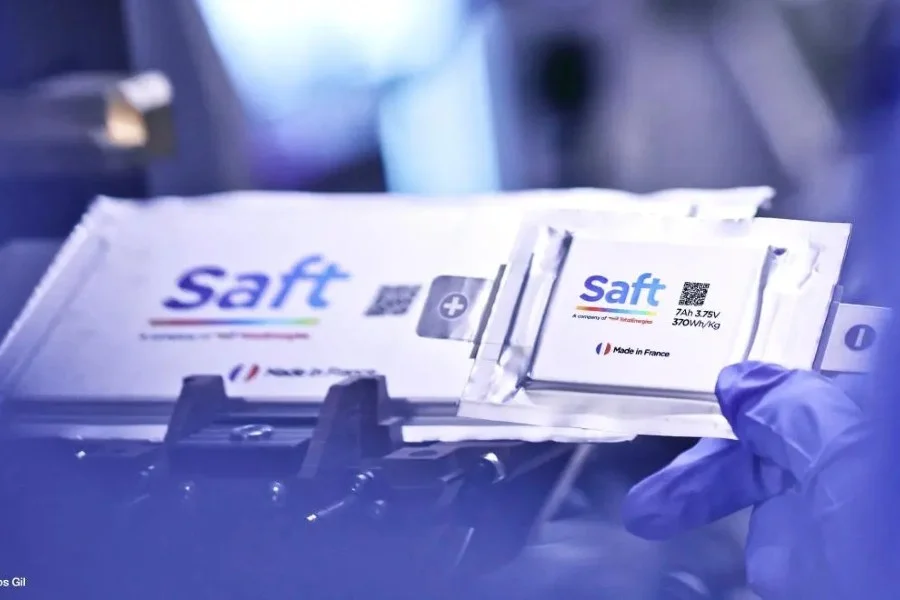
Saft, the battery manufacturer owned by TotalEnergies, has inaugurated new production lines for solid-state battery technologies at its facility in Bordeaux, France. The lines are designed to manufacture polymer-based semi-solid-state batteries and sulphide-based solid-state batteries, with aerospace identified as a primary application.
The company has not announced plans to use the batteries in road vehicles. According to Saft, the production facilities operate at room temperature and are intended to support the industrialisation of technologies developed through several years of research.

Production Lines Cover Two Battery Technologies
Saft said the Bordeaux facility can accommodate both polymer-based semi-solid-state cells and sulphide-based solid-state batteries. The company describes itself as the first French manufacturer to produce its own solid-state battery technologies using both types of electrolyte at room temperature.
Aerospace is a key target market because of the requirements for safety, performance and energy density in aircraft applications. Saft has also recently delivered semi-solid-state cells through its collaboration with aerospace company Safran.
The manufacturer says its new batteries can achieve energy density up to 50% higher than conventional lithium-ion batteries. However, it has not provided detailed cell specifications or disclosed the conditions under which the maximum improvement was measured.
Dry Electrode Process Targets Lower Manufacturing Emissions
The new production lines use a dry electrode manufacturing process. Saft estimates that the method could reduce carbon dioxide emissions during production by up to 40%.
The company has described the batteries as compact and designed to provide safety benefits, but has not disclosed detailed performance figures, production capacity or planned output volumes for the Bordeaux lines.
Saft CEO Cédric Duclos said the facilities mark a step towards manufacturing batteries developed through the company’s research programme.
“Solid-state batteries are among the most promising innovations for meeting tomorrow’s electrification needs. These new production lines mark an important milestone for Saft, as we turn several years of research into real industrial capacity, a statement of our ambition to establish France and Europe as leading players in this strategic technology.”
France’s Solid-State Battery Industry
Saft is not the only French company developing solid-state battery technology. Blue Solutions, part of the Bolloré group, produces lithium-metal-polymer batteries. The company has been undergoing restructuring following problems reported with batteries used in series applications, particularly in buses.
The two companies are pursuing different approaches to solid-state battery technology, and their commercial progress will depend on factors including battery performance, manufacturing costs and reliability in their intended applications.
Saft’s Other Battery Development Projects
Saft is also involved in automotive battery development through Automotive Cells Company (ACC), a joint venture owned by Saft, Stellantis and Mercedes-Benz. ACC produces nickel-based battery cells and modules in France.
Plans for additional ACC factories in Germany and Italy have been cancelled, leaving the joint venture focused on ramping up production at its existing French facility.
Separately, Saft has participated in research projects covering several battery architectures. Together with Stellantis and other partners, it has worked on battery systems integrating inverter and charging functions. In the European SUBLIME research project, launched in 2023, the company worked on sulphide-based solid-state batteries. Saft is also involved in the TALISSMAN project, which focuses on lithium-sulphur batteries for electric vehicles.
The Bordeaux production lines add to these research activities by establishing manufacturing capacity for solid-state battery technologies. Saft has not announced whether the new lines will eventually be adapted for automotive applications or disclosed a timeline for any such development.


