



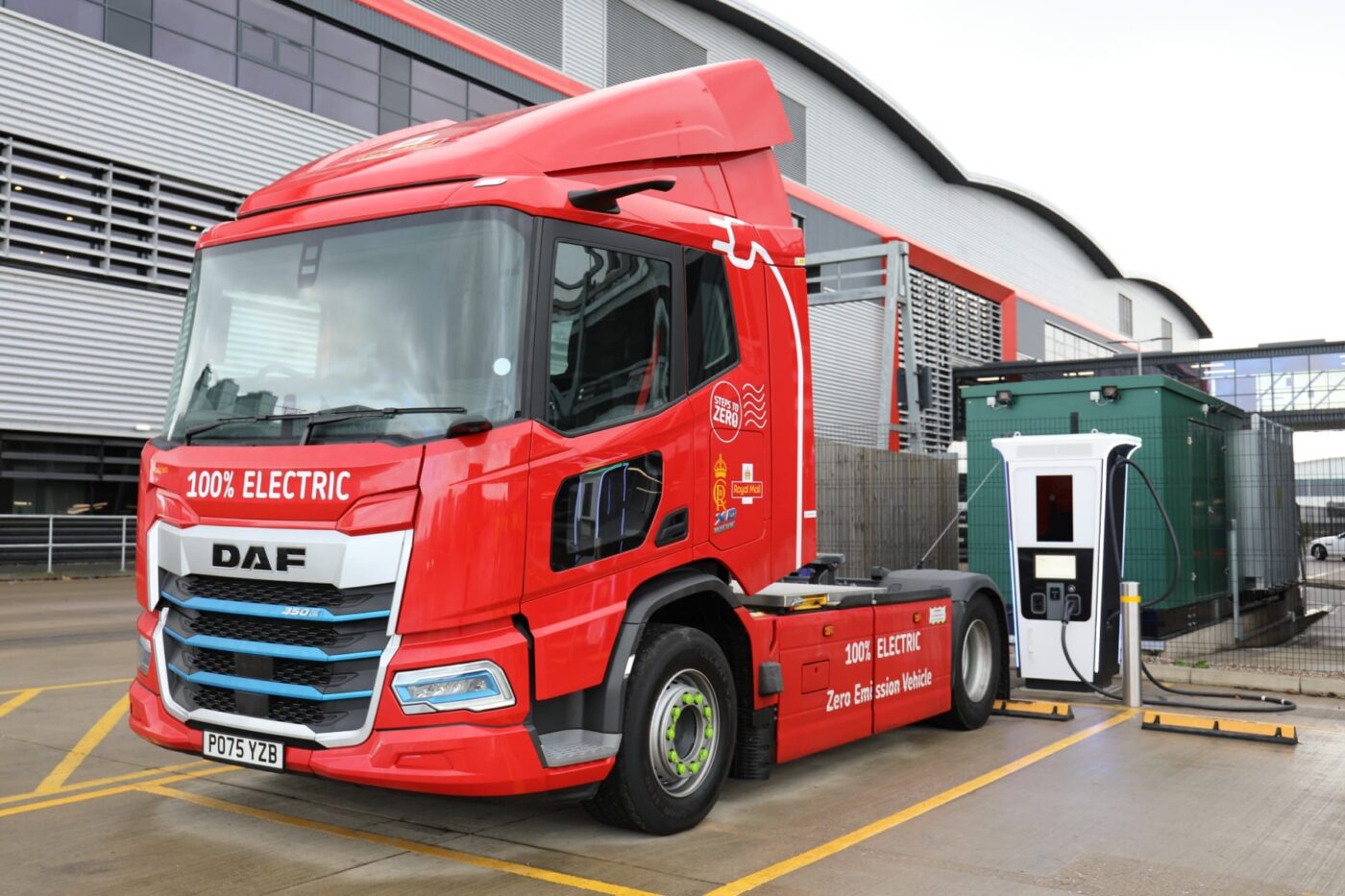
Royal Mail has deployed its first eight electric heavy goods vehicles (HGVs) at parcel hubs in Daventry and Warrington, marking the postal operator’s initial move into zero-emission long-haul transport as part of Britain’s wider freight decarbonisation drive.
The vehicles, DAF XD 350E 42-tonne battery-electric trucks, will handle round-the-clock deliveries between parcel centres and postal depots. Royal Mail said the trucks will be supported by ABB Terra 360 fast chargers, capable of adding rapid driving range during peak operations.
See also: Royal Mail Trials 19-Tonne Electric Trucks in Push to Decarbonise Heavy Fleet
“Introducing electric HGVs into our network is a major milestone in decarbonising our operations and achieving our Net-Zero target,” said Nick Dunn, Royal Mail’s National Distribution & Fleet Director. “This is an important first step in learning how we can efficiently integrate eHGVs into our operations across the country.”
The charging infrastructure has been installed under Gridserve’s Electric Freightway project, which has received £100 million ($127 million) in funding, including £62.7 million from the UK government. The programme aims to deploy 200 public and depot-based 350 kW truck chargers, forming the backbone of the UK’s future electric freight network. Electric Freightway is part of the wider Zero Emission HGV and Infrastructure Demonstrator (ZEHID) scheme, backed by up to £200 million in public funding.
See also: Peugeot to Supply Royal Mail with Over 2,000 Additional Electric Vans
According to DAF Trucks, the XD 350E is powered by the Paccar EX-D2 electric drivetrain with 350 kW output, paired with battery packs of up to 525 kWh gross capacity. While Royal Mail has not confirmed which battery configuration it selected, the use of 360 kW ABB chargers indicates support for ultra-fast DC charging.
Royal Mail already operates what it says is Britain’s largest electric delivery van fleet, with about 7,000 electric vehicles, after first introducing EVs in 2017. The company added more than 100 micro electric vehicles to its fleet last month and reached its 7,000th EV milestone in May 2025.


