
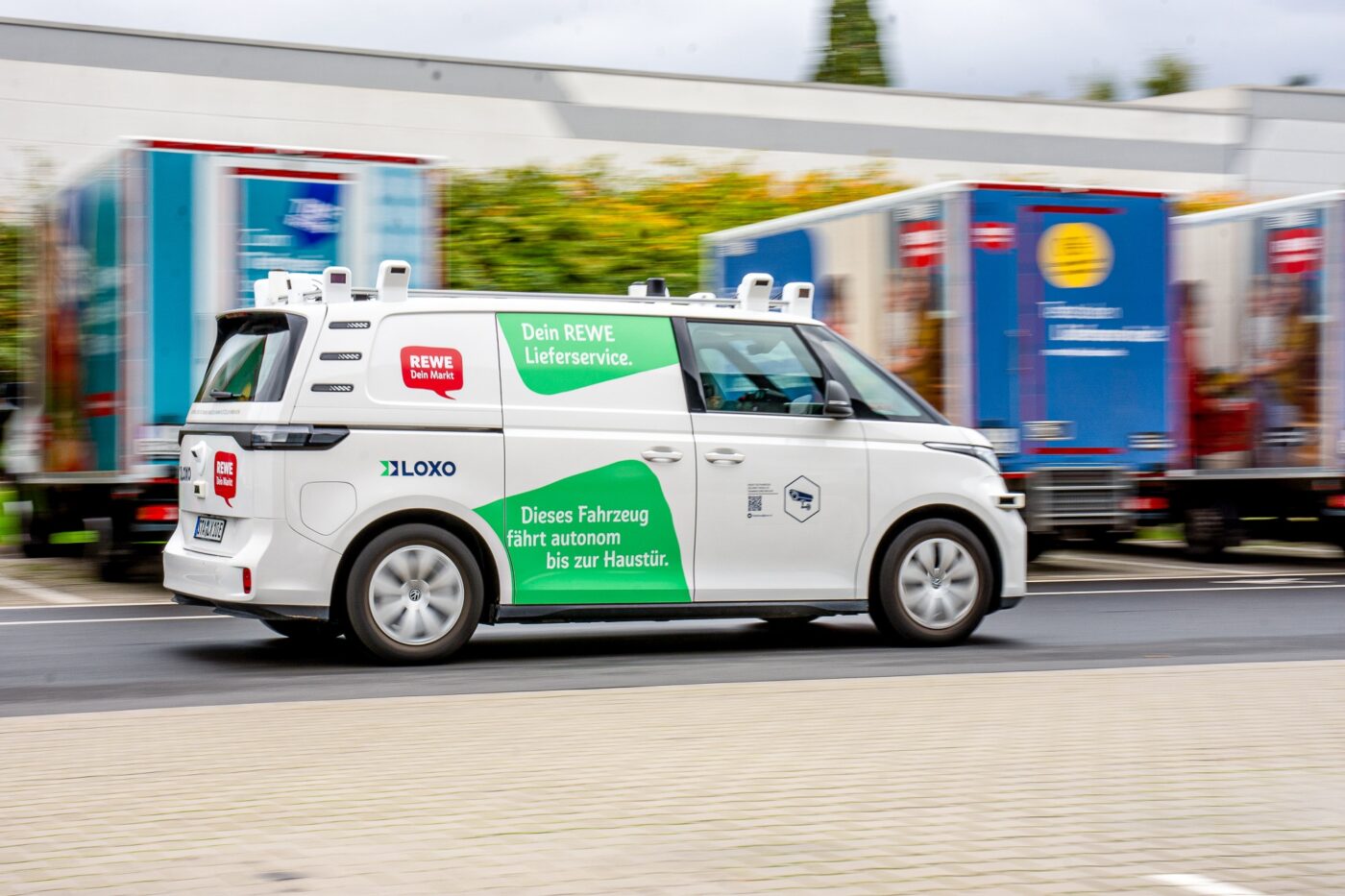
German grocery retailer Rewe has begun a six-month pilot program testing autonomous grocery deliveries in the city of Bochum, in the industrial Ruhr Valley, using a modified VW ID. Buzz. The project is conducted in partnership with Swiss technology start-up Loxo, which develops autonomous systems for commercial vehicles, and Bochum Economic Development.
During the trial, the ID. Buzz will navigate urban routes autonomously while a safety driver remains on board to monitor operations. The vehicle is integrated into Rewe’s existing delivery infrastructure, with routes planned manually and controlled through the retailer’s e-commerce systems. Customers receiving deliveries will see little difference from standard services, as the safety operator continues to bring groceries to the door.
Kai-Uwe Reimers, Head of Research & Innovation at Rewe Digital, said the pilot aims to explore how highly automated vehicles can complement existing delivery processes, noting that the project involves iterative testing and adaptation of applications during implementation.
Rewe described the pilot as the first use of a highly automated vehicle in real-world operations within the German food retail sector. At level 4 autonomy, vehicles can operate independently on certain routes and could eventually operate without a safety officer on board.
Volkswagen is also running multiple autonomous projects with the ID. Buzz. In October 2025, Berlin’s public transport operator BVG and VW’s mobility service Moia began testing the NoWeL4 project using several ID. Buzz vehicles initially without passengers. Across Europe, other autonomous delivery initiatives are advancing, including Atlos’ integration of Electreon’s wireless charging technology and Swedish company Einride’s deployment of a fully autonomous heavy goods vehicle on public roads in Belgium.