





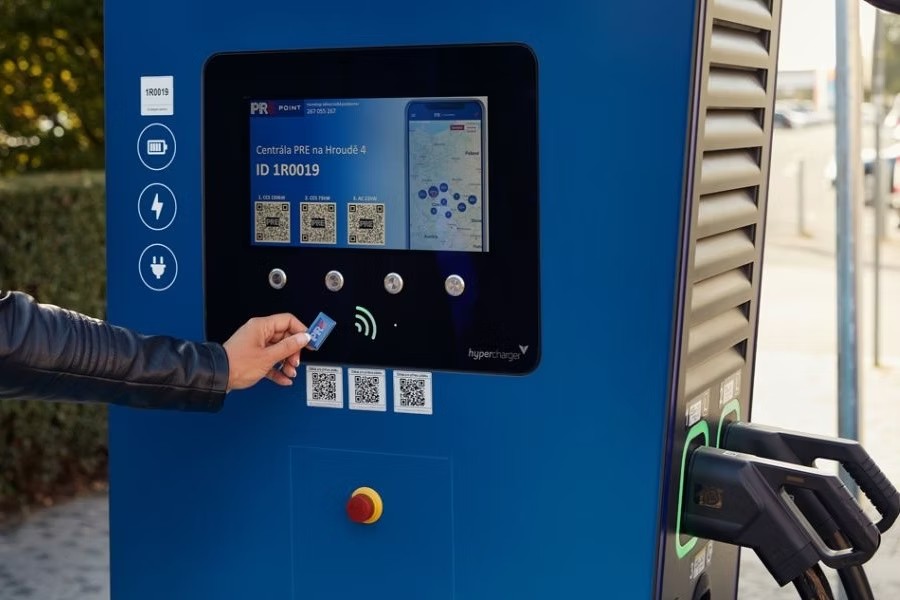
Prague has officially opened its largest electric vehicle charging hub for regular public use, providing capacity for up to 161 vehicles to charge simultaneously at a single location.
The charging facility, located on Novovysočanská Street in the Praha 9 district, has completed a year-long testing period and is now operating as part of the Czech capital’s expanding electric mobility infrastructure.
The hub is operated by energy company Pražská energetika (PRE), in which the City of Prague holds a stake.
High-Capacity Charging Infrastructure
The site includes a total of 161 charging points, of which 147 are available to the public. The remaining charging points are reserved for vehicles operated by the PRE group.
Most charging services are provided through AC infrastructure, complemented by high-power DC charging equipment.
The hub features two public Alpitronic high-power charging stations capable of delivering up to 400kW. At a neighboring PRE facility, six additional non-public HPC chargers with a total of 12 connectors offer charging capacities of up to 300kW.
The broader installation includes 50 standalone AC charging stations, 25 wall-mounted AC chargers and three AC charging units integrated into street lighting infrastructure.
Together, the AC network provides 145 charging connections.
Smart Energy Management System
According to city officials, the charging hub incorporates an energy management platform that continuously monitors electricity consumption from nearby buildings and all connected charging points.
The system dynamically manages charging currents to optimize energy use while reducing pressure on the local electricity distribution network.
City representatives said the approach demonstrates how large-scale charging infrastructure can be integrated into existing urban energy systems without compromising grid stability.
Supporting Prague’s EV Growth
Prague Mayor Bohuslav Svoboda said the project reflects a data-driven approach to developing electric vehicle infrastructure across the city.
“The development of electromobility in Prague must be based on data, not on feelings or fashion trends,” said Svoboda.
“We see that the number of electric vehicles and charging points in the Czech Republic and Europe is growing steadily, but at the same time it is clear that smart, high-capacity hubs in strategic locations work best, not randomly distributed individual stations.”
Jaromír Beránek, Prague’s Deputy Mayor for Transport, described the project as an example of combining charging capacity with intelligent network management.
“I have been involved in the development of electromobility and charging infrastructure for a long time, which is why I am pleased with the launch of this unique hub,” Beránek said.
“I will continue to support similar projects that effectively combine high performance with a smart network, as they are the key to smooth and clean transport in Prague.”
Future Expansion Plans
Drivers can access the charging network through the PID Lítačka mobile application, with plans to add real-time charger availability and occupancy information directly into route planning functions.
PRE is also preparing additional upgrades to the charging hub, including the installation of a canopy structure, a pricing display totem and customer amenities.
According to Libor Hladík, Head of Electromobility at PRE, permitting procedures are underway for the next phase of development, with construction expected to be completed by the end of the year.
The company is also working with city authorities to identify locations for additional large-scale charging hubs.
Potential future sites include Zbraslav, Komořany, Holešovice and Plzeňská Street in the Řepy district, where further high-power charging infrastructure is planned.
The project highlights the growing focus among European cities on centralized, high-capacity charging hubs as electric vehicle adoption continues to increase and urban charging demand expands.


