




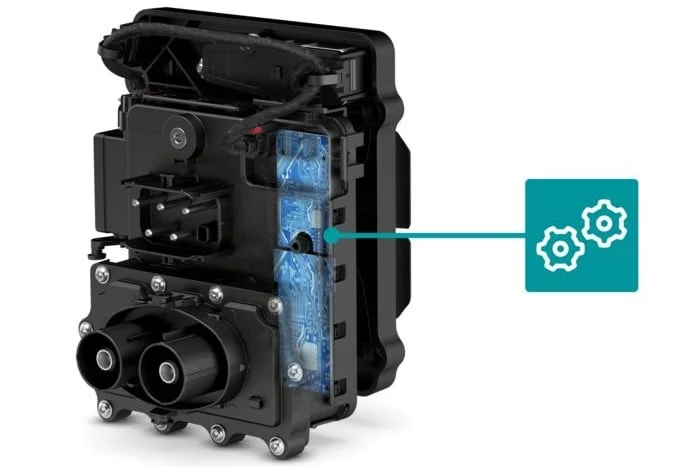
Phoenix Contact has introduced a combined CCS vehicle charging inlet and charging control unit, aiming to simplify electric vehicle architectures and reduce installation space for commercial and heavy-duty applications.
The new product, branded CHARX connect advanced, integrates charging communication and control directly into the vehicle-side CCS charging socket, functions that have traditionally required separate external control devices. Phoenix Contact said sample units are already available for original equipment manufacturers, with series production scheduled to begin in the third quarter of 2026.
The company, headquartered in Blomberg, Lippe, described the system as the world’s first CCS vehicle charging inlet with integrated charging control. It is designed primarily for battery-electric buses, electric trucks, heavy-duty commercial vehicles and off-road machinery, where space constraints and system robustness are critical.
By integrating the control unit directly into the charging inlet, vehicle manufacturers can reduce cabling, eliminate additional interfaces and simplify system architecture, Phoenix Contact said. “This eliminates the need for external control devices and additional interfaces,” the company noted, adding that all charging communication is handled via power line communication (PLC) directly through the inlet.
The charging inlet will be offered in both CCS Type 1 and CCS Type 2 variants, supporting AC and DC charging. Phoenix Contact said the DC rated voltage is up to 1,000 volts, with multiple current options depending on cable configuration: 200 amps, 250 amps or 400 amps, and boost charging of up to 800 amps for short periods.
Further configuration options include variable outlet directions, selectable cable lengths and optional features such as a protective cover, emergency stop button, plug-area illumination and LED status indicators. The charging inlet is also available in a version without the integrated control system, allowing manufacturers to choose based on their vehicle architecture.
Phoenix Contact said the pre-configured combination of inlet and control unit reduces development effort, as OEMs no longer need to implement or align separate charging communication protocols. Maintenance is also simplified, as the inlet can be replaced without additional tools thanks to detachable cable connectors.
With heavy-duty and commercial electric vehicles increasingly adopting high-power charging, the company is positioning the CHARX connect advanced as a modular solution to support faster integration and lower system complexity for next-generation electric platforms.