
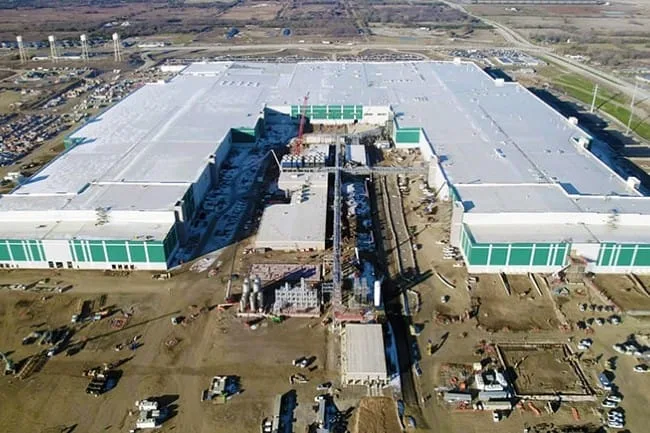
Panasonic has officially inaugurated its new electric vehicle (EV) battery manufacturing facility in De Soto, Kansas, marking the company’s second production site in the United States. The plant, which began construction in late 2022 and represents an investment of around $4 billion, has already started series production of its cylindrical 2170 lithium-ion cells, primarily used in Tesla vehicles such as the Model 3 and Model Y.
At full capacity, the Kansas factory is expected to reach an annual output of approximately 32 gigawatt-hours (GWh) and create roughly 4,000 direct jobs. However, Panasonic has refrained from setting a definitive timeline for reaching this milestone, reflecting caution amid changing market dynamics and weaker-than-anticipated EV demand in North America.
“The opening of our Kansas Factory marks a major milestone in our journey to scale advanced battery production in the United States,” said Kazuo Tadanobu, CEO of Panasonic Energy. The company said the new facility incorporates experience from its Nevada plant, jointly operated with Tesla, and includes labor-saving production lines aimed at achieving 20% higher productivity.
The factory’s output is expected to complement Panasonic’s existing capacity of 41 GWh in Nevada, potentially bringing the company’s total US production to 73 GWh. However, Panasonic has delayed its earlier goal of reaching 30 GWh annually in Kansas by March 2027, according to the Japanese business daily Nikkei, citing internal adjustments amid reduced order volumes from Tesla and evolving US policies under the Trump administration.
In addition to its current 2170 cell production, Panasonic plans to introduce next-generation cells with enhanced energy density and performance. These improvements are to be enabled by advanced materials, including silicon anodes supplied by UK-based Nexeon. The company says these upgraded cells could increase capacity by around five percent.
Panasonic had previously aimed to quadruple its global EV battery production to 200 GWh annually by the end of fiscal year 2030, and to triple its revenue to over 3 trillion yen (approximately $19 billion). However, that timeline is no longer fixed. The revised strategy reflects a broader reassessment of global investment plans, with the company indicating it will more cautiously evaluate future projects in Japan and the US amid shifting consumer demand and regulatory conditions.