





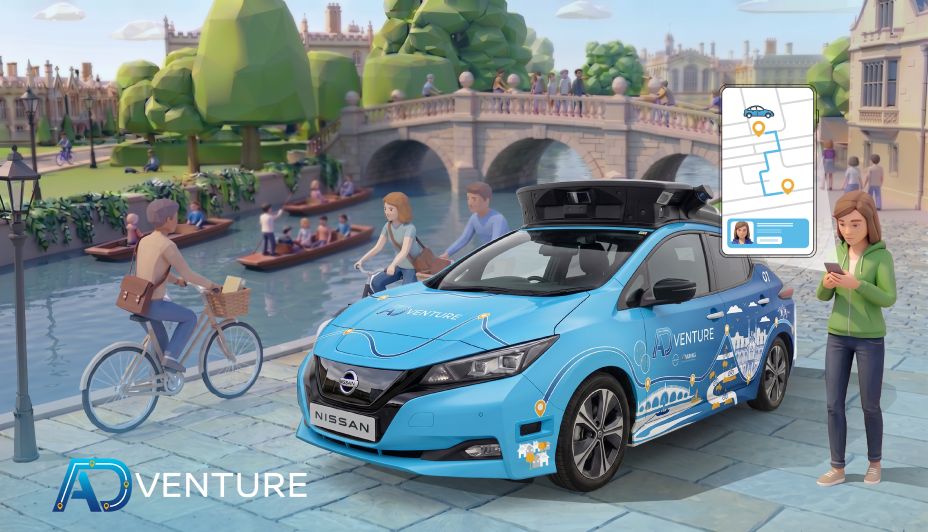
Nissan will lead a £3 million (US$4 million) UK government-backed project to develop a self-driving passenger service in Cambridge, working with WMG at the University of Warwick and PAVE UK. Known as ADventure, the project will examine how autonomous mobility services can be integrated into local transport and will conclude with a public-road demonstration in the city.
Project Focuses on Autonomous Mobility Services
Nissan Technical Centre Europe will lead the project alongside WMG and PAVE UK, an organisation focused on educating the public about automated vehicles.
The test vehicle will be a 2022 Nissan Leaf equipped with Nissan-developed autonomous driving systems. The vehicle has previously been used in UK autonomous driving trials.
Rather than focusing solely on vehicle technology, ADventure will examine how driverless passenger services can operate within existing local transport systems and how communities respond to the technology.
Cambridge was selected because of its existing research and testing activity involving autonomous transport. The project will also allow Nissan to extend its autonomous mobility research beyond London and examine how such services could operate in another UK city.
“This project is an important step for autonomous mobility in the UK. With UK Government backing, it will take autonomous vehicle research beyond central London and into another city, helping us understand how these services can work for different communities and real-life journeys,” said David Moss, Senior Vice President, Research and Development, Nissan Africa, Middle East, India, Europe and Oceania.
“By developing and applying Nissan’s in-house expertise, combined with the wider knowledge from our partners, we can delve further into how self-driving vehicles can improve connectivity, accessibility and quality of everyday life,” Moss added.
Cambridge to Serve as Test Bed
The project will investigate how autonomous passenger services could fit into local transport networks while considering factors such as accessibility and user experience.
The use of an existing 2022 Nissan Leaf for the trials also places emphasis on applying autonomous driving technology within a service environment rather than developing a new vehicle specifically for the project.
Cllr Brian Milnes, Chair of the Greater Cambridge Partnership, said the city has become an important location for autonomous transport research in the UK.
“We’re pleased to be supporting Nissan with their research project and helping them on their autonomous technology journey,” said Milnes.
“Cambridge has already become one of the UK’s most exciting places to test autonomous transport and it’s now being recognised as a test-bed for ADventure,” he added.
“We’re looking forward to working with the project partners and building on the future of self-driving vehicles, particularly exploring the benefits to communities and boosting local transport.”
WMG to Support Safety and User Experience
WMG will contribute its expertise in safe autonomy and user experience to the project. The research will involve working with the public to develop a mobility service designed around local needs and transport priorities.
Professor Siddartha Khastgir, Head of Safe Autonomy at WMG, said the project will combine autonomous technology research with service design.
“We are excited to be partnering with Nissan as they bring their autonomous mobility service plans to the UK,” said Khastgir.
“Applying our deep safety and user-experience expertise to the ADventure project, we will be able to co-create a safe mobility service design with the public in a way that meets both their needs and the city’s transport priorities.”
“This remains a shared mission for all the partners, and reflects the real impact autonomous driving technology can have,” he added.
The project is intended to produce a model that could be applied in other UK communities, with the public-road demonstration in Cambridge serving as the final stage of the programme.


