





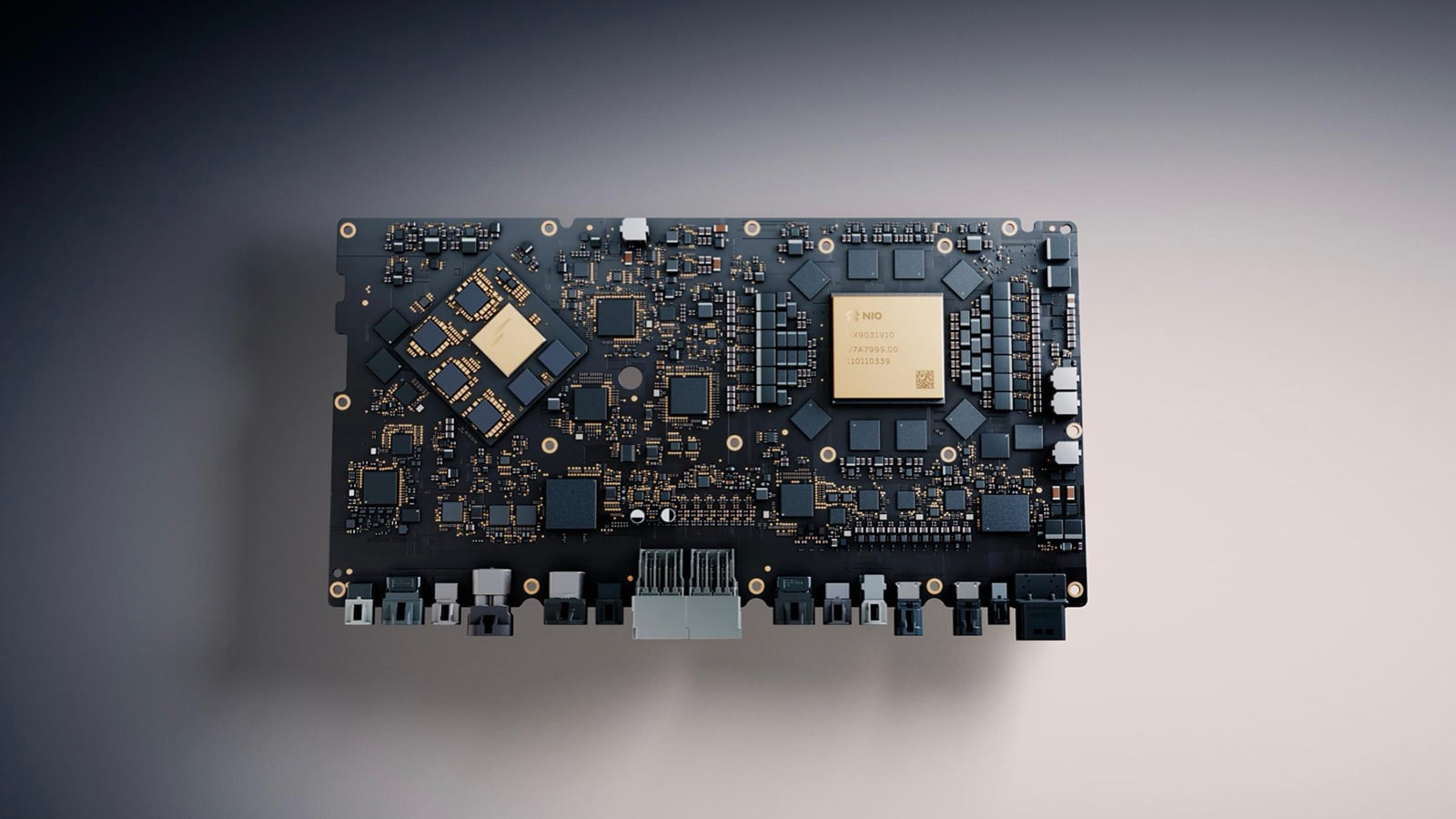
Nio has begun licensing its self-developed smart driving chip technologies to other companies, marking a new phase in its diversification efforts as the Chinese electric vehicle maker faces heightened cost pressures and a commitment to improve profitability in the fourth quarter, according to a report from local media outlet LatePost.
The company has started supplying its Shenji NX9031 smart driving chip externally through a licensing deal with an unnamed automotive chip manufacturer, the report said. While key terms were not disclosed, a chip industry insider cited by LatePost noted that contract values vary significantly depending on the licensing model. For a single intellectual property license, fees typically reach “millions of RMB,” while a system-on-a-chip (SoC) technology license could be worth “hundreds of millions of RMB,” the source said.
Nio unveiled the Shenji NX9031 chip in December 2023 and later integrated it into production vehicles. The flagship ET9 sedan, which began deliveries in March, is equipped with two NX9031 chips, while newer Nio models use one. The company has previously stated that each NX9031 unit provides computing capability equivalent to four mainstream autonomous driving chips. Nio’s earlier vehicles relied on four Nvidia Orin X chips for assisted driving functions.
The commercial rollout of the chip follows internal restructuring of Nio’s semiconductor operations. In June, the chip division was formally registered as Anhui Shenji Technology Co Ltd, led by Nio vice president Bai Jian. The new entity holds RMB 10 million ($1.4 million) in registered capital and covers chip design and sales as part of its business scope. Local outlet Cailian earlier reported that Nio’s aim is to allow the unit to accept external orders as an independent project.
Nio founder and CEO William Li signaled the company’s intention to open its hardware ecosystem to the industry earlier this year. “If you want to buy the best chips, you can come to Nio,” Li said during the China EV 100 Forum on March 29, emphasizing the firm’s willingness to provide chip and operating system technologies to peers.
Industry linkages around Shenji-related operations expanded further in November when Anhui Shenji Technology, Axera Semiconductor and OmniVision Integrated Circuits Group established a joint venture called Chongqing Chuangyuan Zhihang Technology Co Ltd. Axera, which entered the automotive semiconductor market in 2023 after focusing on AI vision chips, holds the largest stake at 36.4 percent, according to LatePost. The report did not confirm whether Axera is the company acquiring Nio’s chip licensing rights.
Axera recently completed a Series C funding round exceeding RMB 1 billion and currently mass-produces its M55 and M76 chip series used in basic driver-assistance systems, competing with Horizon Robotics’ Journey 2 and Journey 3 chips. Its higher-end automotive chips for urban Navigation on Autopilot remain in development.


