
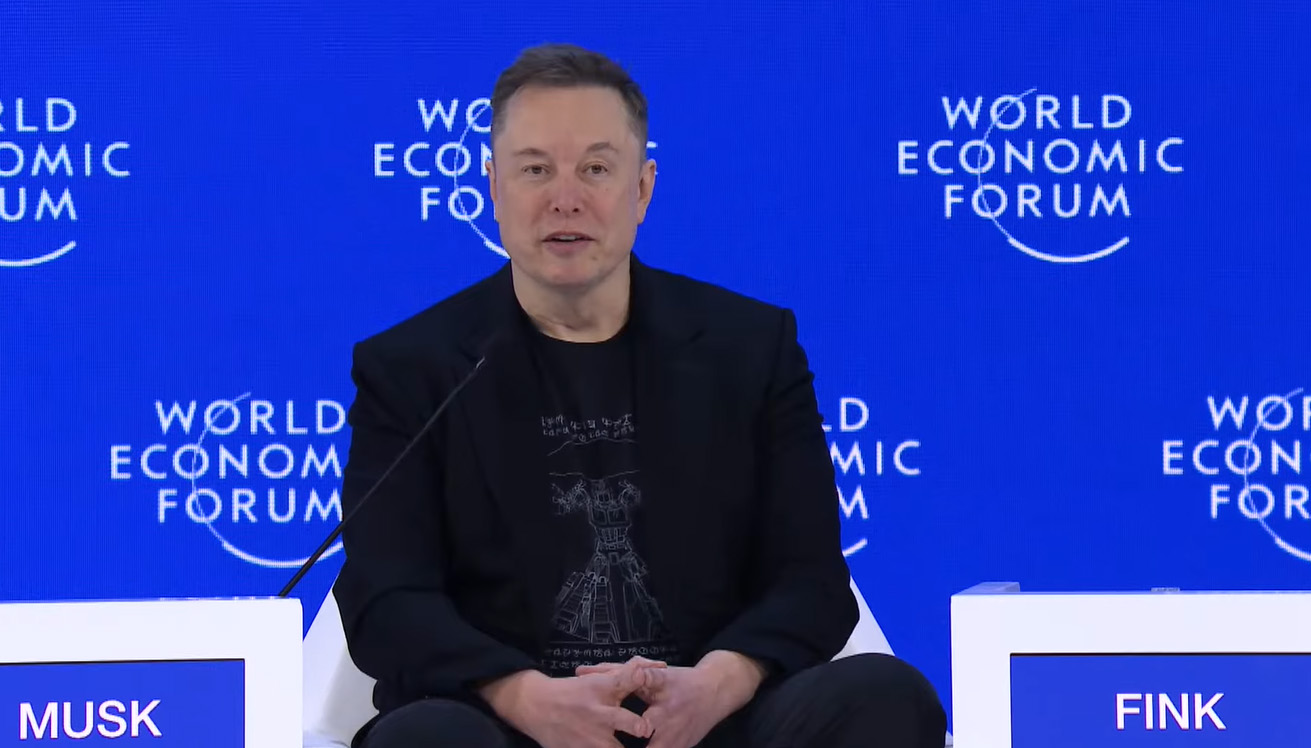
Elon Musk used a last-minute appearance at the World Economic Forum on Thursday to criticise U.S. tariffs on solar power, outline ambitious plans for Tesla including humanoid robot sales next year, and signal that European regulatory approval for its self-driving technology could arrive within weeks.
Musk, who has for years described the forum as elitist and detached from ordinary people, was interviewed by Larry Fink, interim co-chair of the World Economic Forum. Fink opened the session by expressing admiration for Musk, setting the tone for a wide-ranging discussion that touched on artificial intelligence, robotics, reusable rockets and Musk’s long-standing fascination with science fiction.
Musk has become an increasingly prominent political and business figure in recent years, bolstered by his proximity to U.S. President Donald Trump and his leadership of companies including SpaceX, satellite operator Starlink, social media platform X and artificial intelligence startup xAI.
Breaking with Trump’s sceptical stance on renewable energy, Musk said the United States could generate all of its electricity needs from solar power, even accounting for surging demand from data centres driven by Big Tech and artificial intelligence. “You could take a small corner of Utah, Nevada or New Mexico — a very small percentage of the area of the U.S. — to generate all of the electricity that the U.S. uses,” Musk said.
He argued, however, that high tariffs were undermining the economics of solar deployment. “Unfortunately, the tariff barriers for solar are extremely high and that makes the economics of deploying solar artificially high,” Musk said. Trump has openly criticised clean energy and frozen approvals for large onshore wind and solar projects, leaving thousands of megawatts of capacity stalled as U.S. power demand accelerates.
The Davos discussion avoided other geopolitical issues dominating the forum, such as Russia’s war in Ukraine and Trump’s comments on Greenland, instead focusing on technology and the future of automation. Musk predicted robots would eventually outnumber humans, unleashing a major economic expansion, but warned about the risks of unchecked artificial intelligence.
“We need to be very careful with robotics. We don’t want to find ourselves in a James Cameron movie,” Musk said, referencing the Terminator franchise. “Love his movies, but we don’t want to be in Terminator, obviously.”
Musk also reiterated Tesla’s aggressive technology roadmap, including plans to sell humanoid robots next year and expectations that European regulators could soon approve Tesla’s self-driving systems, a milestone that would accelerate broader deployment.
The appearance comes as Musk faces mounting regulatory pressure elsewhere. Governments and watchdogs across Europe and Asia are scrutinising sexually explicit content generated by xAI’s Grok chatbot on X, launching investigations, imposing bans and demanding safeguards as part of a broader global push to curb illegal AI-generated material.
Despite the controversy, Musk closed the session on a lighter note, joking about aliens and space travel. “People ask me do I want to die on Mars,” he said. “And I’m like: yes, but not on impact.”