


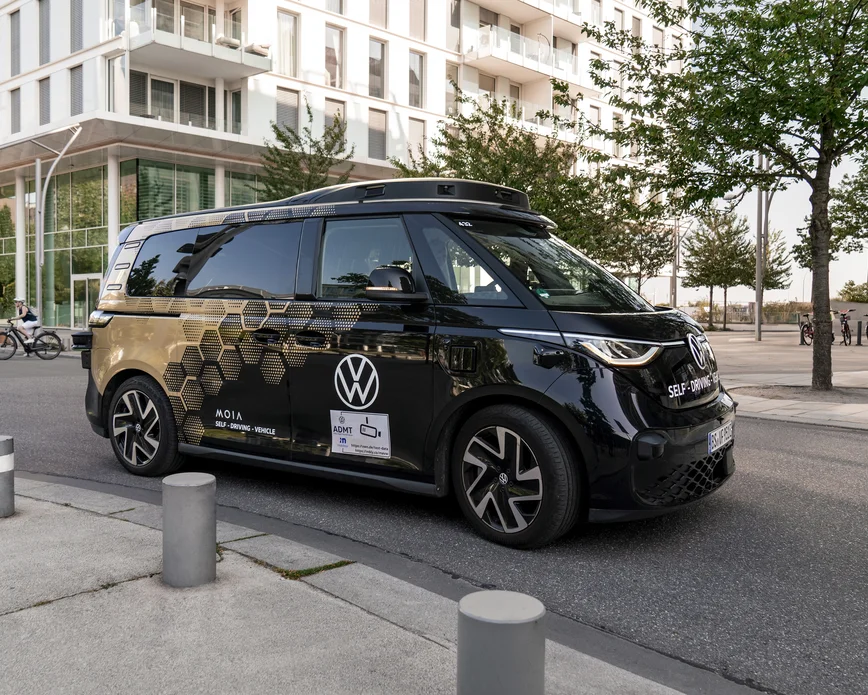
MOIA has launched public trials of its autonomous ridepooling service in Hamburg, allowing selected residents to book rides in self-driving ID. Buzz electric vehicles as part of a pilot project designed to support the future deployment of autonomous public transport.
The initiative is being carried out under the ALIKE project, which is funded by Germany’s Federal Ministry for Digital and Transport and aims to demonstrate how autonomous on-demand mobility services can complement existing public transport networks.
Pilot begins with autonomous ID. Buzz fleet
The initial service area covers parts of Winterhude, Barmbek and Wandsbek in Hamburg, where selected participants can book rides free of charge.
During the trial phase, a safety driver will remain on board each vehicle while MOIA collects operational data and evaluates the performance of the autonomous system. The project is expected to deploy up to 10 self-driving ID. Buzz vehicles.
MOIA’s operating platform combines the ID. Buzz AD autonomous vehicle, Mobileye’s automated driving technology, fleet management software and operational systems into a single integrated solution. The company said the platform is intended to be offered to public transport operators and private fleet providers in the future.
Hamburg project supports international expansion
The Hamburg pilot will serve as the foundation for MOIA’s broader autonomous mobility strategy.
Earlier this year, the company announced a partnership with U.S.-based mobility provider Beep to deploy up to 5,000 autonomous shuttle vehicles for public transport over the next decade. MOIA is also preparing additional autonomous mobility pilot programs in Germany, Norway and the United States.
The company said operational experience gained through the ALIKE project will help support the rollout of autonomous ridepooling services in additional markets.
The trial also coincides with evolving international regulations governing autonomous driving. Recently adopted UNECE rules establish harmonized safety requirements for fully autonomous driving systems, while pilot projects such as ALIKE are expected to provide practical experience to support the commercialization of autonomous mobility services.