
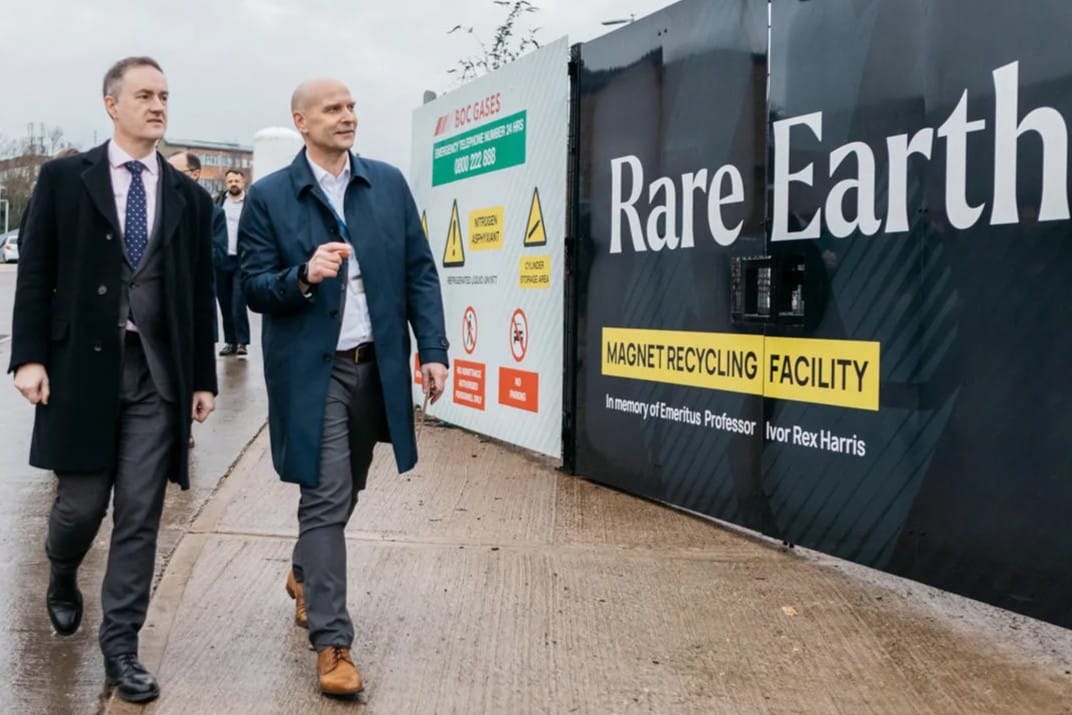
Mkango Resources and the University of Birmingham have commissioned a commercial facility in central England to recycle rare earth magnets, marking a step toward building domestic supply capacity for electric vehicles and other clean energy technologies.
The plant, located at Tyseley Energy Park in Birmingham, separates and reprocesses used rare-earth magnets, recovering alloys that are then manufactured into new sintered magnets. The site expands on an earlier demonstration plant that processed batches of up to 100 kilograms, with the new facility capable of handling more than 400 kilograms per batch. Annual capacity is set at around 100 tonnes in single-shift operation and could exceed 300 tonnes if operated across multiple shifts.
See also: UK’s Ricardo Unveils Rare Earth-Free Electric Motor Prototype
The technology behind the process was developed and patented by the university’s Magnetic Materials Group and commercialised through its spin-out company HyProMag, which was acquired by Mkango in 2023. The method uses hydrogen to break down magnet scrap into neodymium-iron-boron alloy powder, which can then be reused to produce new sintered magnet blocks suitable for industrial use.
Rare earth magnets are a key component in permanent magnet synchronous motors used in electric vehicles, as well as in consumer electronics and renewable energy systems. Demand for such materials has increased as automakers and governments seek to reduce reliance on imported critical minerals and strengthen regional supply chains.
See also: UK Sets Targets to Boost Domestic Supply of Critical Minerals by 2035
The Birmingham facility received £4.5 million in funding from Innovate UK through its Driving the Electric Revolution Industrialisation Centres programme, alongside support from the Innovate Climate Programme, the Engineering and Physical Sciences Research Council, the Advanced Propulsion Centre and EU Horizon funding. The project aligns with the UK government’s Critical Minerals Strategy, published in November 2025, which targets meeting 10% of national critical minerals demand from domestic sources and 20% through recycling by 2035.
“This new facility is great news for the West Midlands which will help create hundreds of well-paid local jobs and is testament to our world-leading expertise in rare earth recycling,” said Industry Minister Chris McDonald. He added that the project was “bringing sintered magnet manufacturing back to the UK for the first time in 25 years.”