



Researchers at the Massachusetts Institute of Technology (MIT) have developed a new battery electrolyte that can dissolve into its molecular components within minutes, allowing lithium-ion cells to be dismantled and recycled more easily. The advance, published in Nature Chemistry, could help reduce waste and strengthen a circular supply chain for electric vehicle batteries.
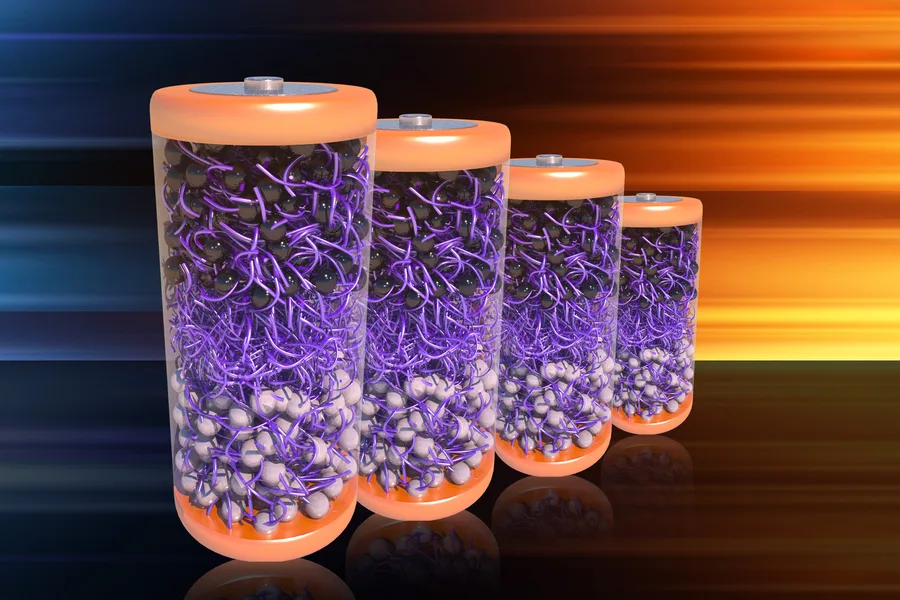
The team created a solid-state electrolyte based on aramid amphiphiles (AAs), molecules that mimic the chemical stability of Kevlar. Modified with polyethylene glycol to conduct lithium ions, the AAs self-assemble in water into nanoribbons with robust backbones and ion-conducting surfaces. When hot-pressed, the nanoribbons form a solid electrolyte layer that is mechanically stable but can break down instantly when immersed in organic solvents.
In laboratory tests, the material transported lithium ions between common electrodes such as lithium iron phosphate cathodes and lithium titanium oxide anodes. While performance was limited during rapid charging due to polarisation, researchers emphasised the main advantage lies in recyclability. When exposed to solvents, the electrolyte dissolves in a process the team compared to cotton candy vanishing in water, leaving behind battery components ready for recovery.
“So far in the battery industry, we’ve focused on high-performing materials and designs, and only later tried to figure out how to recycle batteries made with complex structures and hard-to-recycle materials,” said Yukio Cho, PhD ’23 and first author of the study. “Our approach is to start with easily recyclable materials and figure out how to make them battery-compatible. Designing batteries for recyclability from the beginning is a new approach.”
Cho added the material is not meant to replace existing electrolytes entirely but could serve as a layer to enable disassembly. “We don’t want to say we solved all the problems with this material,” he said. “But what we’re picturing is using this material as one layer in the battery electrolyte. It doesn’t have to be the entire electrolyte to kick off the recycling process.”
Looking ahead, the researchers said the method could also ease supply risks by enabling large-scale recovery of critical materials such as lithium. “If we can start to recycle lithium-ion batteries from battery waste at scale, it’ll have the same effect as opening lithium mines in the US,” Cho said.
The project was supported by the US National Science Foundation and the Department of Energy, with experiments carried out at the MIT.nano Characterisation facilities.


