

The battery-electric Mercedes-Benz eArocs 400 has successfully completed intensive winter testing in northern Finland, clearing a key development milestone ahead of its planned market launch in April, Daimler Truck said.
Designed for urban construction transport, the eArocs 400 marks the first electric version of the long-running Arocs line, which has traditionally been powered by diesel since its introduction in 2013. Mercedes-Benz Trucks unveiled the model last year and plans a limited annual production of about 150 units for selected European Union markets.
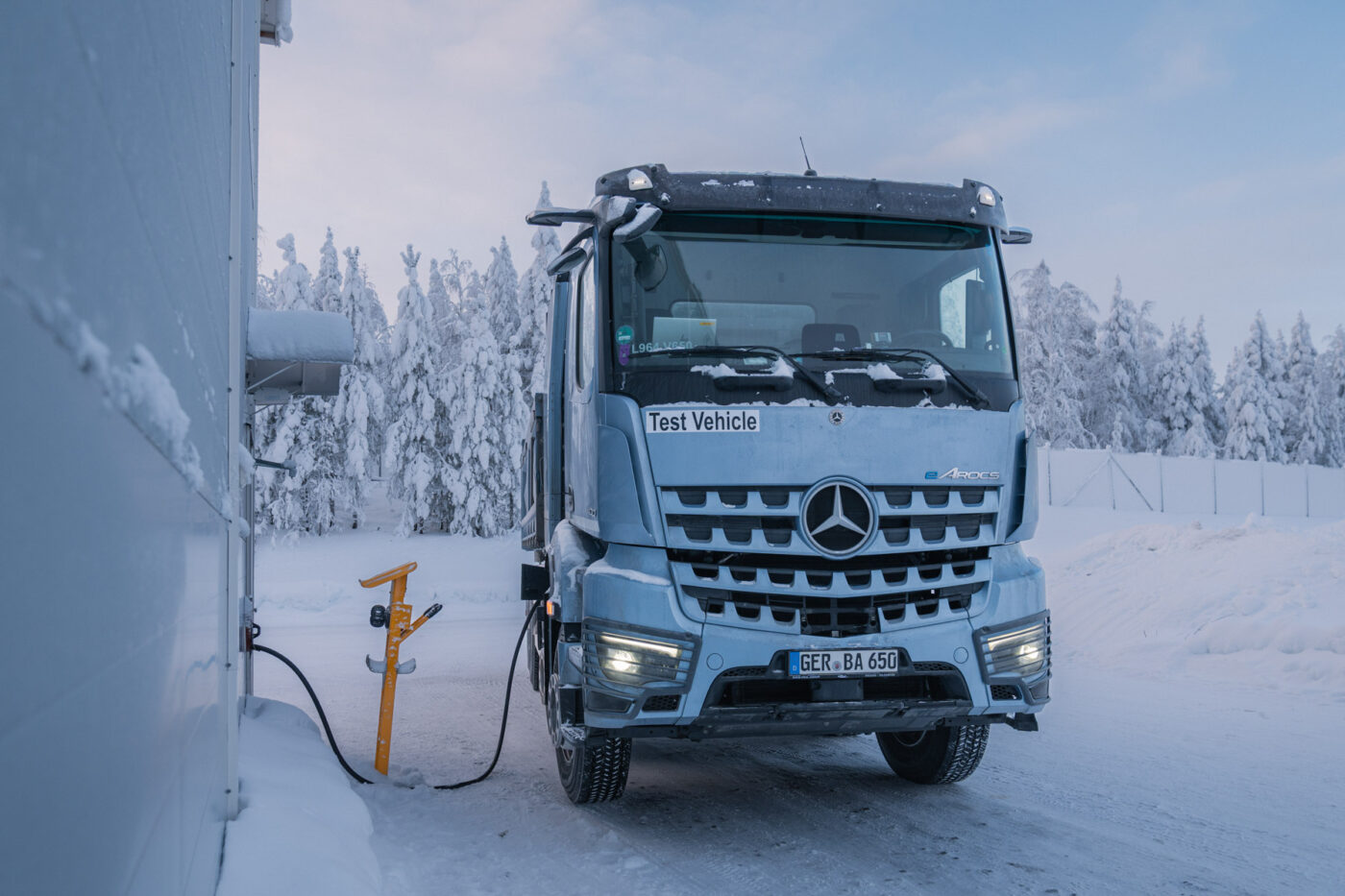
Testing took place near the Arctic Circle in temperatures as low as −20°C, focusing on performance under harsh winter conditions. Engineers evaluated traction and stability on snow and ice, cold-start behavior, battery and charging performance in sub-zero temperatures, electric drivetrain operation and regenerative braking efficiency.
“The winter tests in Finland subjected the eArocs 400 to demanding trials under dry, extremely cold conditions — trials it handled with confidence,” said Michael Kimmich, head of development for the model. He added that the truck demonstrated stable driving characteristics and performance consistent with expectations.

The eArocs 400 shares several key components with Mercedes-Benz’s electric long-haul truck portfolio, including battery technology derived from the eActros 600. It uses two lithium iron phosphate battery packs rated at 207 kWh each, for a total capacity of 414 kWh, mounted behind the cab. The vehicle operates on an 800-volt electrical architecture and supports DC fast charging at up to 400 kW via CCS2 ports on both sides, enabling a 10% to 80% charge in about 46 minutes.
Initially, the electric construction truck will be offered as an 8×4/4 axle vehicle with permissible gross weights of 37 or 44 tonnes and in four wheelbase configurations. Available body types include a concrete mixer and a tipper, targeting street-oriented construction operations. Mercedes-Benz Trucks estimates a range of up to 200 kilometers for the mixer version and up to 240 kilometers for the tipper variant, sufficient for many daily duty cycles without intermediate charging.

Production of the base vehicle will begin at the company’s Wörth plant in Germany in the third quarter of 2026, with the electric drivetrain integration handled by the Paul Group. The model will be available to order from early April.
Daimler Truck said the project reflects its strategy to electrify heavy-duty vehicles across multiple applications, including sectors such as construction that pose additional challenges due to weight, terrain and power requirements.