


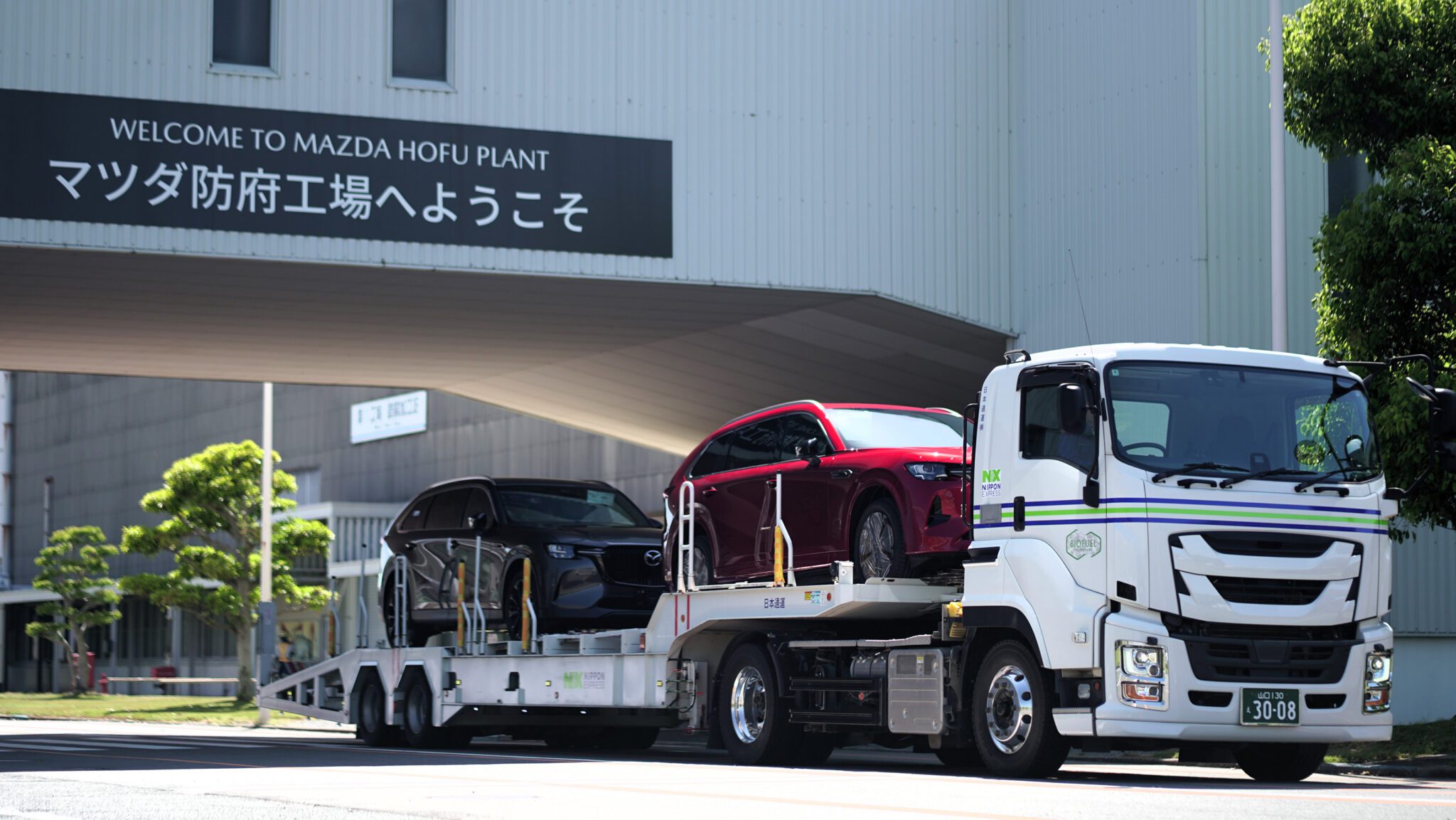
Mazda has launched a biodiesel demonstration project with logistics company Nippon Express to assess the potential of hydrotreated vegetable oil (HVO) as a lower-emission fuel for vehicle transportation operations in Japan.
The trial will run through the end of 2026 and involves transport trailers operating on a round-trip route of approximately 12 kilometers between Mazda’s Hofu manufacturing plant and a nearby vehicle storage facility in Yamaguchi Prefecture.
Evaluating Renewable Diesel in Logistics
The demonstration uses a fuel blend containing approximately 51% HVO and 49% conventional diesel.
The companies will evaluate fuel efficiency, vehicle performance and operational considerations during the trial period, while Mazda will cover the additional cost associated with the renewable fuel.
HVO, often referred to as renewable diesel, can be used in existing diesel vehicles without modifications and does not require dedicated fueling infrastructure.
When produced from waste-based feedstocks such as used cooking oil, HVO can offer significant lifecycle emissions reductions compared with conventional diesel.
Part of Mazda’s Multi-Pathway Strategy
The project forms part of Mazda’s broader approach to reducing transportation emissions through multiple technologies, including hybrid vehicles, plug-in hybrids, biofuels and synthetic fuels.
“We aim to see biodiesel fuel become established in society as one of the measures for decarbonisation, while also positioning it as one pathway for sustaining the use of internal combustion engines into the future,” said Takeshi Fukagawa, general manager of Mazda’s carbon neutral and resource circulation strategy department.
Mazda has previously expressed support for carbon-neutral fuels and was the first automaker to join the eFuel Alliance, which advocates for the inclusion of low-carbon liquid fuels in future emissions regulations.
Existing Biofuel Initiatives
The latest project builds on Mazda’s ongoing work with alternative fuels.
The automaker has previously used biofuel derived from microalgae and used cooking oil in its Mazda Spirit Racing Bio Concept vehicles competing in Japan’s Super Taikyu endurance racing series.
Mazda has also worked with logistics providers in other markets to expand the use of renewable diesel in transportation operations.
Focus on Hard-to-Electrify Transport Segments
Renewable diesel has gained attention as a potential decarbonization option for heavy-duty transport applications where electrification can be more challenging because of vehicle range requirements, infrastructure needs and capital costs.
Industry participants have increasingly adopted HVO in freight and logistics operations as a transitional emissions-reduction measure.
However, the availability of sustainable feedstocks remains a key challenge for large-scale deployment, with supplies of waste-derived oils expected to remain limited relative to overall transportation energy demand.
Additional Industry Partners
The demonstration project also involves truck manufacturer Isuzu, which is supporting the two transport vehicles used in the trial.
Fuel will be supplied by NX Shoji, a member of the Nippon Express Group.
“We will carefully evaluate the impact of fuel switching on transport quality and operations,” said Osamu Sasaki, executive officer at Nippon Express.
Potential Expansion Planned
Mazda estimates that the project could reduce carbon dioxide emissions by approximately 40 metric tonnes during the demonstration period compared with conventional diesel operations.
The company said it intends to evaluate opportunities to expand the initiative by increasing the number of routes and vehicles involved, raising the proportion of biofuel in the blend and potentially extending the program to parts logistics operations.
The project comes as Japan continues exploring multiple pathways to reduce transportation emissions, including biofuels, synthetic fuels, electrification and hydrogen technologies.