




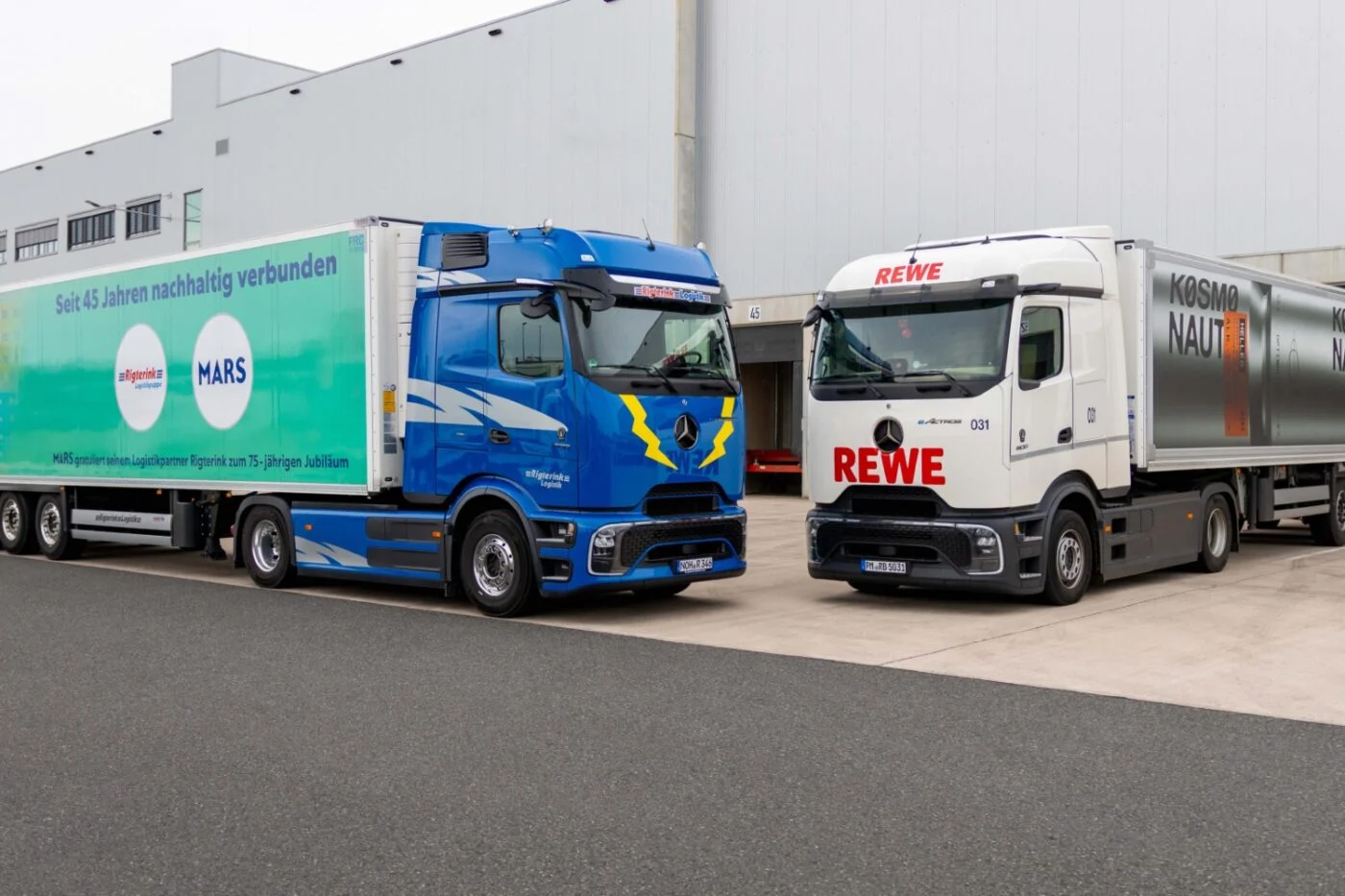
Mars and REWE Group have launched their first continuous cross-border electric freight corridor, using battery-electric trucks to transport food products from manufacturing plants through distribution centers to retail stores in Germany and the Netherlands.
The project introduces a fully electric logistics route supported by 47 battery-electric trucks, marking the companies’ first end-to-end zero-emission freight operation.
Electric Corridor Connects Production to Retail
The new transport network covers products from Mars’ snack, pet food, and food divisions.
Goods are transported by electric trucks from Mars production facilities in Veghel in the Netherlands, Viersen in Germany, and Verden in Lower Saxony to the company’s logistics center in Minden.
From there, shipments continue to REWE’s distribution center in Oranienburg, before being delivered by electric trucks to more than 300 REWE supermarkets and one REWE home delivery warehouse.
Mars operates 23 electric trucks within the corridor, while REWE contributes 24 vehicles, bringing the total fleet to 47.
Millions of Electric Kilometers Completed
The companies said their electric freight operations have already accumulated more than 2.4 million kilometers of driving.
Between January 2024 and April 2026 for Mars, and January 2025 through April 2026 for REWE, the electric fleets have collectively:
- Saved approximately 750,000 liters of diesel
- Avoided nearly 2,600 tonnes of CO₂e emissions on a well-to-wheel basis
Mars said the new corridor demonstrates that fully electric end-to-end freight transport is operationally feasible under real-world logistics conditions while providing valuable data for future expansion.
The companies also highlighted lower vehicle noise, improved driver comfort, and reduced operating costs as additional benefits of battery-electric trucking.
Companies See Long-Term Cost Benefits
Lars Siebel, Executive Director of Logistics and Supply Chain Management at REWE Group, said rising fuel price uncertainty strengthens the business case for electric trucks.
“Our message to all hauliers and truck fleet operators is to conduct a business case analysis for adopting e-mobility.”
He added:
“The volatility of diesel prices will remain high due to geopolitical uncertainties. In comparison, electricity prices are stable and are expected to become even more affordable in the future. Already today, more than half of the routes in our network are cheaper to operate and maintain with a battery-electric truck than with a diesel vehicle.”
Björn Schlenker, Supply Chain Integration Director at Mars Europe, said the project could serve as a model for additional electrified logistics corridors.
“This best practice can be transferred to other electrifiable end-to-end routes, including cross-border ones.”
Part of Mars’ Broader Electrification Strategy
Mars has committed to deploying 300 electric trucks across Europe by 2030, with the goal of reducing annual logistics-related carbon emissions by approximately 10%.
The initiative forms part of the company’s wider target to halve greenhouse gas emissions across its operations and value chain by 2030 compared with 2015 levels.
Mars began deploying electric trucks in Germany in 2024 through a partnership with Einride, later expanding the fleet with Mercedes-Benz eActros 600 trucks operating between its production facilities and logistics centers in Germany and the Netherlands.


