



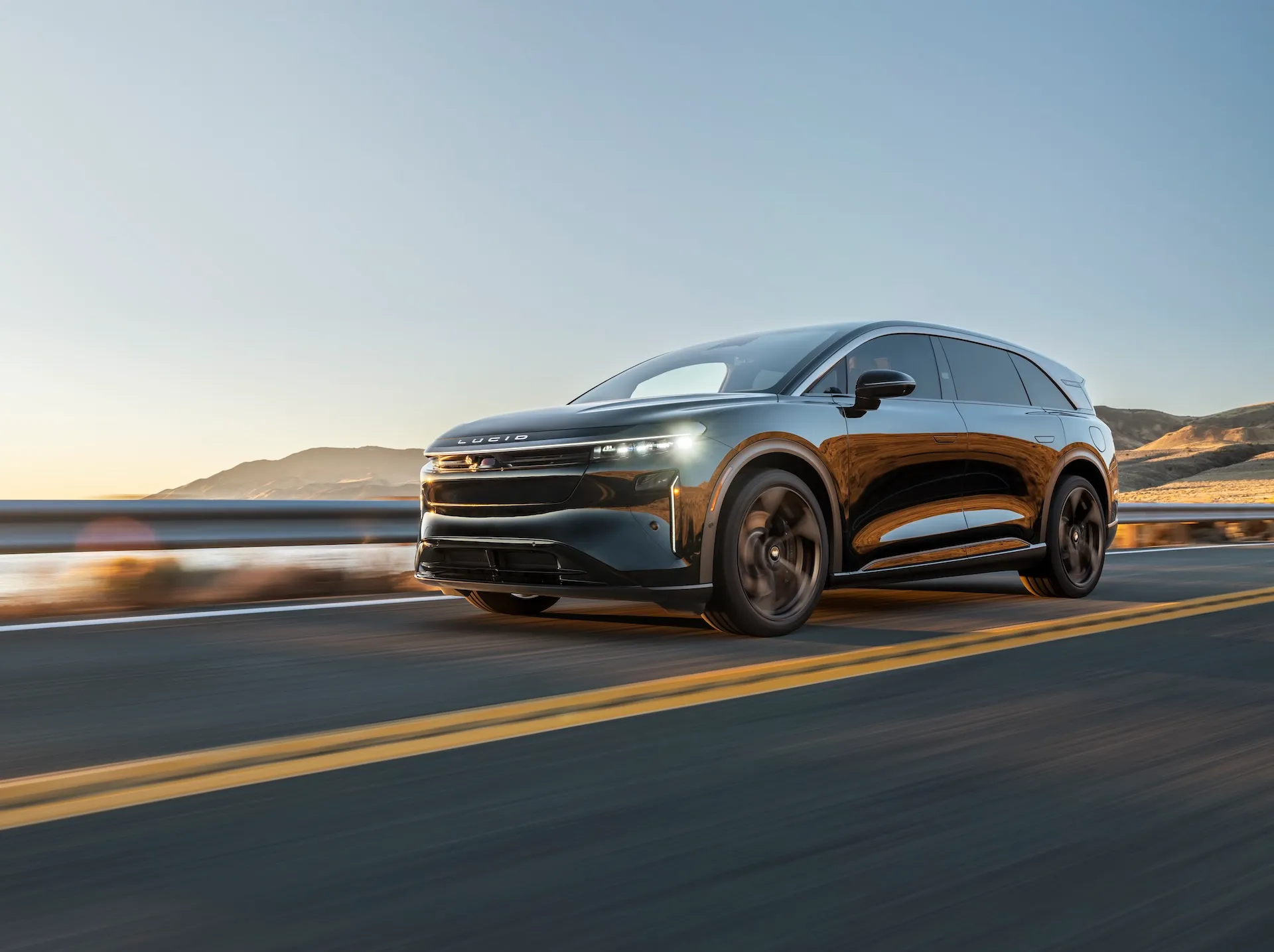
Lucid Group said its upcoming Gravity electric SUV will be the first production electric vehicle to integrate Trimble’s sensor fusion-based positioning technology as standard, a move intended to improve location accuracy in environments where satellite navigation typically degrades.
The system combines Trimble RTX correction services with the company’s ProPoint Go positioning engine, fusing satellite signals with data from six-axis inertial sensors. Lucid said the approach allows the vehicle to maintain continuous positioning with centimeter-level accuracy, even in tunnels, parking garages and “urban canyons” where conventional GPS-based navigation can lose precision.
See also: Lucid Faces Questions in 2025 Over Gravity Hands-Free Feature Timing
Automotive navigation systems typically operate with errors measured in metres, particularly when satellite visibility is reduced. By narrowing this margin to centimetres, Lucid said the technology enables more precise lane-level positioning and more stable vehicle localisation during signal interruptions.
According to Lucid, the positioning system supports several vehicle functions. These include maintaining navigation continuity without signal reacquisition delays, providing accurate location and heading data for the company’s hands-free driver assistance system on highways, and improving range estimation by incorporating more precise altitude and terrain information. The technology is also used to support lane-level infotainment features and high-resolution vehicle tracking for fleet applications.
See also: Lucid Launches Gravity Touring With 337-Mile Range and $79,900 Starting Price
Lucid said the Trimble positioning engine will be available as standard equipment on new Gravity vehicles from late January 2026. Existing Gravity vehicles will receive the functionality through an over-the-air software update, allowing previously delivered models to gain access to the enhanced positioning capability without hardware changes.
The integration reflects a broader industry focus on improving localisation accuracy as vehicles become increasingly reliant on software-driven driver assistance, navigation and energy management systems.


