
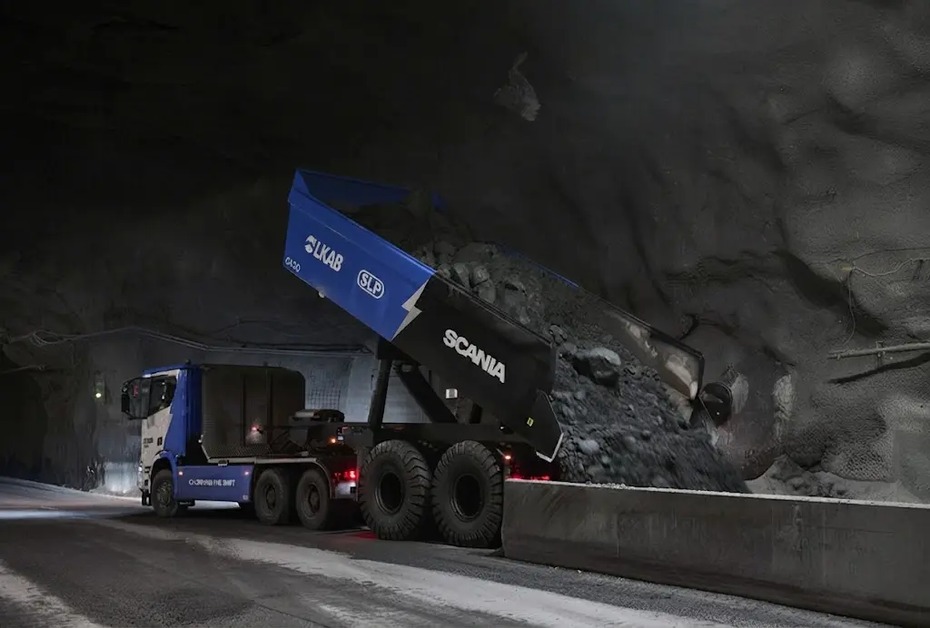
Swedish mining company LKAB has deployed two 120-tonne battery-electric trucks at its Malmberget iron ore mine, where the vehicles operate at depths of up to 1,250 metres. Developed with Scania, the trucks have already transported more than 100,000 tonnes of iron ore since entering service and are being used in regular underground operations.
Heavy Electric Trucks Enter Underground Operations
The battery-electric tractor units each have a payload capacity of just over 70 tonnes, making them, according to LKAB, the largest and heaviest battery-electric trucks currently operating underground.
Sany Expands Autonomous Electric Mining Trucks Into South America
LKAB’s claim specifically relates to underground mining. Larger battery-electric mining dump trucks have already been developed and tested for open-pit operations.
Each of the two trucks is equipped with a 624 kWh battery. Since entering service, they have completed around 1,500 round trips between underground ore shafts and crushing plants.
LKAB moves more than 50,000 tonnes of iron ore per day at Malmberget, making vehicle availability an important factor in the mine’s production operations.
624 kWh Batteries Support Seven Hours of Operation
According to LKAB, the electric trucks can operate for around seven hours on a single charge. During that period, each vehicle can complete approximately 45 cycles and transport roughly 3,200 tonnes of material.
The trucks can charge at up to 375 kW. A full charge from zero to 100% takes around 80 minutes.
Scania and LKAB Deploy World’s First Electric 8×4 Tipper with Twin Steer Axles in Swedish Mine
Operating underground at depths of up to 1,250 metres creates additional requirements for charging, maintenance and vehicle scheduling. The charging process has to be integrated into continuous mining operations, where extended vehicle downtime can affect production.
The testing is therefore focused not only on whether battery-electric trucks can operate underground, but also on whether they can maintain the productivity and availability required for continuous mining.
Sleipner Moves Toward Continuous Operation
LKAB and Scania are also advancing testing of another battery-electric heavy-duty vehicle.
The Sleipner, an 8×4 electric tipper unveiled at the end of 2025, is being prepared for continuous 24-hour operation. The four-axle truck has a fully loaded weight of 60 tonnes, including a payload of 38 tonnes.
Its two battery packs provide a combined capacity of 416 kWh, while the electric motor produces 400 kW.
The initial testing programme involved transporting overburden along a route of approximately five kilometres with an elevation difference of 250 metres.
The next phase will assess whether the Sleipner can replace a diesel truck in continuous production operations.
Sweden’s LKAB Targets Supplying 18% of Europe’s Rare Earth Needs with Arctic Mine
The two electric truck programmes have different objectives. The 120-tonne vehicles are being used to demonstrate battery-electric transport of heavy loads underground, while the 60-tonne Sleipner is being tested primarily for vehicle availability during continuous operations.
LKAB and Scania Expand Electrification Partnership
LKAB and Scania have been testing battery-electric mining vehicles at Malmberget since 2022.
Their earlier programme involved a 6×4 battery-electric tipper, which had covered around 50,000 kilometres by the end of a major testing phase in March 2025.
The deployment of the larger 120-tonne trucks represents a further step toward using battery-electric vehicles in regular heavy-duty underground mining operations.
Zijin Longking Unveils 230-Tonne Electric Mining Truck With 1.6 MW Powertrain
LKAB aims to electrify 30% of its mining fleet by 2027. The company also targets extracting and handling at least five million tonnes of material per year without local emissions.
Source: Fuelcellsworks