





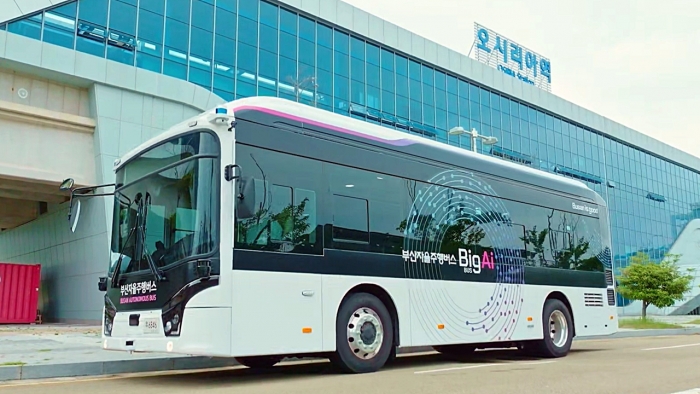
LG Uplus announced on Sept. 17 that it has officially launched an autonomous bus service in Busan’s Osiria tourist district, making the system available for citizen use. Since a July 10 opening ceremony, the buses completed 2,000 km of trial runs, demonstrating operational stability and reliability.
The service features four 16-seat electric buses connecting Osiria Station, Lotte Mall, the Busan National Science Museum, and Gijang Coastal Road. Sharing road space with conventional vehicles, the buses are integrated with traffic signals to automatically stop and start while detecting pedestrians and road conditions to ensure safety. Citizens can board at designated stops, and rides are free for now, with passenger feedback to guide future service improvements. Expansion to the Naeseong-Jungdong BRT corridor is planned.
LG Uplus leads the project, working with RideFlux, which manufactured the autonomous vehicles; NZero, which developed the control systems; and Tracom, responsible for transportation infrastructure. Vehicles, infrastructure, and the control center exchange real-time data, allowing immediate responses to unexpected situations, with continuous monitoring to maximize safety and efficiency.
The company said the service will support nationwide expansion of its smart mobility ecosystem. Drawing on prior demonstration projects in Gangneung, Cheonan, and Siheung, LG Uplus aims to scale eco-friendly mobility solutions that enable convenient travel anytime, anywhere.


