


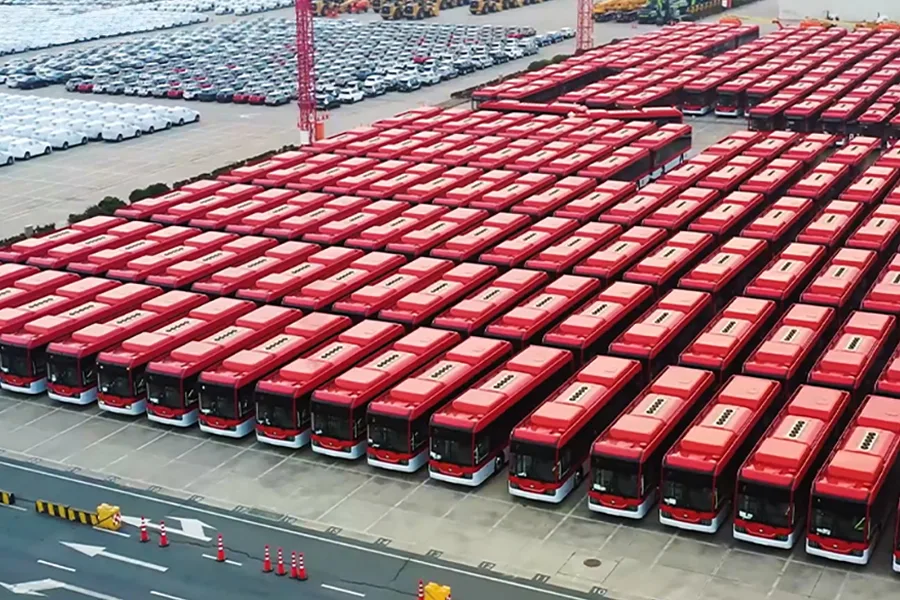
Latin America and the Caribbean are approaching a milestone of 10,000 electric buses in operation, underscoring the rapid expansion of zero-emission public transport across the region, according to a new analysis by the International Council on Clean Transportation (ICCT).
The study, titled Electric Bus Market in Latin America, 2025, found that the region had 9,115 electric buses in operation at the beginning of the year, a 40% increase compared with 2024 and ten times the number recorded in 2017.
More recent data from February showed the fleet had already grown to 9,909 electric buses, suggesting the 10,000-unit threshold may have been surpassed in recent months if deployment trends have continued.
The report, based on data from the E-Bus Radar platform operated by the Zero Emission Bus Rapid-deployment Accelerator (ZEBRA) initiative, covers 33 countries across South America, Central America and the Caribbean. The analysis includes both battery-electric buses and trolleybuses.
According to the ICCT, battery-electric buses have become the dominant technology in the region’s electric bus market, increasingly replacing trolleybuses as the preferred zero-emission solution.
Despite the growth, deployment remains concentrated in a small number of countries and cities.
“Chile, Colombia, and Brazil make up most of the fleet (80%), with deployment clustered in a few major cities,” the ICCT said in its report.
Chile accounted for 47% of all electric buses operating in Latin America and the Caribbean at the end of 2024, followed by Colombia with 17%, Brazil with 16% and Mexico with 12%. The remaining countries collectively represented about 8% of the regional fleet.
At the city level, Santiago de Chile remains the dominant market.
The Chilean capital operated 4,222 electric buses as of February, representing roughly 40% of all electric buses in Latin America. The city’s fleet expanded by 55% between 2024 and 2025, according to the report.
São Paulo recorded one of the fastest growth rates among major cities, increasing its fleet from 460 electric buses to 1,095 by the beginning of 2025. By February, the total had risen further to 1,271 units.
Bogotá remained another major electric bus hub with 1,554 vehicles in operation, while Mexico City and Quito reported fleets of 804 and 145 electric buses, respectively.
The report found that Chinese manufacturers continue to dominate the market.
Chinese bus maker BYD led the region with 2,961 electric buses delivered between 2017 and 2025, accounting for approximately 32% of the fleet. Foton ranked second with 1,492 vehicles, followed by Yutong with 1,417 units and Zhongtong Bus with 946.
Brazilian manufacturer Eletra was the highest-ranked non-Chinese supplier, with 894 vehicles in operation, primarily in its domestic market.
Together, the top five manufacturers accounted for approximately 85% of all electric buses operating across the region.
Other manufacturers represented smaller shares of the market, including King Long, Scania, Mercedes-Benz, Higer Bus and Sunwin Bus.
Vehicle sizes between 12 and 15 metres dominated the market, accounting for 68% of the electric bus fleet. Smaller buses measuring between 8 and 11 metres played a particularly important role in Colombia, where they represented nearly half of the country’s electric bus fleet.
The ICCT also assessed the environmental benefits of electric buses across different countries, concluding that battery-electric buses significantly reduce greenhouse gas emissions compared with diesel-powered vehicles.
“BEBs achieve significant reductions in life-cycle greenhouse gas emissions compared to internal combustion engine vehicles,” the ICCT said.
According to the report, life-cycle emissions reductions for battery-electric buses range from 66% in Mexico to 85% in Brazil. The differences largely reflect variations in national electricity generation mixes and grid carbon intensity.
For 12- to 15-metre battery-electric buses, the ICCT estimated emissions reductions of 85% in Brazil, 77% in Colombia, 70% in Chile and 66% in Mexico compared with diesel buses.
The findings highlight the growing role of electric buses in reducing urban transport emissions across Latin America while underscoring the influence of Chinese manufacturers and the concentration of deployment in a handful of major metropolitan areas.