
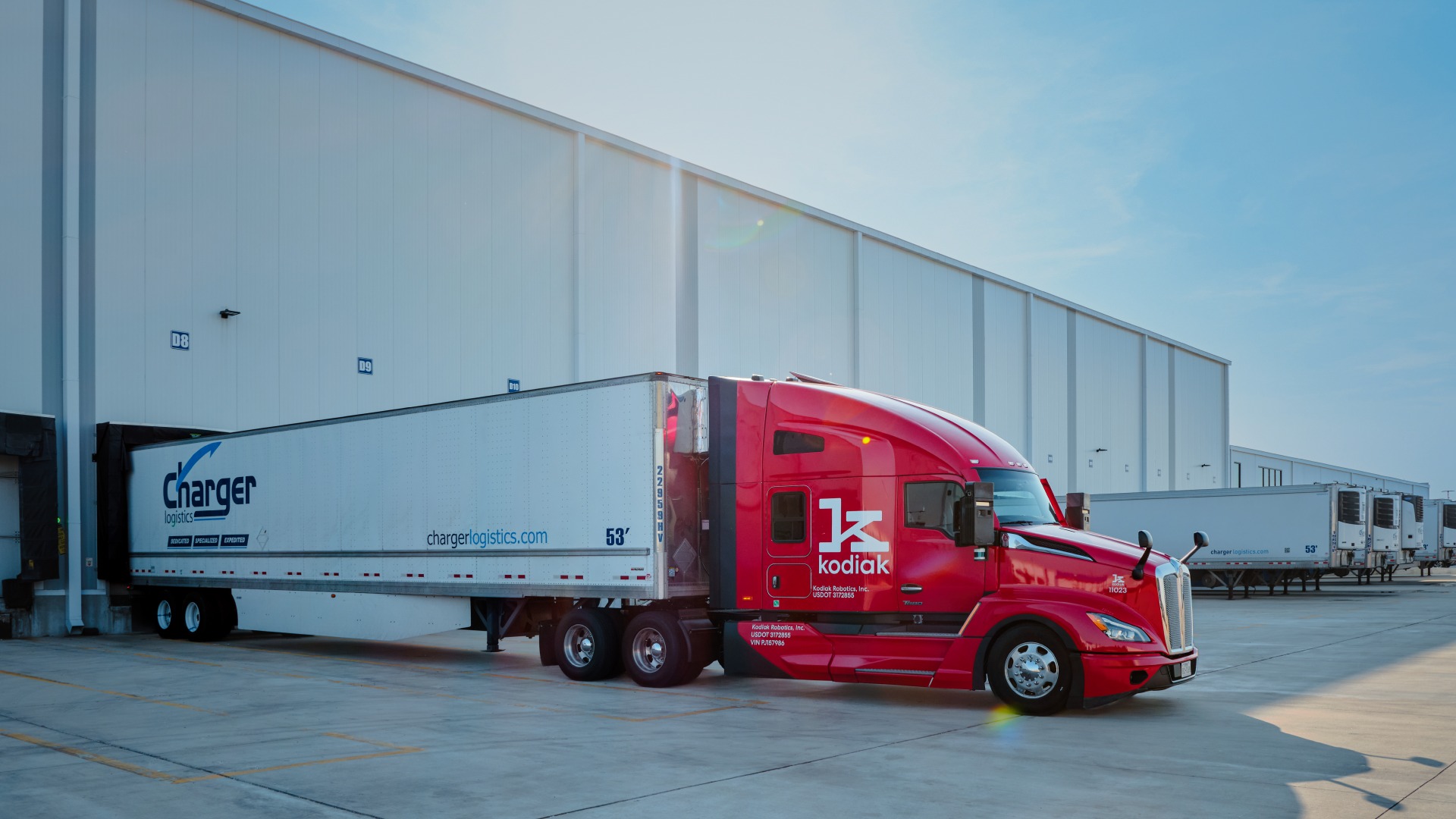
Kodiak AI and Charger USA have begun a collaboration to transport refrigerated and dry freight using trucks equipped with Kodiak’s autonomous driving system, the Kodiak Driver, on a 435-mile route between the companies’ terminals in Dallas and Laredo, Texas.
The service carries freight for consumer packaged goods and food and beverage customers. The companies completed their first delivery on September 8, 2026, and are currently operating with a safety driver behind the wheel.
Kodiak and Charger intend to transition the route to driverless operations once Kodiak completes its safety case, a structured, evidence-based assessment intended to demonstrate that its autonomous driving system is acceptably safe within a defined operating environment.
Autonomous Freight on a Key Texas Corridor
The Dallas–Laredo route marks Kodiak’s first service corridor connecting to Laredo, one of the busiest commercial land ports of entry in the United States.
The Port of Laredo handled more than $350 billion in international trade in 2025, accounting for nearly 40% of total US trade with Mexico, according to the companies.
Consumer packaged goods and food and beverage shipments are among the freight categories moving through the corridor. The companies are using autonomous-equipped trucks to transport both temperature-controlled and dry cargo, although they have not disclosed shipment volumes or the number of trucks assigned to the route.
The collaboration combines Kodiak’s autonomous driving technology with Charger USA’s freight operations. Charger operates as an asset-based carrier across North America, with temperature-controlled transportation among its core services.
Driverless Operations Depend on Safety Validation
The trucks currently operate with safety drivers onboard. Driverless service on the Dallas–Laredo route remains a future objective, contingent on completion of Kodiak’s safety case.
Kodiak said its long-haul Autonomy Readiness Measure reached 96% at the end of September 2026. The measure tracks the percentage of claims and supporting evidence in the company’s safety case that are materially complete. It is an internal readiness measure and does not, by itself, establish that the system has completed safety validation or is ready for driverless operation on this route.
Kodiak plans to launch long-haul driverless service by the end of 2026.
The company has operated driverless commercial trucks in the Permian Basin since December 2024, where customer-owned vehicles operate without anyone in the cab. The Dallas–Laredo collaboration extends its operations to a different freight corridor and use case.
Charger Integrates Kodiak Driver Into Its Fleet
Kodiak commercializes its technology through a Driver-as-a-Service model, deploying the Kodiak Driver on trucks owned and operated by customers.
Charger plans to integrate the system into its fleet and use it alongside its existing transportation operations and in-house transportation management system (TMS). The companies expect the collaboration to expand to additional routes within Charger’s network over time.
Andy Khera, president of Charger USA, said:
Autonomy lets us build a network that serves both our customers and our drivers. Combining our in-house TMS, managed transportation, and the Kodiak Driver creates a nearly fully automated ecosystem that gives our customers long-term capacity continuity through changing labor markets and freight demand, while bringing our drivers home every night.
Don Burnette, founder and CEO of Kodiak, said:
Charger came to us knowing what they wanted from autonomy and what they need to see before scaling it. That clarity makes for a strong collaboration. The Dallas–Laredo lane extends the Kodiak Driver into a new corridor, and gives both companies the operating foundation we need to scale driverless service.
Expansion Plans
The companies intend to evaluate additional routes as Charger integrates Kodiak’s technology into its fleet. They have not announced a timetable for expanding the service or confirmed when driverless operations will begin on the Dallas–Laredo corridor.
The collaboration adds another commercial freight application for Kodiak’s autonomous driving system, while its planned expansion will depend on safety-case completion, operational performance and the requirements of each route.