




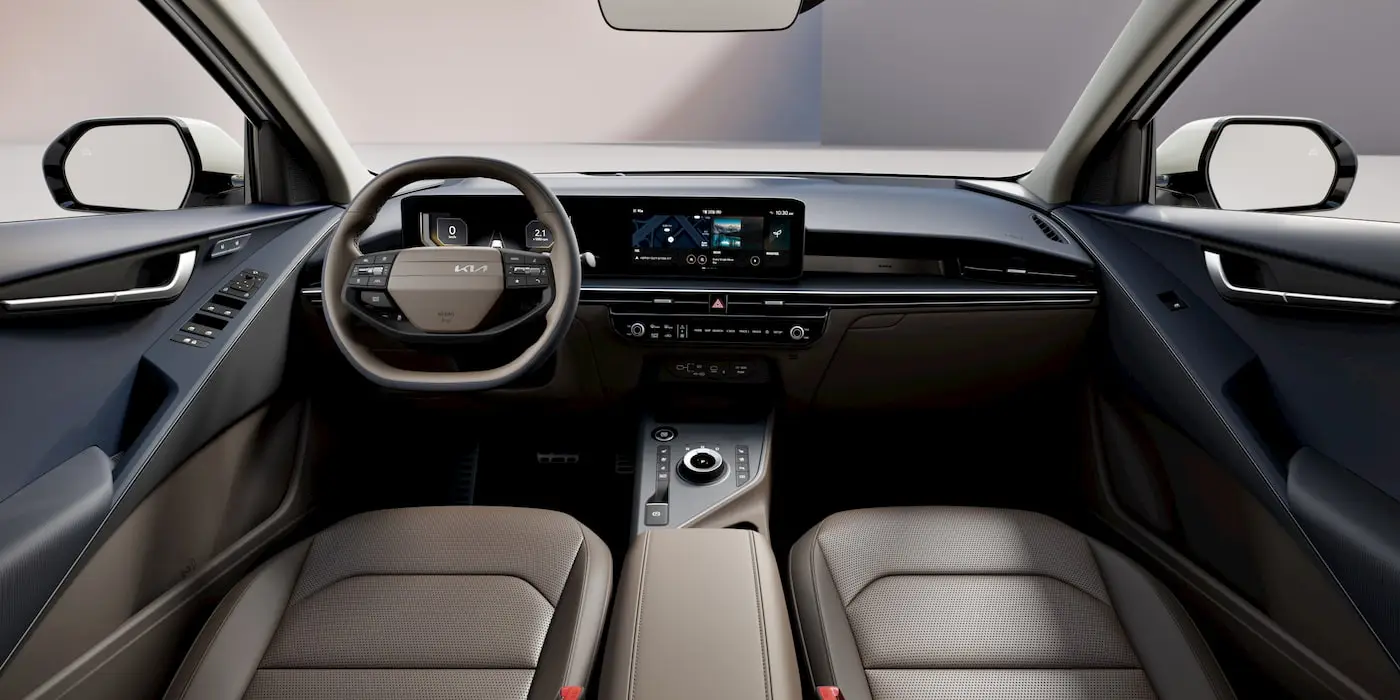
Kia plans to further increase the use of digital technology in the interiors of its next-generation vehicles while retaining physical buttons for key functions, its interior design chief said, as the automaker seeks to balance advanced features with ease of use.
The South Korean carmaker’s current models rely heavily on touchscreens for infotainment and climate controls but still include traditional switchgear for essential functions. That approach sets Kia apart from several newer Chinese rivals, which have moved toward minimalist interiors dominated by digital interfaces.
See also: Kia Unveils GT Variants of EV3, EV4 and EV5 at Brussels Motor Show
“We never really went away completely from buttons,” Jochen Paesen told Autocar. “There are certain functions you need to find straight away and you don’t want to mess up, so we keep them physical. Now we’re learning from that to increase the digital and experiential component.”
Paesen said Kia is cautious about adding digital features purely for novelty, even as competition from fast-moving Chinese brands raises the pace of innovation. “You can’t look past the fact that China is cooking up a lot of things quickly,” he said, adding that technology must ultimately be useful and intuitive rather than overwhelming.
See also: Kia Unveils Entry-Level EV2 Compact SUV for Europe With Up to 448 km Range
As Kia sells vehicles globally, Paesen said extensive market research shows customer expectations are broadly similar across regions. Deep, multi-layered menus are a common frustration, regardless of how tech-savvy a user may be. “If to get to a function you have to go down three steps in a menu, that’s bad for everybody,” he said.
He added that the challenge for future vehicles will be to make technology feel less like a tool that drivers must learn and more like a system that actively simplifies tasks. While no automaker has fully solved that problem, Paesen said Kia aims to focus on interaction logic that reduces complexity while maintaining a sense of warmth and brand identity.
See also: Kia Opens Reservations for EV5 in Canada With Prices Starting at C$43,495
Kia’s strategy reflects a broader industry shift, as automakers reassess the heavy reliance on touch-only controls seen in some recent models. “Novelty is great,” Paesen said, “but we’re going into the next phase where there’s a lot of value to be found and added.”


