



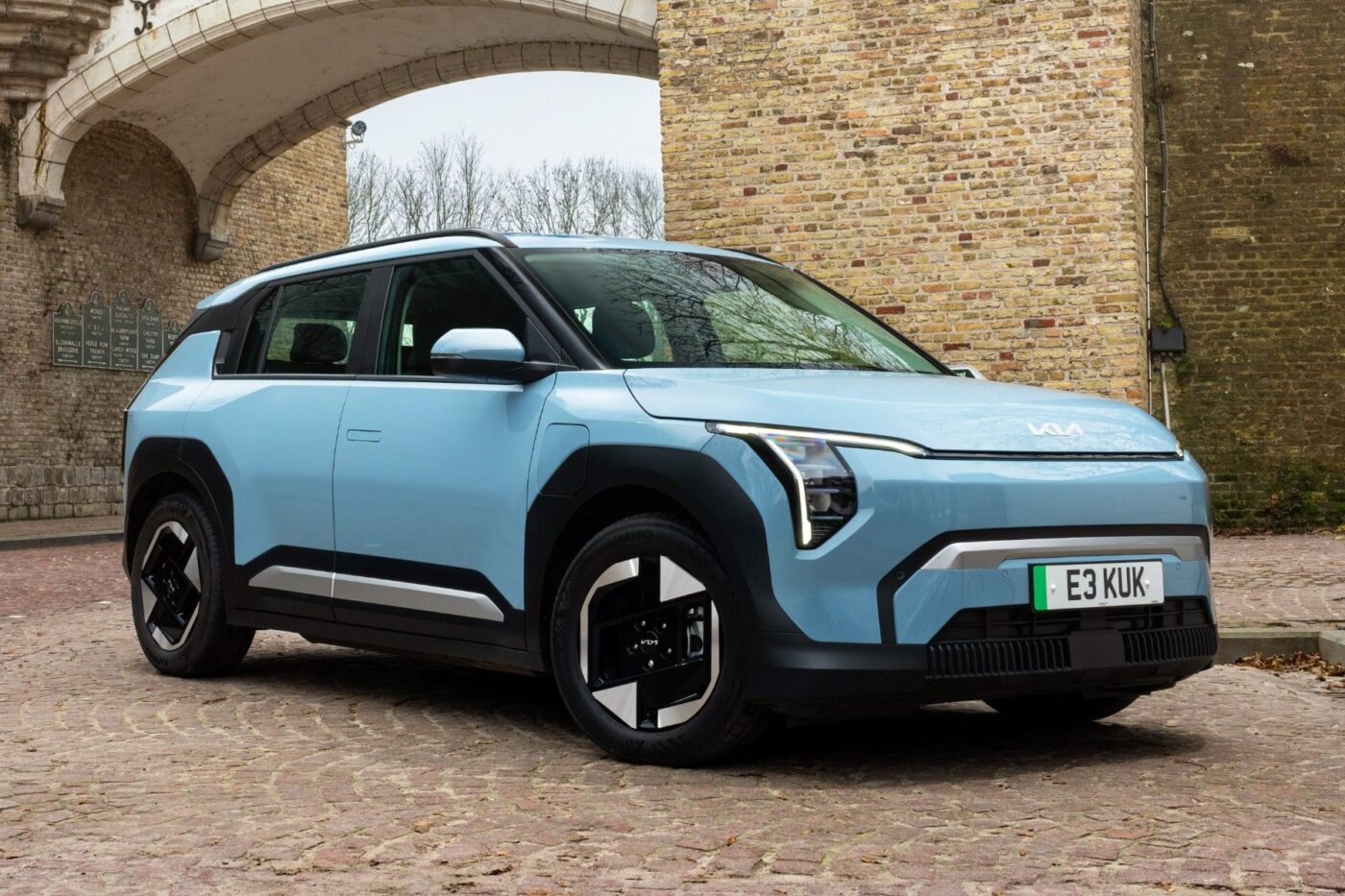
Kia will begin production of its EV3 electric sport utility vehicle in Mexico on August 4, making the country the second global manufacturing base for the model after South Korea.
The EV3 will be assembled at Kia’s existing plant in Pesquería, Nuevo León, as part of a broader investment that also includes charging infrastructure, renewable energy projects and water recycling initiatives to support electric vehicle adoption in Mexico.
EV3 Production Begins at Existing Plant
Kia announced the investment package during an event at Mexico’s National Palace attended by President Claudia Sheinbaum, Economy Minister Marcelo Ebrard and executives from Kia Mexico.
Kia EV3 Earns Top “Very Good” Rating in Euro NCAP Assisted Driving Test
Rather than constructing a new factory, the automaker has modified its existing production line to accommodate the EV3.
According to Kia Mexico President Horacio Chávez, the approach allows the company to expand electric vehicle production while making efficient use of existing manufacturing capacity.
The company expects the project to create approximately 500 new jobs this year and another 1,500 positions by 2030.
Kia said the EV3 will become the first battery-electric vehicle that the company both manufactures and sells in Mexico. While a significant share of production will remain in the domestic market, additional vehicles will be exported to other regional destinations.
Local Content to Increase Over Time
Economy Minister Marcelo Ebrard said the Mexican-built EV3 will initially have a local content level of 27%, with the figure expected to rise as domestic sourcing expands.
High-value components, including battery systems, will continue to be imported from Asia during the initial production phase.
Increasing domestic value creation forms part of the Mexican government’s industrial strategy under the Plan México initiative, which aims to attract advanced manufacturing and strengthen the country’s electric vehicle supply chain.
The investment also comes as North American vehicle manufacturers continue adapting production strategies amid evolving trade policies and discussions surrounding regional content requirements.
Investment Extends Beyond Vehicle Production
Alongside local manufacturing, Kia plans to develop an electric vehicle support network that includes home charging solutions, public charging stations along urban corridors and highways, roadside assistance services and mobile charging units.
To reduce the environmental impact of the Pesquería facility, the company will also build a solar power plant with an initial capacity of 2 megawatts, with expansion planned to 8 megawatts by 2030.
According to Kia, the completed solar installation will generate enough electricity to supply the annual consumption of more than 4,000 households.
The investment package also includes construction of a second wastewater treatment facility capable of processing approximately 1,050 cubic meters of industrial water each day, allowing around 70% of the plant’s water consumption to be recycled. The project is expected to improve water efficiency in Nuevo León, a region that has experienced recurring drought conditions.
EV3 Supports Kia’s Manufacturing Expansion
Plans to expand electric vehicle production at Kia’s Nuevo León facility first emerged in 2023, although the company had not previously confirmed which model would be built locally.
Kia EV3 Named 2025 World Car of the Year at New York Auto Show
The Pesquería plant, which began operations in 2016 and has an annual production capacity of approximately 400,000 vehicles, currently manufactures internal combustion engine models including the Forte and Rio.
Kia has not disclosed which EV3 variants will be produced in Mexico.
In Europe, the model is offered with 58.3-kilowatt-hour and 81.4-kilowatt-hour battery options, delivering up to 600 kilometers of driving range under the WLTP testing standard. The vehicle features a front-mounted 150-kilowatt electric motor and a 400-volt electrical architecture.
Source: mexicobusiness.news, news.sbs.co.kr, reuters.com