


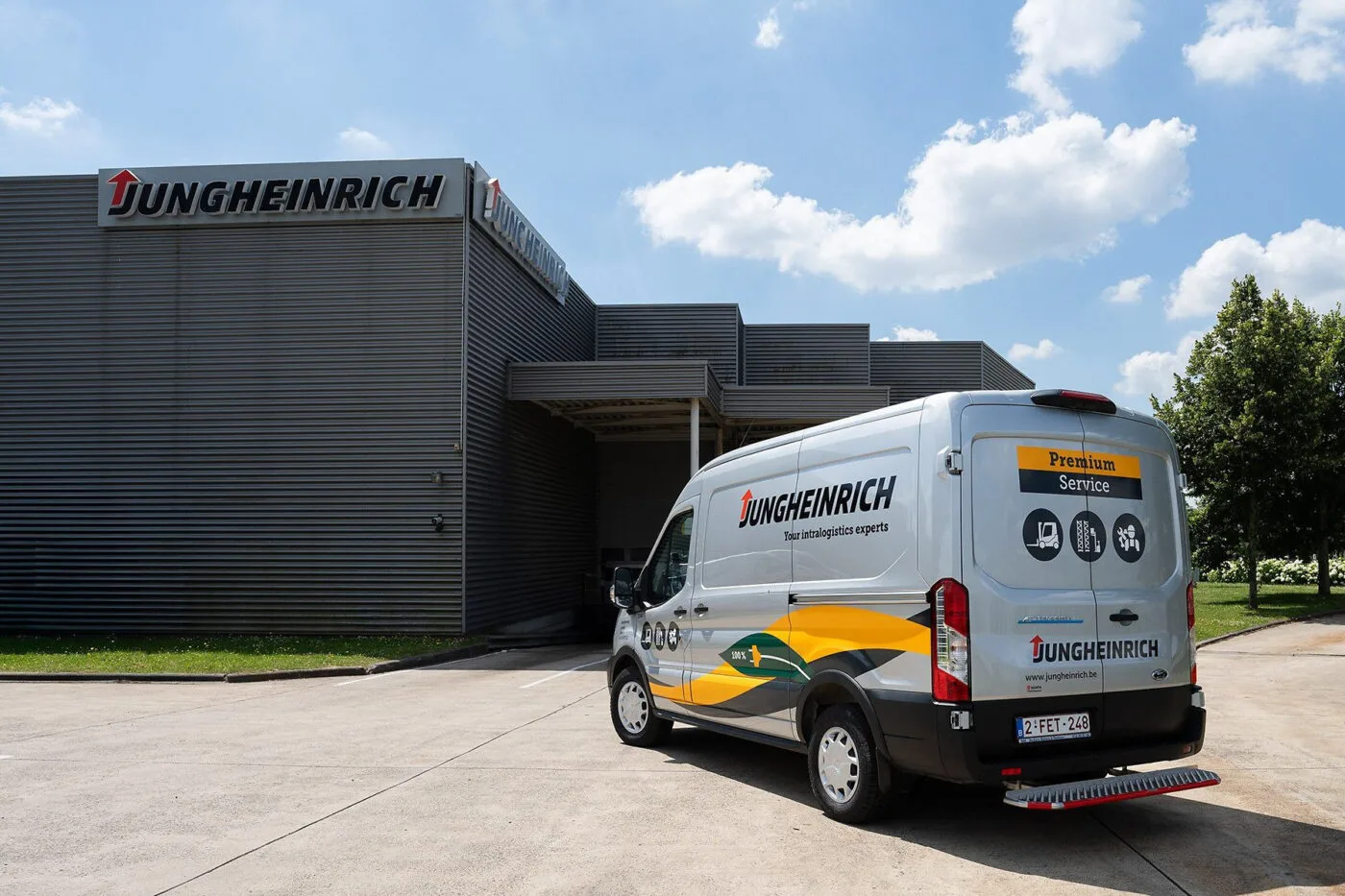
Hamburg-based intralogistics specialist Jungheinrich has announced plans to accelerate the electrification of its global customer service fleet, aiming for more than half of its 7,000-vehicle fleet to be fully electric by 2030. The company expects to have more than 3,500 electric service vehicles in operation by the end of the decade as part of its wider sustainability strategy.
Jungheinrich’s customer service operations form a crucial part of its logistics business, which supplies electric forklifts, pallet trucks and other industrial transport vehicles to warehouses worldwide. To minimize downtime for its customers, the company deploys more than 6,300 service technicians across 42 countries. Jungheinrich said it has developed “practical and tailor-made solutions” to address common challenges of electric mobility, such as limited range and insufficient charging infrastructure. Various EV models were tested in real-world conditions, leading to the selection of a dedicated lineup suited to its operational needs.
See also: Biogena Rolls Out Austria’s Largest Electric Mini Fleet with 126 Cooper SE Models
The company has introduced a dynamic route planning model based on its own data, allowing most service technicians to travel less than 100 kilometers per day — a range well within the capability of most modern electric vans. Diesel vehicles are now used only in time-critical cases requiring long-distance travel. “The technology and charging infrastructure for electric vans is constantly evolving,” said Mathias Lentfer, Vice President After Sales at Jungheinrich. “We are confident that, with ongoing progress and the practical experience to date, we will achieve our goal of 50 percent electrification by 2030.”
Pilot projects in Norway, Hungary and Finland launched in 2022 marked the foundation for the company’s electrification program, which has since expanded rapidly. Jungheinrich expects its global electrification rate to be five times higher by the end of 2025 compared with the previous year. Markets such as Norway, the Netherlands, Switzerland and Ireland are forecast to exceed a 30% EV share by the end of 2024, followed by Austria, Belgium, Finland and Slovakia in 2026. Germany, Denmark and France are expected to reach that milestone by 2028, when roughly 2,000 electric service vehicles will be on the road.
See also: Ikea Canada Achieves 72% EV Home Deliveries, Backed by Multi-Million-Dollar Charging Investment
In Switzerland, the company plans to exceed its 30% target this year, with three-quarters of its local fleet set to be electric by 2026. “The systematic electrification of our service fleet is not only pragmatic, but also an investment in a clean and better future,” Lentfer said. “It enables us to reduce our carbon emissions and operating costs while making a measurable contribution to the transition in the transport sector.”