
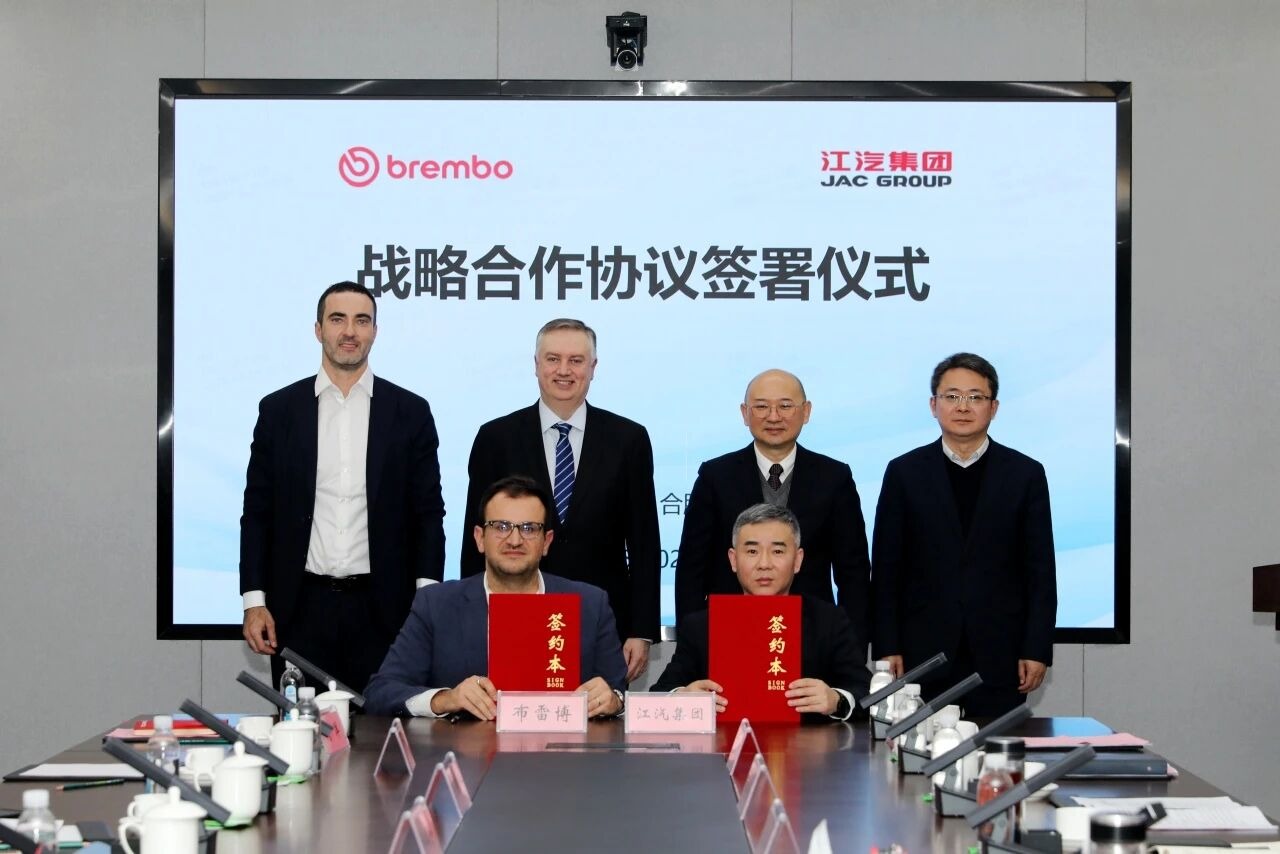
Chinese automaker JAC Group said on Feb. 6, 2026, that it has entered into a strategic partnership with Italian braking specialist Brembo, as both companies seek to develop next-generation braking technologies tailored to China’s rapidly evolving automotive market.
Under the agreement, the two companies will jointly work on advanced braking systems and software-driven solutions designed to integrate more closely with electric drivetrains and intelligent driving architectures. Financial details of the partnership were not disclosed.
For JAC Group, the collaboration forms part of its broader strategy to move upmarket and strengthen its capabilities in smart and premium vehicles. The automaker has said braking systems are increasingly critical not only for safety, but also for driving feel, energy recuperation efficiency and the performance of advanced driver-assistance and intelligent driving functions.
JAC Chairman Xiang Xingchu has previously cited cooperation with Brembo on the MAEXTRO S800 model as an initial step. The new agreement signals an expansion of that relationship to a broader, platform-level collaboration across future vehicle programmes.
Brembo said the partnership supports its ambition to evolve beyond its traditional role as a component supplier. Chief Executive Daniele Schillaci has described the move as part of a shift toward becoming a full solutions provider, combining high-end braking hardware with proprietary control software and digital services.
China’s highly competitive electric and intelligent vehicle market is expected to serve as a testing ground for this integrated approach, as automakers race to differentiate their products through software-defined features and system-level performance.
At the technical level, the companies said the partnership aims to embed braking systems more deeply into vehicles’ electronic and electrical architectures. By coordinating braking with electric powertrains and intelligent driving domains, the systems are expected to deliver more refined pedal response, improved energy management and higher levels of redundancy.
Industry analysts say such integration could turn braking from a largely invisible safety component into a differentiating feature, particularly as vehicles become increasingly software-defined.