
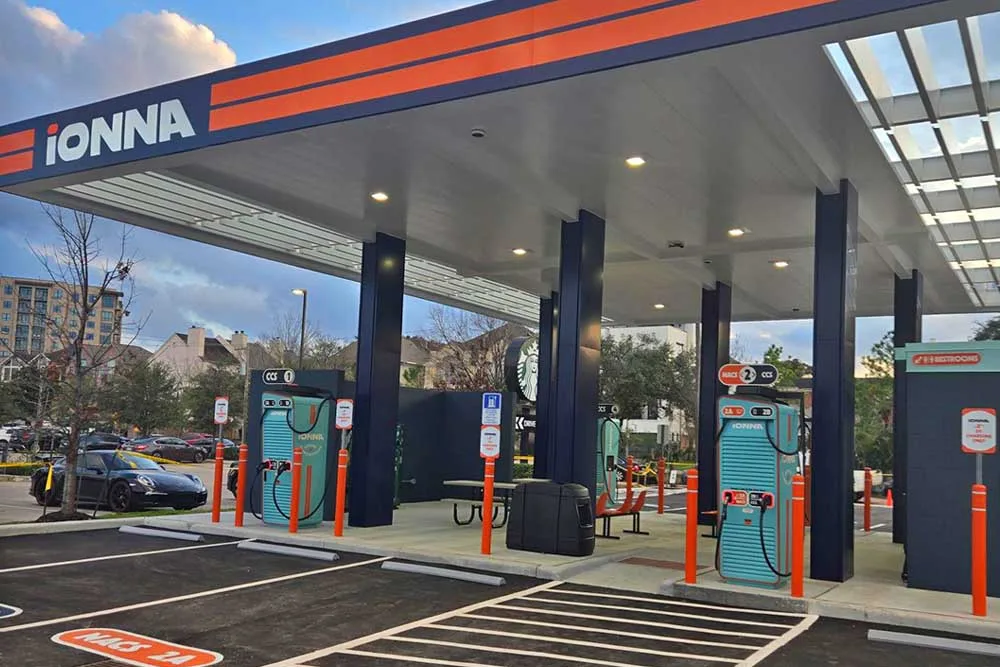
Ionna has opened its 100th fast-charging location in the United States, marking a key milestone two years after its formation by a consortium of major global automakers.
The joint venture—backed by BMW, General Motors, Honda, Hyundai, Kia, Mercedes-Benz, Stellantis and Toyota—has deployed nearly 1,000 charging points across its first 100 sites, averaging about 10 chargers per location.
Ionna said an additional 340 charging hubs, representing roughly 3,700 charging points, are already under contract and in advanced planning or implementation stages. This brings the total number of contracted chargers to around 4,700 nationwide.
Recent sites have opened in locations including Forest Park and West Point in Georgia, as well as Limon in Colorado, as the network continues to expand across key regions of the country.
Seth Cutler said a distinguishing feature of the network is that roughly one-third of its charging locations are covered—an uncommon characteristic in the US market.
To encourage adoption, Ionna has introduced promotional incentives in collaboration with its shareholders. A current campaign offers a 10% charging discount to General Motors electric vehicle drivers using Plug&Charge or brand-specific apps such as Chevrolet, GMC and Cadillac. Additional promotional programs from other partner automakers are expected to roll out throughout the year.
The company is also expanding its retail offering, with plans to open a second unmanned convenience store at a charging hub in Dallas. The store will feature “Just Walk Out” technology developed by Amazon.
Geographically, most Ionna charging sites are currently concentrated along the West Coast, southern and central US regions, and parts of the East Coast. Expansion into states such as Michigan and New York is expected as deployment continues.
Ionna aims to install a total of 30,000 charging points across North America by 2030, with its current rollout focused on the United States. The joint venture has also committed to investing more than $250 million in charging infrastructure in California alone over a three-year period, with more than 1,000 chargers planned for the state.
The expansion reflects growing efforts by automakers to build dedicated charging networks to support electric vehicle adoption and improve long-distance charging accessibility.