
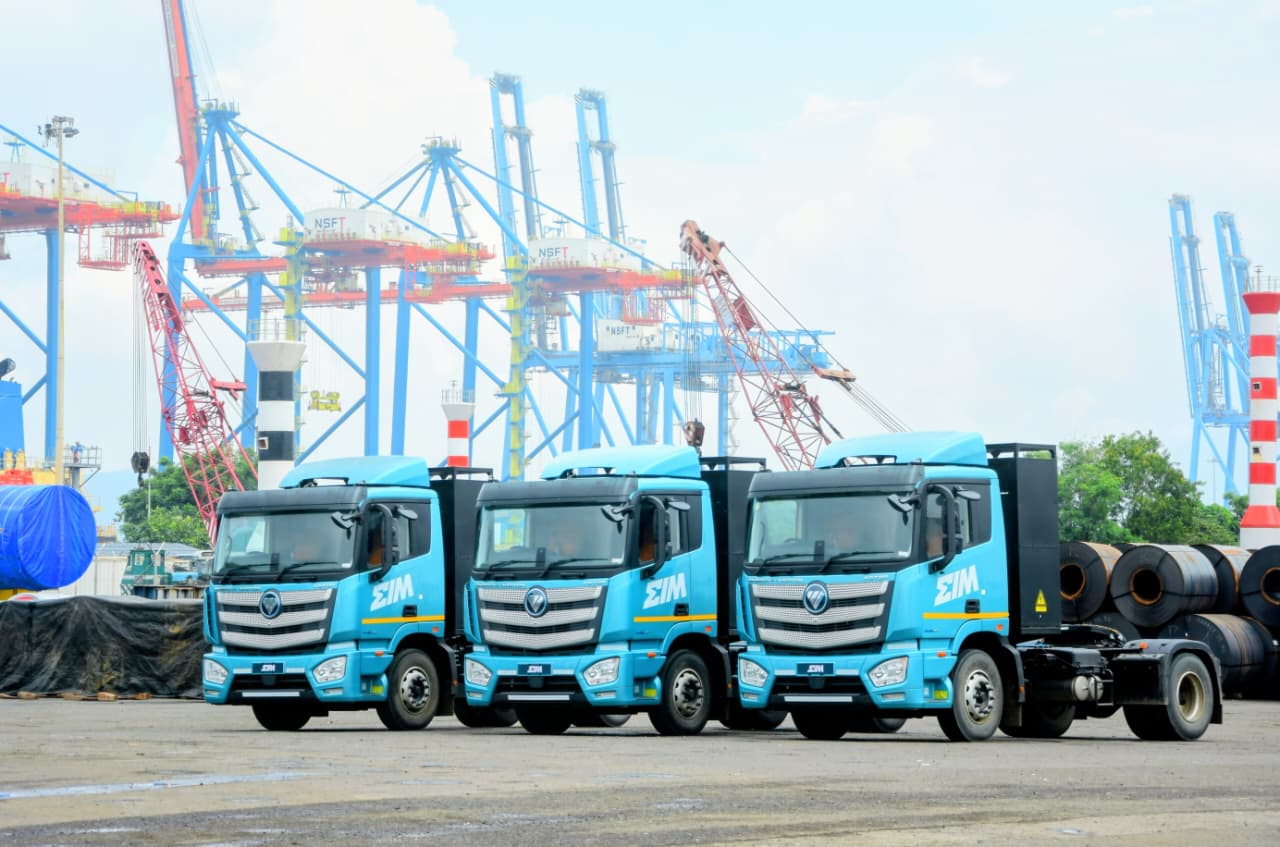
India has commissioned its first fleet of battery-swappable heavy-duty electric trucks at the Nhava Sheva Distribution Terminal in Jawaharlal Nehru Port Authority (JNPA), creating the country’s largest electric truck fleet at any port.
JNPA has deployed 50 trucks and plans to expand the fleet to 80 by year-end, before replacing 90% of its roughly 900 heavy-duty trucks with electric models by 2026. The port authority will also create dedicated EV lanes across all terminals. “We are taking a major step towards sustainability by deploying these trucks and ensuring smooth movement with a dedicated lane for EVs,” said Unmesh Sharad Wagh, Chairman of JNPA and Vadhvan Port Project Limited.
See also: India Rolls Out Subsidy Guidelines for 72,000 EV Chargers and Battery Swap Stations
The vehicles are supplied by Mumbai-based Energy In Motion, which also installed a battery-swapping station capable of replacing depleted battery packs with fully charged units in about seven minutes. The company’s 55-tonne tractor, branded ‘Ashwa’ and based on Foton’s eAuman series, uses a CATL battery with a capacity of 282 kWh.
Energy In Motion Managing Director and CEO Narendra Murkumbi said the trucks had undergone extensive road-testing ahead of launch. “We have tested the Ashwa in Indian conditions for more than 100,000 kilometres to ensure reliability and efficiency,” he said.
See also: Tesla Delivers First Model Y in India After Years of Delays
Energy In Motion holds exclusive rights to market and assemble Foton’s electric heavy-duty trucks in India for six years. It has signed an agreement with the Maharashtra government to build a factory in Talegaon near Pune, with investment of 10.65 billion rupees ($128 million), starting with 1 billion rupees in the first phase. Assembly is expected to begin by June 2026.
The company has priced its electric tractor at 6.3 million rupees (about $75,600) excluding the battery pack and has sold 125 units to date. It expects costs to fall to 6 million rupees by 2027 through localisation, and aims to establish up to 30 battery-swapping stations nationwide within two years.
Source: pib.gov.in, linkedin.com