



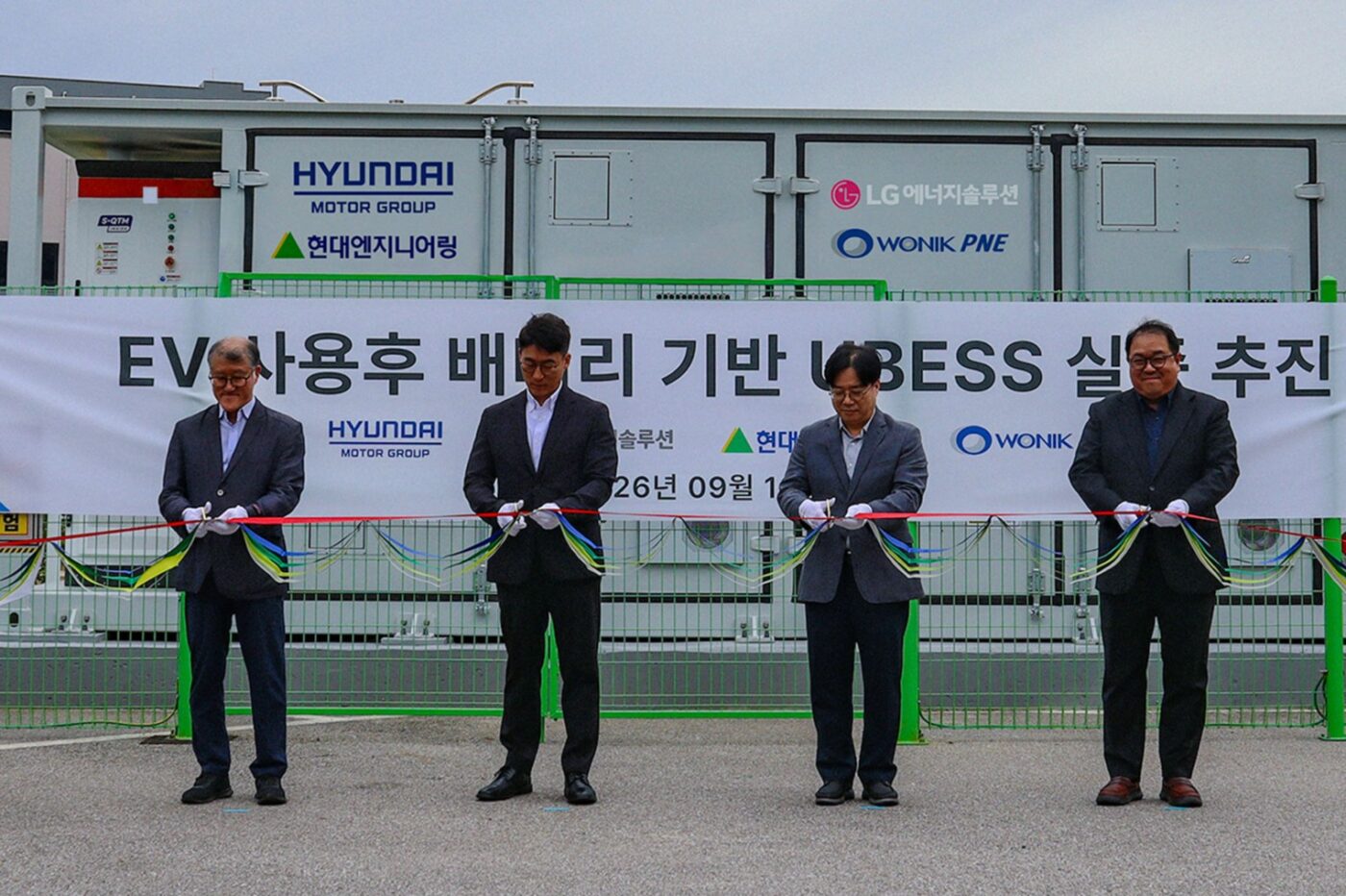
Hyundai Motor and Kia are collaborating with LG Energy Solution on a demonstration project in South Korea that combines second-life electric vehicle batteries with a battery energy storage system for EV charging infrastructure.
The pilot is designed to assess whether batteries removed from electric vehicles can be safely and economically reused as stationary energy storage systems. It uses decommissioned battery packs from vehicles based on Hyundai Motor Group’s E-GMP platform and is described by the companies as the first demonstration in South Korea to use decommissioned E-GMP battery packs for this type of application.
200 kWh Battery Storage System
The system has been installed at the Wonik PNE plant in Dongtan, Hwaseong, south of Seoul, with a storage capacity of 200 kWh. Known as a UBESS (Ultra-Burned Energy Storage System), it is connected to DC fast chargers used to recharge electric vehicles.
The system is designed to store electricity during off-peak periods, when electricity prices are lower, and supply that stored energy to EV fast chargers during periods of higher demand. The approach is intended to examine how repurposed EV batteries could support charging infrastructure while providing a potential second-use application for batteries removed from vehicles.
Companies Develop Second-Life Battery Business Model
Hyundai and Kia are using the project to investigate a potential business model for the safe and efficient deployment of repurposed EV batteries.
LG Energy Solution is manufacturing the UBESS units using used battery packs from Hyundai and Kia vehicles. The company is also supporting performance and safety verification through its battery diagnostics and system operation technologies.
Hyundai Engineering is evaluating the system’s potential in commercial environments, drawing on its experience with EV charging infrastructure. Its work includes examining how second-life battery storage could be integrated into EV charging infrastructure development and related business operations.
Wonik PNE, which manufactures charging stations, is responsible for stable system operation and technical verification, using its experience in charger manufacturing and infrastructure construction.
Testing Battery Performance and Charging Efficiency
The participating companies will assess several aspects of the system during the demonstration, including charging and discharging control algorithms, safety and reliability, battery performance retention, charging quality and overall operational efficiency.
The project will also examine the practical feasibility of reusing EV batteries in commercial environments and the potential role of second-life batteries in establishing a circular battery economy.
The demonstration comes as automakers and battery companies explore ways to extend the useful life of EV batteries after they are no longer suitable for automotive applications. Stationary storage can provide an alternative use for batteries that retain usable capacity but may no longer meet the requirements of vehicle applications.
Second-Life Batteries Already Used in Stationary Storage
The use of repurposed EV batteries in stationary energy storage is already being explored by other companies. Porsche, for example, established a stationary energy storage system at its Leipzig plant using used batteries from the Taycan.
Battery storage has also been integrated directly with DC fast-charging infrastructure. Companies including ADS-TEC and ELMI Power have developed charging systems that combine energy storage with high-power EV charging.
Hyundai, Kia and LG Energy Solution’s project differs in that it specifically combines decommissioned E-GMP battery packs with a stationary storage system connected to DC fast chargers, allowing the companies to evaluate the technology as an integrated commercial charging solution.


