
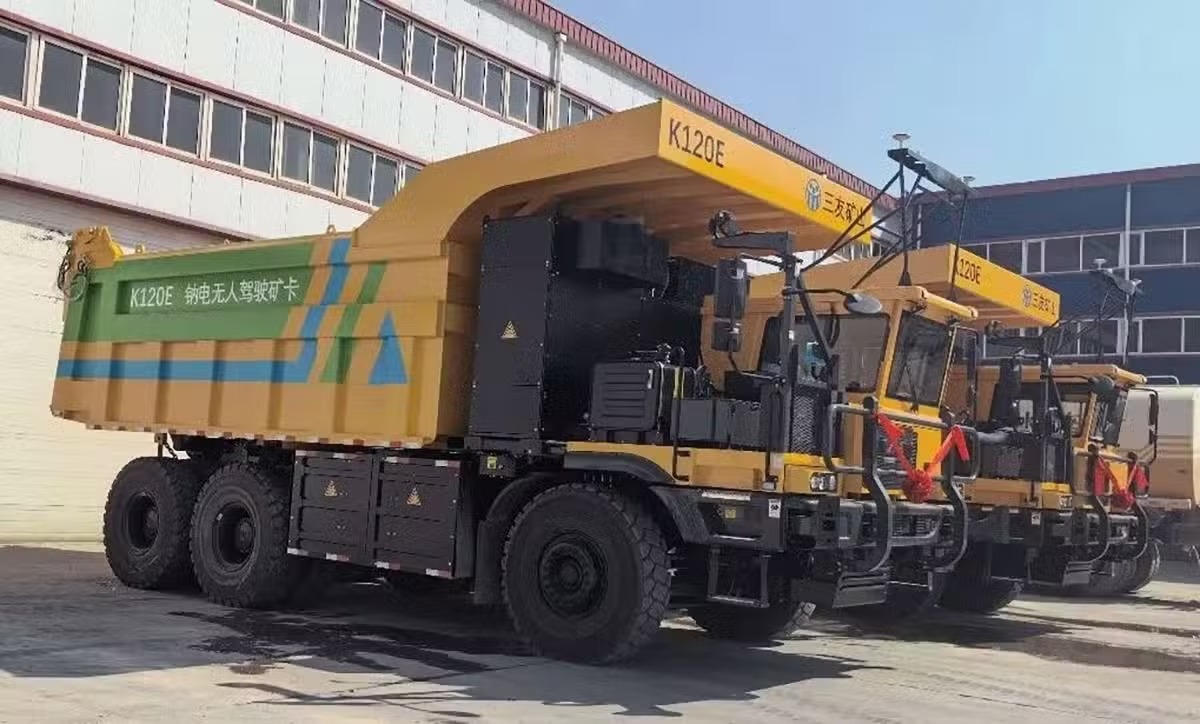
China has taken another step toward commercializing sodium-ion battery technology after Hina Battery delivered what it describes as the world’s first all-electric mining truck powered by sodium-ion batteries.
The vehicle, jointly developed by Hina Battery and Shaanxi Tonly Heavy Industries, was delivered in July to Sanyou Mining, a subsidiary of Tangshan-based Sanyou Group, marking the technology’s entry into heavy-duty mining equipment.
Sodium-Ion Powers Heavy-Duty Mining
The electric mining truck is built on Tonly’s 120E series platform and is equipped with Hina Battery’s proprietary Haixing battery system, providing a total energy capacity of 676kWh.
Hina Battery introduced the Haixing battery platform in March 2025, featuring battery cells with an energy density exceeding 165Wh/kg.
According to the company, the battery system can be fully recharged in approximately 20 to 25 minutes while maintaining a cycle life of more than 8,000 charging cycles under fast-charging conditions.
The company said sodium-ion technology offers long cycle life, strong charging performance and stable operation across a wide temperature range, making it well suited to demanding mining environments.
Designed for Harsh Operating Conditions
Mining operations are among the largest consumers of diesel fuel, while harsh working conditions—including dust, continuous heavy loads and large temperature fluctuations—create significant challenges for battery-powered equipment.
Hina Battery said its sodium-ion system addresses these challenges by enabling smaller battery packs, rapid charging and high utilization rates, helping accelerate the transition from diesel-powered machinery to electric alternatives.
The company believes sodium-ion batteries can provide a competitive solution for heavy industrial applications where reliability and durability are critical.
Commercial Vehicle Expansion Continues
The mining truck represents Hina Battery’s second major commercial vehicle milestone this year.
In June, FAW Jiefang completed extensive road testing of an all-electric heavy truck jointly developed with Hina Battery.
The Jiefang J6P electric tractor was equipped with a 339kWh sodium-ion battery and completed more than 15,000 kilometres of testing over nearly seven months.
According to FAW Jiefang, the battery retained more than 90% of its usable capacity at temperatures as low as minus 40 degrees Celsius while delivering a fast-charging cycle life exceeding 8,000 cycles.
China Accelerates Sodium-Ion Development
Chinese battery manufacturers are accelerating the commercialization of sodium-ion technology as they seek alternatives to lithium-ion batteries that can offer lower costs and improved resource security.
CATL announced in May that it plans to invest 5 billion yuan ($736.5 million) to build 40GWh of annual sodium-ion battery production capacity in Fujian.
Earlier this year, CATL introduced a sodium-ion battery designed for light commercial vehicles before partnering with Changan Automobile to unveil what it described as the first mass-produced passenger vehicle using sodium-ion batteries.
BYD has also disclosed development of a sodium-ion battery capable of more than 10,000 charge cycles, while BAIC Group has introduced prototype cells with energy densities exceeding 170Wh/kg.
Cost Remains the Key Challenge
Despite recent technological advances, manufacturing costs remain the primary barrier to wider adoption.
Hina Battery General Manager Li Shujun said in March that sodium-ion batteries currently cost between 0.5 yuan and 0.7 yuan per watt-hour, compared with approximately 0.3 yuan to 0.5 yuan per watt-hour for lithium-ion batteries.
Li expects production costs for sodium-ion cells to continue falling over the next several years, with price parity expected around 2027 or 2028. He forecasts sodium-ion battery costs could decline to around 0.3 yuan per watt-hour by 2028, improving their competitiveness across commercial vehicle and industrial applications.