

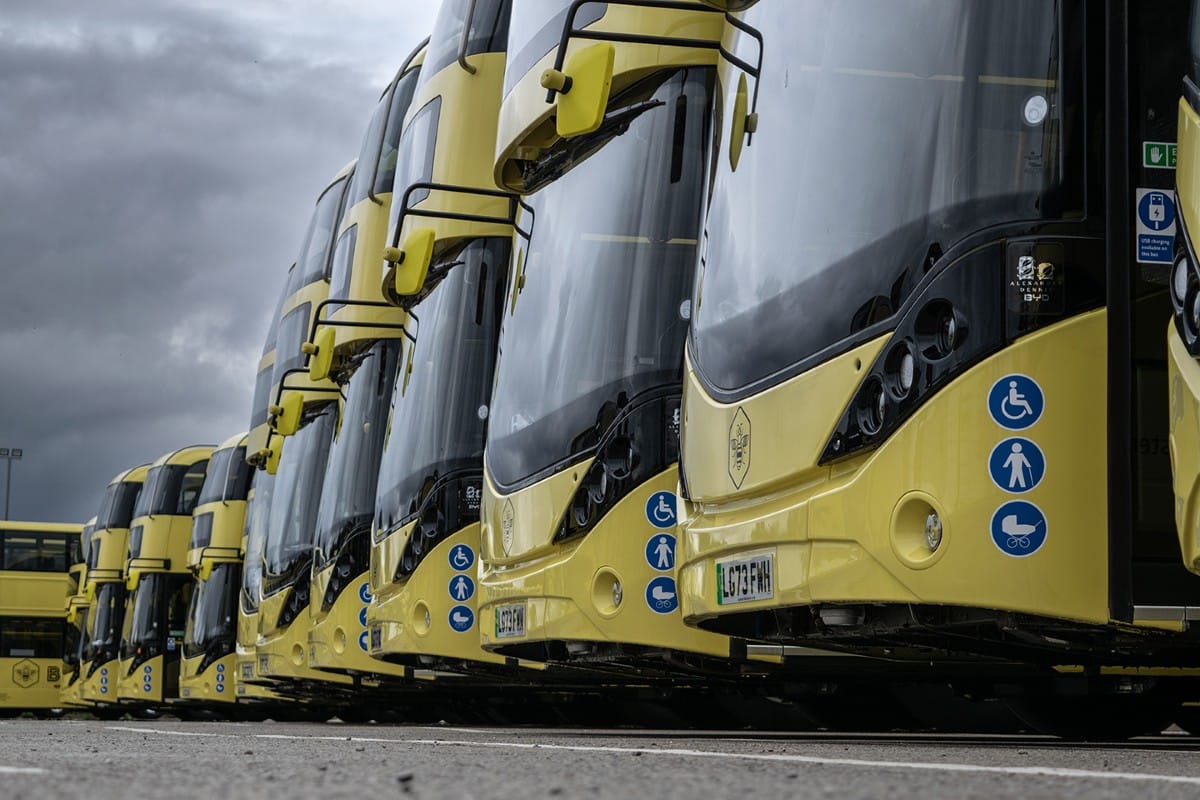
he Greater Manchester Combined Authority has approved the release of nearly £60 million to procure around 220 additional battery-electric buses, expanding the region’s Bee Network as local authorities accelerate plans to fully decarbonise public transport by 2030.
The £59.1 million allocation will subsidise the additional cost of replacing Euro VI diesel buses with zero-emission electric models. The first new vehicles from the order are expected to enter service by the end of 2026 and will convert a further 13% of the Bee Network bus fleet from diesel to electric operation.
See also: Go North West Tests Retrofitted Electric Bus for Greater Manchester’s Bee Network
The Bee Network, launched in 2023, is a flagship initiative designed to integrate buses, trams, bicycles and, eventually, rail services into a single transport system. The network already operates around 350 battery-electric buses, representing about 20% of the total fleet.
“The Bee Network is making public transport more affordable, frequent and cleaner,” said Vernon Everitt, Transport Commissioner for Greater Manchester. “We are accelerating investment to introduce even more electric buses to add to those that already comprise 20% of our vehicles, marking another significant step towards the goal of a fully zero-emission bus fleet by 2030.”
See also: Trafford Council Partners with Be.EV to Expand EV Charging Infrastructure in Greater Manchester
The funding forms part of the £1.07 billion City Region Sustainable Transport Settlement, which is supporting a wide range of low-carbon transport upgrades across Greater Manchester. Local officials have said the long-term objective is to transition the entire Bee Network bus fleet to zero-emission operation by the end of the decade.
Electric bus deployment is also expanding in Manchester city centre. The free-to-use central shuttle network has been upgraded with 12 Volvo BZL single-deck electric buses. The Bee Network Committee has also approved plans to extend tram and tram-train links and to build a new transport hub in Tyldesley, which will include electric vehicle charging infrastructure.
See also: Trafford Council Partners with Be.EV to Expand EV Charging Infrastructure in Greater Manchester
In June, Greater Manchester said it would fully electrify its public transport system by 2030 using a £2.5 billion share of a broader £15.6 billion UK government funding package aimed at upgrading transport networks across English city regions. Under the plan, the city region is targeting the rollout of 1,000 new electric buses powered by renewable energy, alongside the electrification of tram, train and public-use e-bike networks. Officials have described the project as the UK’s first fully integrated and all-electric public transport system outside London.
Additional central government funding has already been channelled into cleaner transport across the region. In January 2025, the UK government unveiled an £86 million air-quality initiative for Greater Manchester, with £51.1 million earmarked for 117 new buses, including 40 zero-emission vehicles and 77 Euro VI-compliant models, as well as charging infrastructure for electric operations.
See also: UK’s Be.EV Expands to London With Four New Ultra-Rapid Charging Hubs
Infrastructure development is also progressing. Greater Manchester has completed construction of a fully electric bus depot in Ashton, which has housed 83 Volvo BZL MCV electric double-deck buses since summer. The region also placed two separate orders for 50 electric double-deck buses each from British manufacturer Alexander Dennis in 2022.