




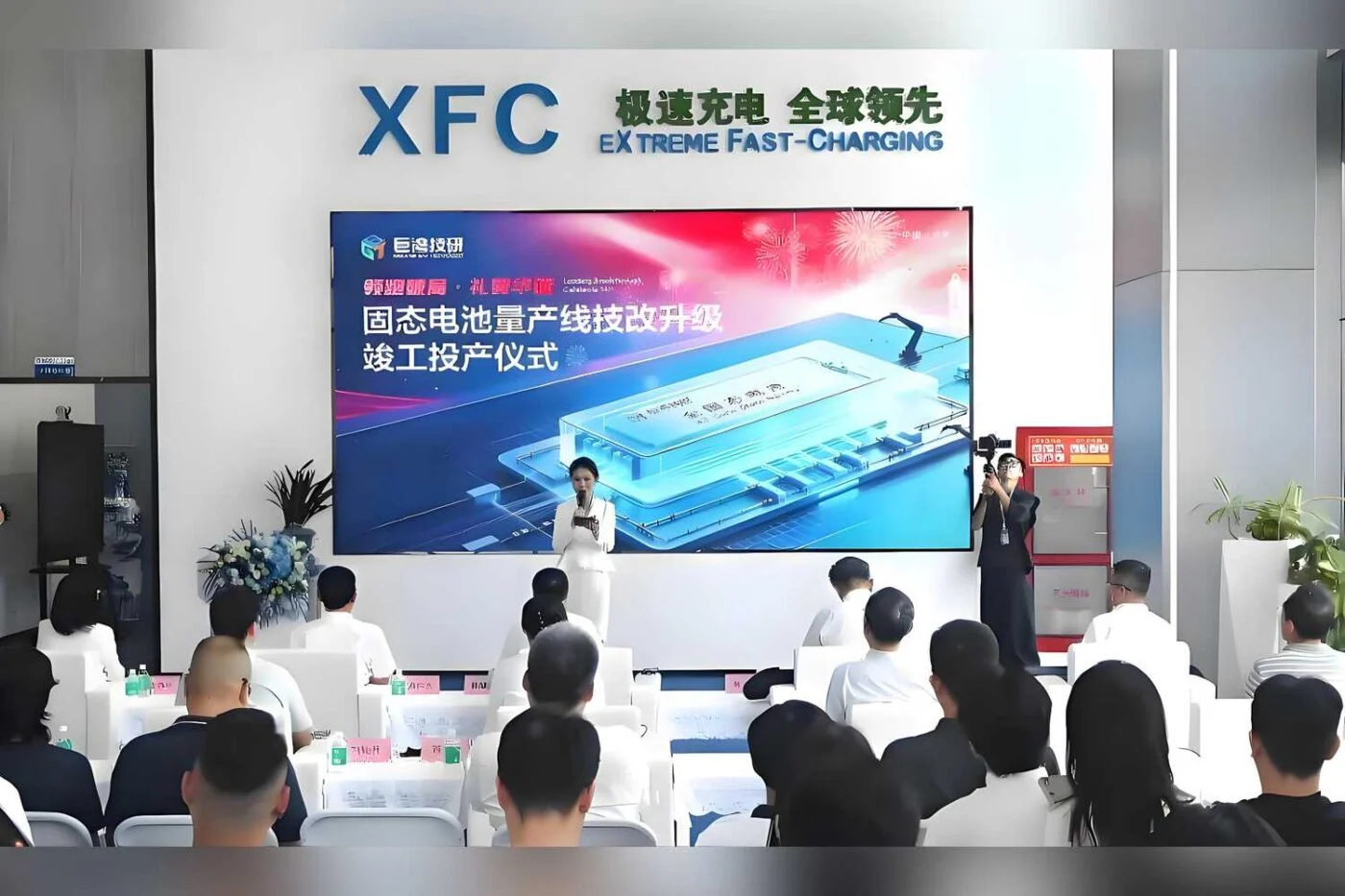
Greater Bay Technology (GBT), a Chinese battery developer backed by the GAC Group, began series production of all-solid-state battery cells on 13 October at its facility in Nansha, near Guangzhou. The company is using a converted lithium-ion production line with an initial capacity of 1 gigawatt-hour (GWh), which could be expanded to as much as 4 GWh.
Rather than constructing a dedicated factory, GBT repurposed existing manufacturing equipment to produce the new cells. The company says the approach allows it to retain much of the established lithium-ion production process while introducing modifications for its solid-state electrolyte technology.
GBT aims to use the production model to limit capital expenditure and reduce the financial risks associated with scaling a new battery technology.
Production Process Uses Existing Lithium-Ion Equipment
GBT’s manufacturing approach centres on a proprietary organic-inorganic composite electrolyte. The company introduces the electrolyte into the cell as a liquid precursor before solidifying it internally, a process it says creates an elastic interface with the electrodes.
This differs from solid-state battery approaches based on sulphide electrolytes, which generally require carefully controlled, oxygen-free and extremely dry processing environments.
According to GBT, the electrolyte is injected and cured in a dry, oxygen-free environment, while other major production stages can continue using conventional lithium-ion equipment. These include electrode manufacturing, stacking, formation and testing.
The company says the same production line can manufacture both conventional lithium-ion cells and solid-state cells, allowing production to switch between the two depending on demand. GBT also produces its solid electrolyte and key raw materials internally and reports holding more than 50 patents related to the technology.
GBT founder and chief technology officer Huang Xiangdong described the approach as an adaptation of existing manufacturing infrastructure.
This is not a new line built from scratch; it is an existing line with a new core.
Huang said the project progressed from A-sample development in April 2026 to series production in October.
Battery Standard and Performance Claims
GBT says two of its production cells have met requirements in tests conducted by the National Power Battery Innovation Center. The company describes its cells as the first to be verified under the new Chinese standard GB/T 48093.1-2026.
Published on 28 August 2026, the standard, titled Solid-state battery for electric vehicle – Part 1: Terms and classification, defines terminology and classifications intended to distinguish solid-state batteries from semi-solid and hybrid designs. It is scheduled to enter into force on 1 January 2028.
GBT cites energy-density figures ranging from 260 to 480 watt-hours per kilogram (Wh/kg), depending on the cell generation and material configuration. The first generation entering production uses pouch cells for automotive applications and established electrode materials. Later generations are expected to introduce technologies including lithium-metal anodes.
These figures are company-reported specifications across different generations and configurations, rather than a single confirmed performance figure for every cell currently in production.
Safety and Durability Require Further Validation
GBT has also cited tests conducted under China’s GB 38031-2025 battery safety standard. In an externally conducted nail-penetration test on a fully charged cell, the company reported that neither fire nor explosion occurred.
For durability, GBT says its cells have cycle stability comparable to conventional lithium-ion batteries. It has not provided detailed cycle-life figures in the information released.
The results offer an initial indication of the company’s safety and durability claims, but performance under wider operating conditions, long-term degradation and manufacturing consistency will remain important factors as production scales.
Partnerships and Potential Applications
Alongside the production launch, GBT announced cooperation with Hubei Liming Lithium Technology, which is expected to integrate the cells into battery systems for vehicles and stationary energy storage.
The company is also working with an electric vertical take-off and landing (eVTOL) aircraft development centre in Shenzhen. GBT says it is in advanced discussions with several major automakers regarding potential series-production applications.
Electric vehicles are the company’s primary target market, but it also identifies eVTOL aircraft, humanoid robots, stationary storage and specialised vehicles as potential applications.
In Europe, GBT is working with commercial vehicle startup Flynt. The company says it offers its technology through cell supply agreements, technology transfer and joint ventures.
Scaling Remains the Key Test
GBT’s production launch comes as battery developers seek ways to move solid-state technology from laboratory development into industrial manufacturing. Reusing lithium-ion production equipment could reduce the investment required to establish initial production capacity, if the approach can deliver consistent cell quality and competitive manufacturing costs.
However, the launch alone does not establish whether the technology can achieve its announced energy-density figures, durability and cost targets at larger production volumes. Those outcomes will depend on manufacturing yields, quality control, customer validation and performance in real-world applications.
GBT’s next challenge will be demonstrating that its production process can scale reliably while meeting the safety, cost and performance requirements of automotive and other demanding markets.


