
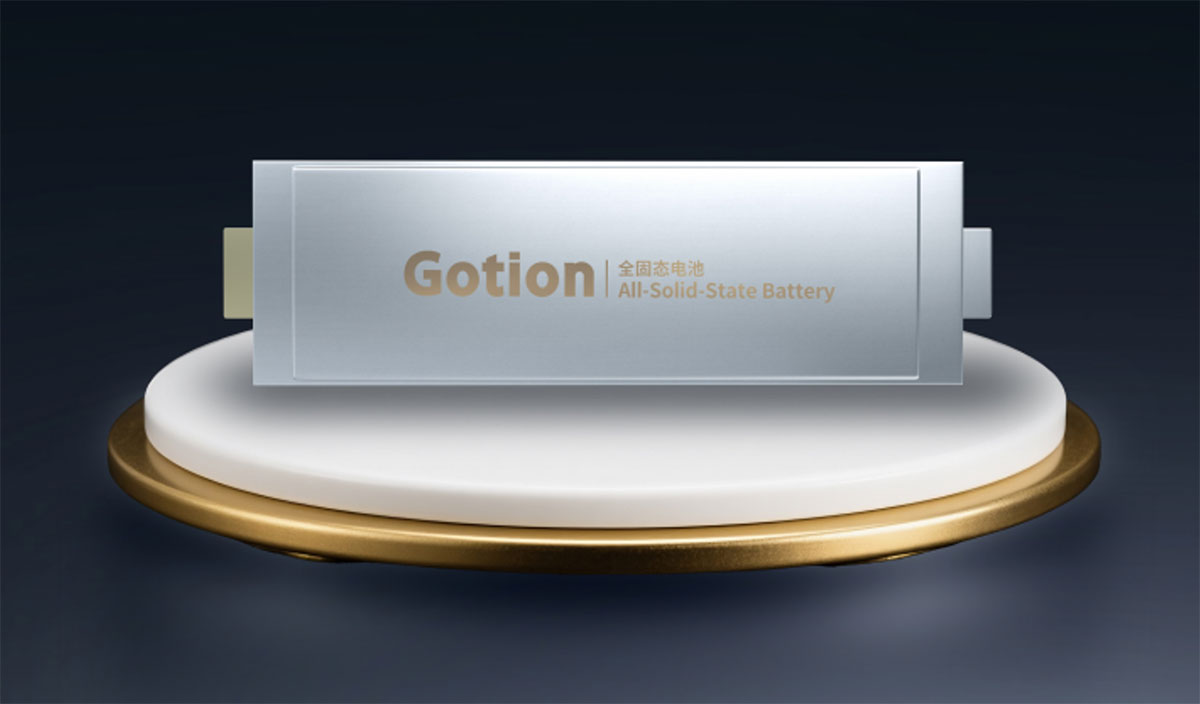
Gotion High-Tech, the Chinese battery manufacturer backed by Volkswagen, said its self-developed all-solid-state “Jinshi Battery” has entered pilot-scale production, marking a significant milestone in China’s race toward large-scale solid-state battery manufacturing.
The company also confirmed that design work has begun for a 2 GWh mass production line, according to Chinese outlet IT-Home. The move positions Gotion among the leading players in the country’s push to industrialise advanced battery technologies that promise higher energy density, improved safety, and longer lifespans for electric vehicles.
See also: Gotion High-tech to Supply Advanced Battery Cells to Ehang’s EH216 eVTOL Series
Developed over eight years, the Jinshi Battery uses a sulfide-based solid electrolyte and several material innovations, including micronised electrolytes, ultra-thin coated single-crystal cathodes, and three-dimensional mesoporous silicon anodes. Gotion said the cell achieves an energy density of 350 Wh/kg — roughly 40% higher than mainstream ternary lithium batteries — and passes rigorous safety tests such as 200°C thermal chamber exposure, nail penetration, and crush trials.
“Our Jinshi Battery represents a breakthrough in solid-state energy storage, combining high energy density with robust safety and production feasibility,” a Gotion spokesperson said in a company statement. “This is a crucial step toward large-scale industrialisation of solid-state batteries.”
Gotion’s first 0.2 GWh pilot line, fully equipped with domestically sourced machinery, has maintained a stable 90% yield rate. The company reports that ionic conductivity in its sulfide electrolyte has improved by 60%, while preload pressure during assembly has been reduced by 90%, improving cell consistency and scalability. After a year of endurance validation, cell capacity has risen 150% compared with early prototypes.
The Jinshi Battery supports over 3,000 charge cycles and is projected to last up to one million kilometres. Its pack system achieves an energy density of 280 Wh/kg, enabling an estimated driving range of 1,000 km per charge, with reliable performance across temperatures from -20°C to 85°C. Prototype vehicles using the battery have already completed more than 10,000 km of road testing.
See also: Gotion High-Tech Seeks Battery Separator Supply Deal with SK IE Technology
While the company has not disclosed the cost or construction timeline for the 2 GWh production line, industry analysts estimate investment requirements of between 1.5 billion and 2 billion yuan ($205–273 million) per GWh, based on similar semi-solid battery projects. Gotion aims to begin small-scale vehicle integration by 2027 and expand to full mass production by 2030.
In addition to electric vehicles, Gotion is working with Chinese eVTOL manufacturer EHang to adapt solid-state battery technology for low-altitude aircraft. Analysts say the company’s progress could help narrow the gap with Japanese and Korean competitors, though challenges remain in cost management and interface stability before large-scale commercialisation becomes viable.