



Geely plans to begin pilot testing solid-state batteries in electric vehicles from 2027 as the Chinese automaker advances development of a technology it says could eventually enable driving ranges of more than 1,000 km. The most advanced version under development is expected to reach an energy density of up to 500 Wh/kg at battery-pack level, according to reports cited by CarNewsChina.
Real-world validation of the technology has already begun, with a broader pilot programme planned for 2027 across brands within Geely Holding. The company has not yet identified the first brands or models that will use the batteries, nor disclosed how many vehicles will participate.
Geely Targets 500 Wh/kg Battery Packs
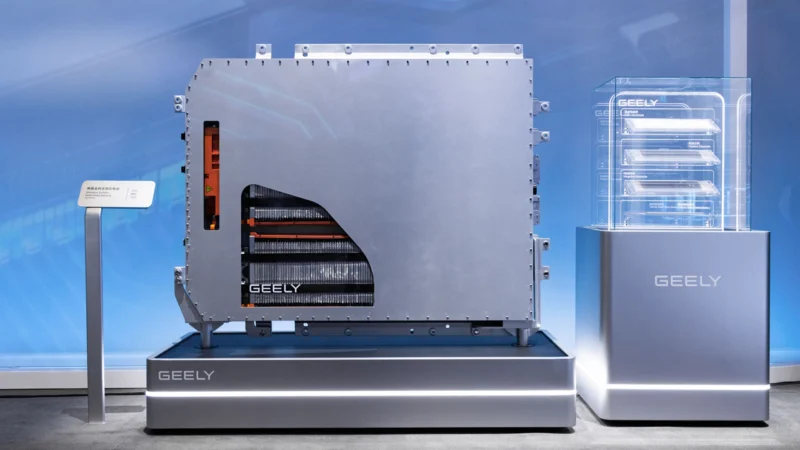
Geely is developing several solid-state battery variants, with the highest-performing version targeting an energy density of up to 500 Wh/kg.
According to media reports, the figure applies to the battery pack rather than individual cells. That would represent a substantial increase over the approximately 128 Wh/kg pack-level energy density of the first-generation Zeekr “Golden Brick” battery.
Geely has linked the higher energy density to a potential driving range of more than 1,000 km on a single charge. However, the company has not disclosed the testing cycle or methodology behind the range target.
Details including battery capacity, charging performance and specific cell chemistry have also not yet been released.
Solid-State Battery Testing Starts Before Wider Deployment
Geely said real-world validation of its solid-state technology is already underway in 2026. The next stage will involve vehicles from across its broader brand portfolio beginning in 2027.
Geely Holding’s brands include Geely, Zeekr, Lynk & Co, Volvo, Polestar, Lotus and Smart.
The 2027 programme is being described as a pilot operation rather than full-scale commercial deployment. Geely has not provided a timetable for when vehicles equipped with the new batteries will become broadly available to customers.
For materials development, Geely is working with U.S. chemical company Dow. The collaboration includes an adhesive for solid-state cells that Dow says remains stable across temperatures ranging from minus 40 to plus 120 degrees Celsius.
2027 Emerges as Pilot Year for Solid-State Batteries
Geely is not the only major Chinese automaker targeting 2027 for initial solid-state battery applications.
BYD plans to deploy solid-state batteries in demonstration vehicles from 2027 and is reportedly preparing small-scale production of cells using a dual solid-electrolyte system. The company confirmed in 2025 that it had produced its first solid-state cells, although wider commercialization is not expected until later in the decade.
CATL is also targeting pilot production in 2027. However, Chairman Robin Zeng has cautioned against expectations of rapid mass-market adoption.
Zeng said in June that CATL’s solid-state battery technology was at level four on a nine-level technology readiness scale, indicating that significant technical and manufacturing challenges remain.
Chinese Automakers Continue Solid-State Battery Development
Other Chinese automakers are pursuing similar technology programmes. Dongfeng Motor has targeted production of 50,000 vehicles equipped with its internally developed solid-state batteries by 2027.
Chery Automobile has also unveiled an all-solid-state battery that it says can support a driving range exceeding 1,500 km.
BYD has filed six new patents covering solid-state battery materials, cell structures and manufacturing technologies, further expanding its development programme.
The activity across the Chinese automotive and battery industries suggests that 2027 is likely to be an important period for pilot deployments and manufacturing validation of solid-state batteries, although large-scale commercial production remains further away.


