

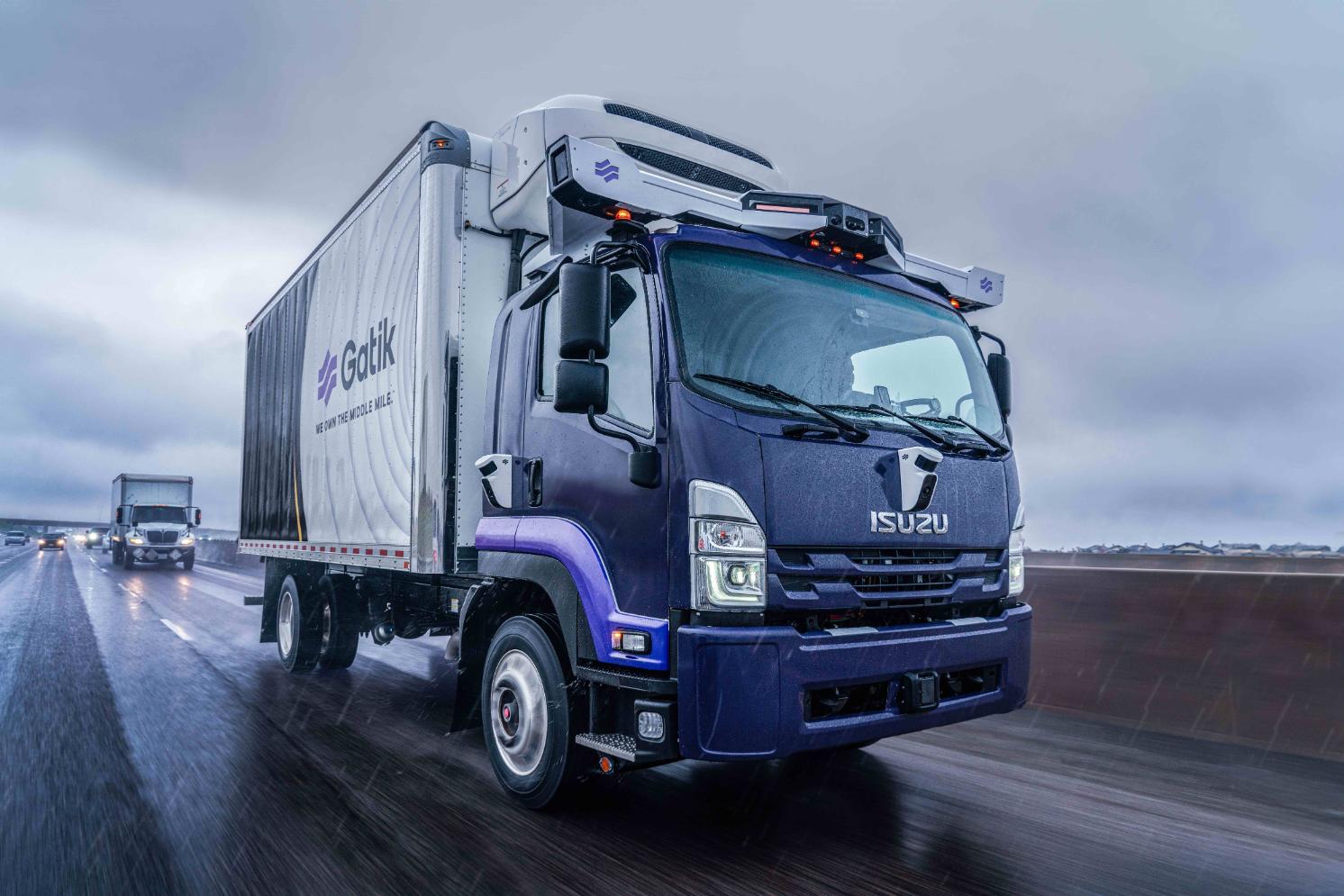
U.S. autonomous trucking startup Gatik has raised $200 million in a funding round led by Qatar Investment Authority (QIA), with participation from Koch Disruptive Technologies, Millennium Management, ARK Invest, Intact Private Capital and other investors. The Santa Clara-based company is using its autonomous driving technology to operate fully driverless freight trucks on commercial routes in the United States and Canada.
Gatik Expands Commercial Autonomous Freight
Gatik operates 41 fully driverless box trucks for PepsiCo across Dallas, Phoenix and Northwest Arkansas. The company also operates autonomous trucks for Fortune 50 retailers, grocery companies and consumer packaged goods businesses across Texas, Arizona, Arkansas and Canada.
Gatik Launches Simulation Platform to Support Autonomous Freight Deployment
Founded in 2017 by Gautam Narang, Arjun Narang and Apeksha Kumavat, Gatik focuses on autonomous freight transportation between distribution centers and retail locations.
Rather than developing autonomous vehicles for every possible driving environment, the company has concentrated on repeatable commercial routes where trucks can transport goods between established points within defined logistics networks.
Gautam Narang, chief executive and co-founder of Gatik, said the latest financing reflects demand for the company’s autonomous freight technology and its commercial operations.
“This round, led by some of the world’s leading financial institutions, is a clear validation of Gatik’s commercial leadership in autonomous freight,” said Gautam Narang, chief executive and co-founder of Gatik.
Autonomous Trucks Move Into Commercial Operations
The funding comes as autonomous trucking companies increasingly move from testing toward commercial freight operations.
Gatik Rolls Out Fully Driverless Truck Operations With $600 Million in Contracted Revenue
Byron Knight, president of Koch Disruptive Technologies, said autonomous freight is beginning to demonstrate practical applications in supply chains.
“We’ve long believed autonomous freight has the potential to improve the efficiency and reliability of supply chains,” said Byron Knight, president of Koch Disruptive Technologies.
Knight said the technology is moving beyond development and into real-world commercial operations.
Justin Smith-Lorenzetti, managing director at Intact Private Capital, said the sector will increasingly depend on demonstrated technology, safety standards and the ability to operate at scale.
“We are no longer debating the potential of autonomous trucking,” said Justin Smith-Lorenzetti, managing director at Intact Private Capital.
QIA Makes Major Deep-Tech Investment
The Gatik financing represents QIA’s largest single venture investment of the summer and its third significant deep-tech investment in 10 weeks.
Gatik, Loblaw to Deploy 50 Autonomous Trucks in Greater Toronto Area
Abdulla Al-Kuwari, head of industrials at QIA, said the sovereign wealth fund sees autonomous freight as part of the development of future logistics infrastructure.
“Autonomous freight is transforming the global logistics industry, making it more efficient and reliable,” said Abdulla Al-Kuwari, head of industrials at QIA.
QIA was established in 2005 to diversify Qatar’s economy and invest the country’s financial resources. Its recent deep-tech investments have included companies working in satellite technology, semiconductor manufacturing and autonomous logistics.
The investments in these areas reflect a focus on physical infrastructure and technologies that can have applications across commercial and government sectors.
Gatik Targets Defined Freight Networks
Gatik’s approach to autonomous trucking centers on high-frequency transportation routes between distribution centers and retail stores.
Gatik Introduces New Safety Standards for Autonomous Freight Vehicles
Its vehicles are designed to repeatedly operate within established commercial networks, allowing the company to focus its autonomous driving system on specific freight operations rather than broader passenger vehicle applications.
The company said it currently operates driverless trucks across Texas, Arizona, Arkansas and Canada for major retailers, grocery companies and consumer goods businesses.