

The Fraunhofer Battery Alliance is expanding its cooperation with South Korean research and industry partners through two new letters of intent focused on battery technology and the wider battery value chain.
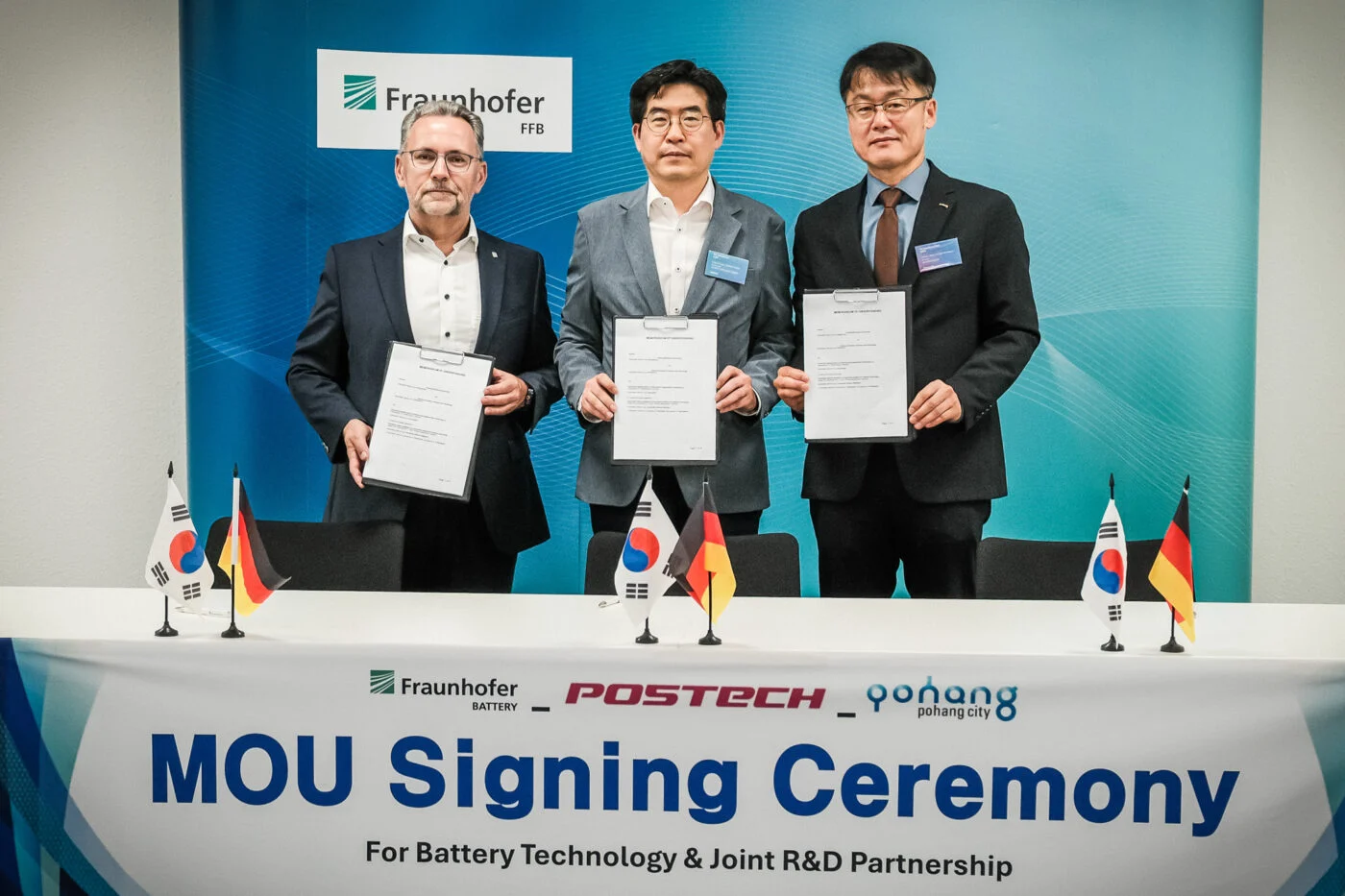
The agreements were signed during a delegation visit to the Fraunhofer Research Institution for Battery Cell Production (FFB) in Münster. The partners include Pohang University of Science and Technology (POSTECH), the city of Pohang and the Korea Environment Corporation (K-eco).
The planned cooperation covers research and development in areas including battery materials, cell production, next-generation battery technologies and recycling.
Research to Cover Battery Materials and Cell Manufacturing
The agreement involving POSTECH and the city of Pohang will examine potential joint research topics across several stages of battery development.
These include materials for lithium-ion batteries, next-generation battery technologies, cell manufacturing processes, production technologies, recycling and circular-economy applications.
The city of Pohang is expected to provide administrative and policy support, including funding-related assistance for joint activities involving local companies and international research partners.
POSTECH brings existing expertise in advanced battery technologies. In early 2026, researchers from POSTECH, KAIST and Gyeongsang National University reported an anode-free lithium-metal battery with a volumetric energy density of 1,270 Wh/l. The researchers reported that the cell retained 81.9% of its initial capacity after 100 cycles, with the results also demonstrated in larger pouch cells.
Fraunhofer FFB Provides Scale-Up Infrastructure
The Fraunhofer FFB in Münster will play a central role in the planned cooperation. The research institution combines laboratory-scale research with production-oriented development for cylindrical, prismatic and pouch cells.
Depending on the project, researchers can examine individual manufacturing processes or complete production chains.
The FFB PreFab facility in Münster-Amelsbüren provides infrastructure for testing new materials, cell concepts and manufacturing processes under near-industrial conditions. This enables researchers to evaluate scalability at an early stage and prepare technologies for potential series production or larger-scale industrial manufacturing.
“The development of new battery technologies and the establishment of a sustainable battery value chain require close cooperation between research and industry across national borders,” said Jens Tübke, Director of the Fraunhofer FFB and spokesperson for the Fraunhofer Battery Alliance.
Tübke said the cooperation with South Korean partners will combine scientific expertise to develop solutions for battery cell production and recycling.
K-eco Agreement Focuses on Battery Recycling
The second letter of intent, signed with K-eco, places greater emphasis on battery recycling and recovered materials.
The cooperation will examine material characterisation, certification and quality assurance procedures for recycled battery materials. The partners also plan to explore research approaches that could support compliance with the EU Battery Regulation.
Standardised approaches for evaluating and certifying recovered materials could play a role in developing more effective circular-economy models for batteries.
Battery recycling continues to face economic challenges despite advances in processing technologies. Research conducted within the EU Safeloop project recently estimated current losses in battery recycling at around €1.90 per kilogram of battery pack, with hazardous-goods transport, dismantling and uncertainty around material recovery identified among the cost drivers.
Germany and South Korea Strengthen Battery Research Links
The Fraunhofer FFB is among Germany’s major publicly funded battery research initiatives. The German federal government is providing up to €750 million for research facilities and projects at the FFB, while North Rhine-Westphalia is contributing a further €320 million for land and new buildings.
The FFB is also part of the German federal government’s broader battery research strategy.
The new agreements strengthen cooperation between German and South Korean battery research organisations across both emerging cell technologies and recycling. However, the partners have not disclosed specific joint research projects, project timelines or additional funding commitments associated with the newly signed letters of intent.