




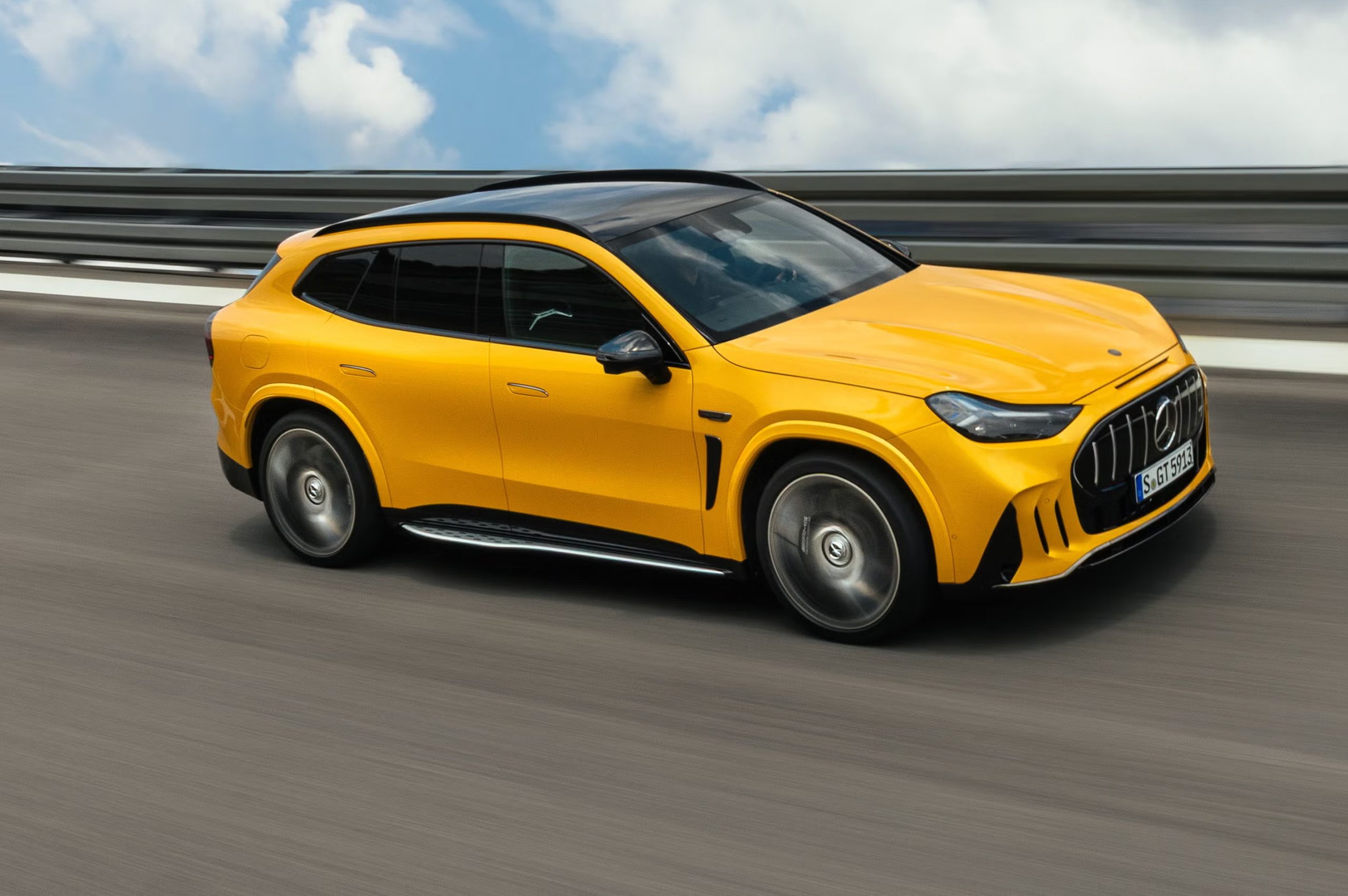
Mercedes-AMG is extending its performance-car philosophy into the full-size electric SUV segment with the 2028 Mercedes-AMG GT SUV. The all-electric model combines up to 1,153 horsepower, a claimed 0–60 mph acceleration time of 2.4 seconds and DC fast-charging capability of up to 710 kW.
The GT SUV is the first full-size SUV developed entirely in-house by AMG and the second model built on the company’s new AMG.EA electric performance platform, following the AMG GT 4-Door Coupe.
Three versions are planned for launch: the GT53 SUV, GT55 SUV and range-topping GT63 SUV. The model is expected to reach US dealerships in summer 2027, although US pricing and EPA driving-range estimates have not yet been announced.
Mercedes-AMG GT SUV Price and Model Lineup
The GT SUV lineup offers three configurations with different motor arrangements, battery capacities and performance characteristics. The GT53 serves as the entry point, while the GT55 and GT63 receive a more complex three-motor setup.
| Model | Electric Motor Configuration | Battery Capacity | Maximum DC Charging Power |
|---|---|---|---|
| GT53 SUV | Two motors | 106.0 kWh | 600 kW |
| GT55 SUV | Three motors | 128.0 kWh | 710 kW |
| GT63 SUV | Three motors | 128.0 kWh | 710 kW |
Mercedes-AMG has not announced US pricing for any of the three versions. Further details are expected closer to the vehicle’s planned dealership arrival in summer 2027.
Electric Motor Configuration and Performance
The GT53 uses two electric motors, one on each axle, to provide all-wheel drive. Its rear motor is paired with a two-speed transmission that uses a shorter first gear for acceleration and a taller second gear for more efficient high-speed driving.
The GT55 and GT63 adopt a three-motor arrangement, with one motor at the front and two at the rear. The front motor can be disconnected when additional power or traction is unnecessary, helping reduce energy consumption during suitable driving conditions.
The two rear motors can distribute torque between the individual rear wheels, supporting traction and handling. All three versions feature AMG Performance 4MATIC+ all-wheel drive.
| Powertrain Feature | GT53 SUV | GT55 SUV | GT63 SUV |
|---|---|---|---|
| Electric motors | 2 | 3 | 3 |
| Front motor | Yes | Yes | Yes |
| Rear motors | 1 | 2 | 2 |
| All-wheel drive | AMG Performance 4MATIC+ | AMG Performance 4MATIC+ | AMG Performance 4MATIC+ |
| Maximum output | Not specified in the announcement | Not specified in the announcement | Up to 1,153 hp across the lineup |
| 0–60 mph | Not specified | Not specified | As little as 2.4 seconds across the lineup |
The headline figures of up to 1,153 hp and 2.4 seconds for the 0–60 mph sprint highlight the performance potential of the range. Exact output and acceleration figures for each individual variant have not been provided in the available announcement.
Battery Capacity and 800-Volt Architecture
The AMG GT SUV uses an 800-volt electrical system designed to support high-power charging and the demands of a performance-oriented electric powertrain.
Battery capacity varies by model. The GT53 uses a 106.0 kWh battery, while the GT55 and GT63 receive larger 128.0 kWh packs.
| Battery Specification | GT53 SUV | GT55 SUV | GT63 SUV |
|---|---|---|---|
| Battery capacity | 106.0 kWh | 128.0 kWh | 128.0 kWh |
| Electrical architecture | 800V | 800V | 800V |
| Maximum DC charging power | 600 kW | 710 kW | 710 kW |
The larger batteries in the GT55 and GT63 are paired with higher peak charging capability. Actual charging performance will depend on the charging station, battery temperature, state of charge and other operating conditions.
Rapid Charging and Driving Range
Charging speed is a major feature of the GT SUV. Mercedes says the GT53 can add up to 236 miles of WLTP-rated range in 10 minutes, while the GT55 and GT63 can add up to 280 miles over the same period.
These figures refer to range added under the manufacturer’s stated conditions, rather than a complete battery charge.
| Charging Specification | GT53 SUV | GT55 SUV | GT63 SUV |
|---|---|---|---|
| Maximum DC charging power | 600 kW | 710 kW | 710 kW |
| WLTP range added in 10 minutes | Up to 236 miles | Up to 280 miles | Up to 280 miles |
| Projected WLTP range | Not announced | Not announced | Approximately 385–435 miles, depending on configuration |
| US EPA range | Not announced | Not announced | Not announced |
The GT63’s projected WLTP range is approximately 385–435 miles, depending on configuration. US EPA estimates have not been released and may differ from European figures because of differences in testing procedures.
The combination of a large battery and high charging power is intended to make the GT SUV suitable for longer journeys as well as performance driving.
AMG Active Ride Control+ Suspension
The GT SUV introduces AMG Active Ride Control+, a suspension system designed to manage body movements during acceleration, braking and cornering.
The system is standard on the GT63 and optional on the GT55. It combines hydraulic dampers with adjustable air springs and is designed to control body roll without conventional anti-roll bars.
The system aims to keep the SUV flatter through corners, reduce nose-dive under braking and limit body lift during acceleration. It is also intended to deliver a more comfortable ride on longer trips and uneven roads.
This approach reflects the engineering challenge of combining high performance with the weight, ride-height requirements and passenger comfort expected from a full-size SUV.
AMG Dynamic Plus Package and Performance Controls
The GT63 includes the AMG Dynamic Plus Package as standard, while buyers of the GT55 can select it as an option.
The package includes the AMG Race Engineer Control Unit, which allows drivers to adjust aspects of motor response, handling and traction through three rotary controls.
The system is intended to give drivers greater control over the vehicle’s dynamic behaviour, with settings that can be adapted to different road conditions and driving preferences.
Together with the available suspension technology and multi-motor powertrain, these features are designed to deliver a more configurable driving experience than a conventional luxury electric SUV.
AMGForce Sport+ and Simulated Engine Sound
Mercedes-AMG is also addressing the emotional side of performance driving through AMGForce Sport+, which adds simulated combustion-engine sounds and gear-change effects.
The GT53 reproduces six-cylinder-style sounds, while the GT55 and GT63 simulate V8 engine sounds. AMG says it recorded real engines using more than 100 measurements and 16 microphones to develop the sound profiles.
The audio changes with acceleration and driving style. Simulated gear changes can be triggered using the steering-wheel paddles, while seat vibrations and a dedicated display help reinforce the experience.
The system does not change the electric powertrain into a combustion engine. Instead, it provides an artificial sound and feedback layer intended to recreate some of the sensory elements associated with traditional AMG performance models.
Seven AMG Dynamic Select Driving Modes
The GT SUV offers seven AMG Dynamic Select modes, each designed to change the vehicle’s responses for a different driving situation.
| Driving Mode | Primary Purpose |
|---|---|
| Comfort | Smooth driving and improved everyday comfort |
| Sport | Sharper responses and more dynamic handling |
| AMGFORCE Sport+ | Simulated engine sounds and gear-change effects |
| Race | Track-oriented settings, including Drift Mode, Drag Race and Launch Control |
| Slippery | Additional control for wet, snowy or icy conditions |
| Eco | Reduced power output and energy-saving settings |
| Individual | Customisable vehicle settings |
The modes allow drivers to adjust the character of the vehicle, from efficiency-focused everyday use to more performance-oriented driving.
Race-related features are intended for appropriate controlled environments. Their use should always follow the vehicle’s instructions and applicable safety requirements.
Exterior Design and Active Aerodynamics
The GT SUV shares visual cues with the AMG GT 4-Door Coupe but adopts a larger body suited to its SUV format. Its design features a sharply sloping roofline, wide stance, muscular wheel arches and frameless side windows.
Six circular rear lights provide a distinctive lighting signature, while active aerodynamic components help balance airflow, cooling requirements and stability.
The Aerokinetics Airpanel system uses movable louvers in the front bumper to regulate cooling airflow. When additional cooling is unnecessary, the louvers can remain closed to reduce aerodynamic drag.
An active rear spoiler is fitted to the GT55 and GT63. It adjusts automatically to help improve stability and traction as driving conditions change.
These features illustrate how the GT SUV combines styling with aerodynamic management to support performance and efficiency.
Interior Displays and Passenger Comfort
The cabin follows a driver-focused layout with a large digital instrument display and central infotainment screen. Buyers can also select an additional display for the front passenger.
| Interior Feature | Specification |
|---|---|
| Digital instrument display | 10.2 inches |
| Central infotainment screen | 14.0 inches |
| Front passenger display | 14.0 inches, optional |
| Rear seating | Three-person bench |
| Rear seatbacks | Folding |
| Panoramic glass roof | Transparent and opaque modes |
| Customisation programme | Mercedes Manufaktur |
The rear bench accommodates three passengers, while folding rear seatbacks provide additional cargo flexibility.
The panoramic glass roof can switch between transparent and opaque modes, allowing occupants to adjust the amount of light entering the cabin. Mercedes’ Manufaktur programme will provide additional opportunities to personalise the interior and exterior.
Cargo Capacity and Front Trunk
Despite its performance focus, the GT SUV offers storage space for everyday use and longer journeys.
The rear cargo area provides 21.4 cubic feet of capacity behind the rear seats. A separate 2.8-cubic-foot front trunk adds space for smaller bags and other items.
| Storage Area | Capacity |
|---|---|
| Rear cargo area | 21.4 cubic feet |
| Front trunk | 2.8 cubic feet |
| Total stated storage capacity | 24.2 cubic feet |
The rear seatbacks can fold to provide additional loading flexibility, although a maximum cargo capacity with the seats folded has not been announced.
2028 Mercedes-AMG GT SUV Specifications at a Glance
| Specification | Details |
|---|---|
| Model year | 2028 |
| Vehicle type | Full-size electric performance SUV |
| Platform | AMG.EA |
| Available versions | GT53, GT55, GT63 |
| Maximum stated power across lineup | Up to 1,153 hp |
| Fastest stated 0–60 mph time | 2.4 seconds |
| Electrical architecture | 800V |
| GT53 battery | 106.0 kWh |
| GT55 battery | 128.0 kWh |
| GT63 battery | 128.0 kWh |
| GT53 maximum DC charging power | 600 kW |
| GT55/GT63 maximum DC charging power | 710 kW |
| GT63 projected WLTP range | Approximately 385–435 miles |
| GT53 motors | 2 |
| GT55/GT63 motors | 3 |
| All-wheel drive | AMG Performance 4MATIC+ |
| Suspension system | AMG Active Ride Control+ |
| Digital instrument display | 10.2 inches |
| Central touchscreen | 14.0 inches |
| Optional passenger display | 14.0 inches |
| Rear cargo capacity | 21.4 cubic feet |
| Front trunk | 2.8 cubic feet |
| Expected US dealership arrival | Summer 2027 |
| US pricing | Not announced |
| US EPA range estimates | Not announced |
Can the Mercedes-AMG GT SUV Redefine Electric Performance SUVs?
The 2028 Mercedes-AMG GT SUV combines high output, advanced suspension technology and ultra-high-power charging in a full-size electric SUV package. Its three-motor GT55 and GT63 versions are designed to deliver the performance and torque distribution expected from AMG, while the GT53 offers a different balance of motor configuration and battery capacity.
The model’s headline figures include up to 1,153 hp, a claimed 0–60 mph time of 2.4 seconds and charging power of up to 710 kW. Active aerodynamics, AMG Active Ride Control+ and configurable driving modes add further technical depth beyond straight-line acceleration.
The cabin and cargo arrangements also reflect the practical requirements of a full-size SUV, with a three-person rear bench, folding seatbacks and storage space in both the rear and front trunks.
Its final market position will depend on pricing, EPA range ratings, real-world charging performance and the specifications of competing electric performance SUVs. Those details remain outstanding ahead of its planned US dealership arrival in summer 2027.
The AMG GT SUV nevertheless represents a significant expansion of Mercedes-AMG’s electric ambitions, aiming to combine the brand’s performance identity with the space, technology and everyday usability of a full-size SUV.


