



GAC Aion has opened pre-sales for the Ray 7, a new all-electric sedan developed to appeal to younger buyers in China. Prices start at 128,800 yuan ($19,160) and reach 158,800 yuan across five variants, with two main CLTC driving-range options of 530 km and 702 km.
The Ray 7 is the first model in Aion’s new Ray series and the first to feature the brand’s redesigned logo. All variants use Huawei’s DriveONE integrated electric drive system and a single rear-mounted motor, while selected trims add LiDAR-based driver assistance and more advanced braking technology.
The launch follows Aion’s announcement of the Ray series in July and the first public display of the Ray 7 in August.
GAC Aion Ray 7 Price and Variants
The Ray 7 lineup consists of five variants divided between two battery configurations. The 530 km versions provide a lower entry price, while the larger-battery models target buyers seeking greater driving range and additional equipment.
| Variant | CLTC Range | Pre-Sales Price |
|---|---|---|
| Driving Fun | 530 km | 128,800 yuan |
| LiDAR | 530 km | 138,800 yuan |
| 702 km variant 1 | 702 km | 138,800 yuan |
| 702 km variant 2 | 702 km | Not individually specified |
| Top trim | 702 km standard configuration | 158,800 yuan |
Aion has confirmed that the three 702 km variants span prices from 138,800 yuan to 158,800 yuan. The available information does not specify the individual price and trim names for every version in that group.
The three LiDAR-equipped variants start at 138,800 yuan and offer navigation-assisted driving on urban roads and highways.
Exterior Dimensions and Fastback Design
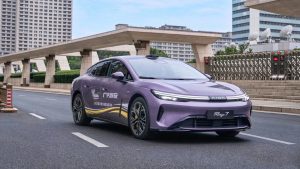
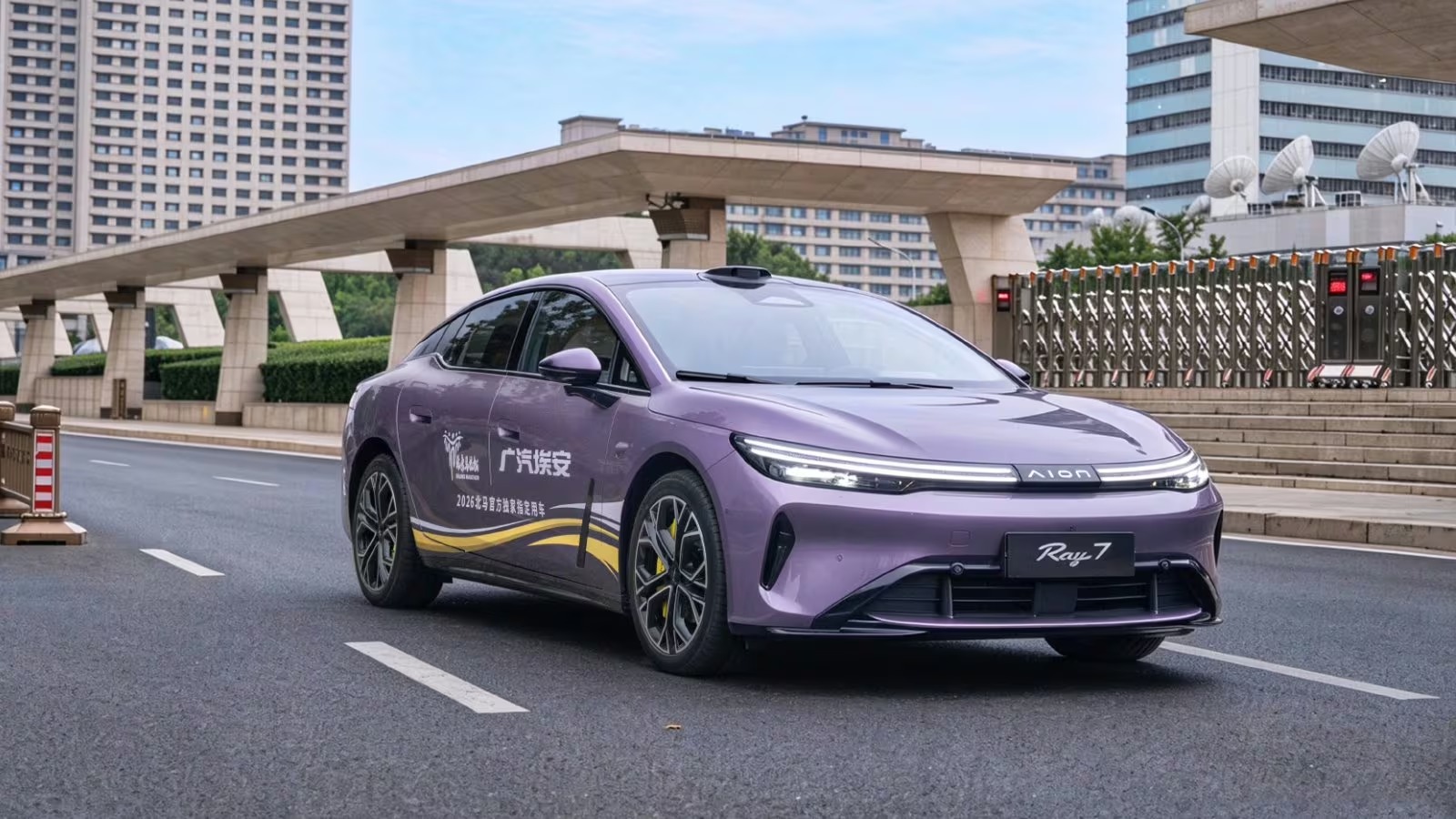
The GAC Aion Ray 7 features a five-seat layout and a fastback-style body. Semi-concealed door handles contribute to its streamlined appearance, while the model introduces Aion’s redesigned logo.
Its dimensions place it in the midsize electric sedan category, with a 2,920 mm wheelbase intended to provide space for passengers across both rows.
| Dimension | Specification |
|---|---|
| Length | 4,960 mm |
| Width | 1,900 mm |
| Height | 1,455 mm |
| Wheelbase | 2,920 mm |
| Seating capacity | 5 |
| Body style | Fastback sedan |
The Ray 7’s design and positioning reflect Aion’s effort to attract younger customers with a modern-looking sedan rather than focusing exclusively on traditional family-oriented styling.
Interior Design and Digital Equipment
The cabin combines a digital instrument cluster with a floating central touchscreen. Wireless phone charging and integrated front sport seats add to the model’s technology-focused interior.
Aion has positioned the Ray 7 as a sedan for younger buyers, with a simplified digital cockpit and integrated seat design supporting that approach.
Further details about screen dimensions, infotainment software and the full standard-equipment list have not been specified in the available launch information.
Huawei DriveONE Electric Powertrain
All five Ray 7 variants use Huawei’s DriveONE integrated electric drive system, paired with a single rear-mounted motor.
The motor delivers a maximum output of 180 kW, equivalent to approximately 241 horsepower, and 235 Nm of torque. Acceleration varies according to battery and trim configuration.
The 530 km versions accelerate from 0 to 100 km/h in 7.4 seconds, while the standard 702 km versions complete the same sprint in 6.9 seconds.
| Powertrain Specification | Details |
|---|---|
| Electric drive system | Huawei DriveONE |
| Motor configuration | Single rear-mounted motor |
| Maximum power | 180 kW (241 hp) |
| Maximum torque | 235 Nm |
| 0–100 km/h, 530 km versions | 7.4 seconds |
| 0–100 km/h, 702 km versions | 6.9 seconds |
| Drivetrain | Rear-wheel drive |
The shared motor output means the main performance differences between the two battery groups come from their configuration and associated vehicle specifications rather than a change in peak motor power.
Battery Options and CLTC Driving Range
The Ray 7 is offered with two lithium iron phosphate (LFP) battery configurations.
The 530 km versions use a 45.58 kWh battery with cells supplied by Aion’s Yinpai Battery unit. The 702 km versions use a larger 62.98 kWh battery with cells supplied by CATL, incorporating Aion’s Magazine Battery safety technology.
| Battery Configuration | Battery Capacity | Cell Supplier | CLTC Range |
|---|---|---|---|
| Standard-range versions | 45.58 kWh | Yinpai Battery | 530 km |
| Long-range versions | 62.98 kWh | CATL | 702 km |
| Long-range with optional high-performance package | 62.98 kWh | CATL | 600 km |
Aion quotes CLTC energy consumption of 9.7 kWh per 100 km for the 530 km versions and 9.8 kWh per 100 km for the standard configuration of the 702 km versions.
The optional high-performance package reduces the stated range of the long-range configuration to 600 km under the CLTC cycle. Buyers should therefore distinguish the standard 702 km range from the figure associated with that optional package.
CLTC figures are based on China’s testing procedure. Actual range will depend on driving speed, weather, road conditions, passenger load and climate-control use.
LiDAR-Based Driver Assistance
Three Ray 7 variants are equipped with LiDAR and support navigation-assisted driving on urban roads and highways.
The sensor package comprises 27 sensors, including one 192-channel LiDAR unit, three 4D millimeter-wave radars, 11 cameras and 12 ultrasonic sensors.
Aion says the driver-assistance algorithms share the same technological foundation as those used in WeRide’s Level 4 robotaxis. This describes a claimed technology foundation and should not be interpreted as meaning the Ray 7 itself offers Level 4 autonomous driving.
| Driver Assistance Equipment | Quantity |
|---|---|
| Total sensors | 27 |
| 192-channel LiDAR | 1 |
| 4D millimeter-wave radars | 3 |
| Cameras | 11 |
| Ultrasonic sensors | 12 |
The LiDAR-equipped versions are priced from 138,800 yuan. Actual feature availability and performance may depend on software, road conditions, local regulations and the level of driver supervision required.
Advanced Braking Technology on the Top Variant
The highest-specification Ray 7, priced at 158,800 yuan during pre-sales, receives Huawei’s chip-level integrated drive-and-brake architecture and an EMB fully electric brake-by-wire system.
The EMB system uses electronic control to manage braking rather than relying on a conventional mechanical-hydraulic arrangement alone. This forms part of the top variant’s more advanced chassis and vehicle-control equipment.
The other four variants use a Onebox integrated braking control system.
The difference in braking architecture provides another distinction between the range-topping model and the lower-priced versions, beyond battery capacity and driver-assistance equipment.
GAC Aion Ray 7 Specifications at a Glance
| Specification | Details |
|---|---|
| Model | GAC Aion Ray 7 |
| Vehicle type | Battery-electric sedan |
| Seating capacity | 5 |
| Number of variants | 5 |
| Pre-sales price range | 128,800–158,800 yuan |
| Motor output | 180 kW (241 hp) |
| Maximum torque | 235 Nm |
| Motor layout | Single rear-mounted motor |
| Electric drive system | Huawei DriveONE |
| Standard-range battery | 45.58 kWh LFP |
| Long-range battery | 62.98 kWh LFP |
| Maximum standard CLTC range | 702 km |
| Optional high-performance package range | 600 km CLTC |
| Energy consumption, 530 km version | 9.7 kWh/100 km CLTC |
| Energy consumption, standard 702 km version | 9.8 kWh/100 km CLTC |
| 0–100 km/h, 530 km version | 7.4 seconds |
| 0–100 km/h, 702 km version | 6.9 seconds |
| LiDAR-equipped variants | 3 |
| Length | 4,960 mm |
| Width | 1,900 mm |
| Height | 1,455 mm |
| Wheelbase | 2,920 mm |
Can the GAC Aion Ray 7 Attract Younger EV Buyers?
The Ray 7 gives GAC Aion a new electric sedan with a broad range of specifications at pre-sales prices below 160,000 yuan. Its fastback design, digital cockpit and Huawei DriveONE powertrain form the core of the package, while the long-range variants offer up to 702 km of claimed CLTC range.
The five-variant lineup also gives buyers a choice between a lower-cost configuration and models with LiDAR-based navigation assistance. The top trim adds Huawei’s integrated drive-and-brake architecture and fully electric brake-by-wire technology.
The model’s eventual market performance will depend on final production specifications, customer pricing, real-world efficiency and the practical performance of its driver-assistance systems.
With the Ray 7, Aion is expanding its product portfolio while introducing a new design identity. Its combination of range, technology and pricing could help the brand appeal to younger customers seeking a feature-rich electric sedan in China’s competitive EV market.


