
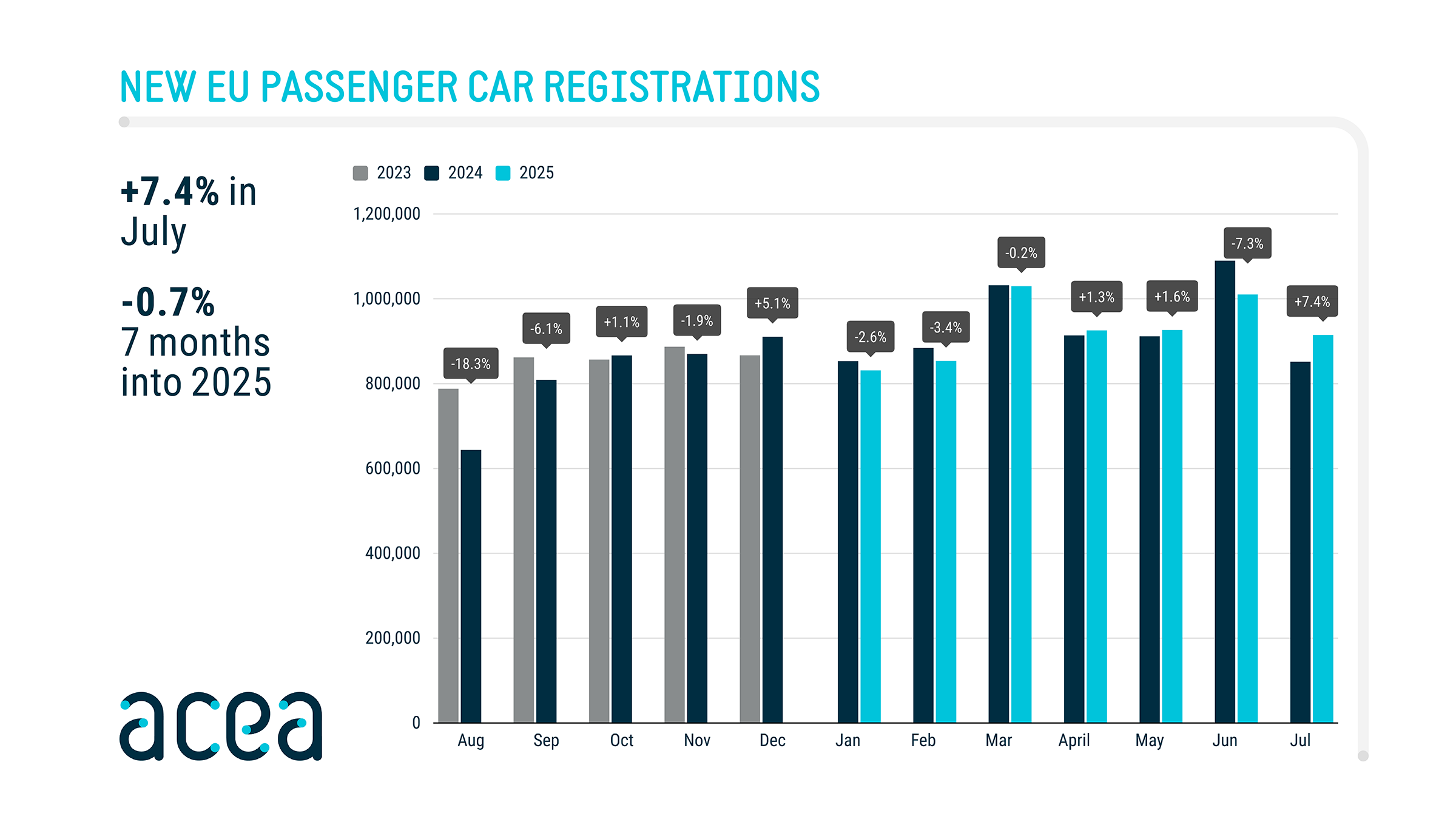
New car sales in Europe rose 5.9% in July, lifted by strong demand in Germany that outweighed declines in Britain, France and Italy, data from the European Automobile Manufacturers Association (ACEA) showed on Thursday.
Registrations across the European Union, Britain and the European Free Trade Association increased to 1.09 million units, with Germany posting an 11.1% gain while sales fell 5% in the UK, 7.7% in France and 5.1% in Italy. Other markets such as Spain, Poland and Austria recorded sharper increases of 17.1%, 16.5% and 31.6%, respectively.
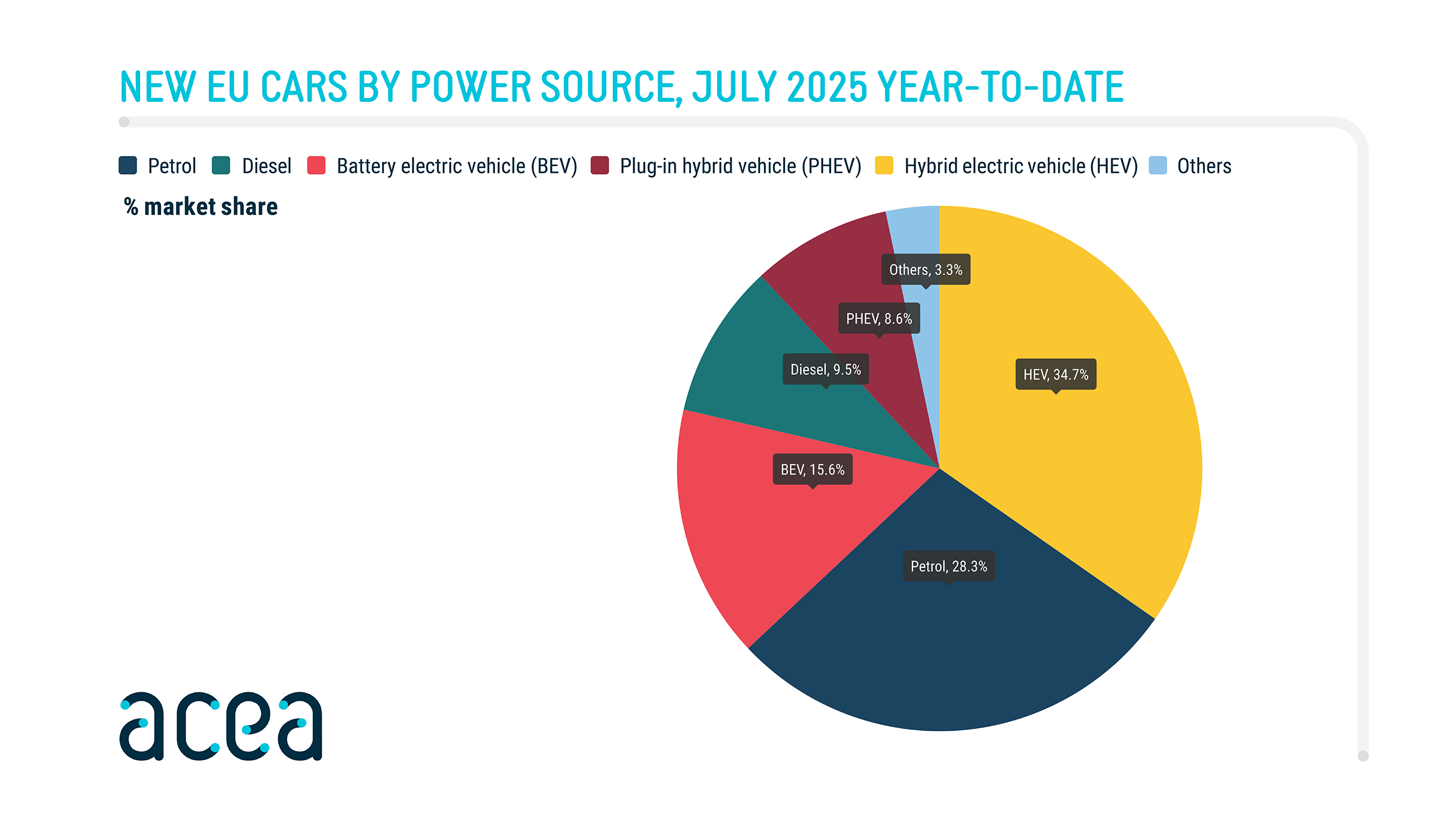
Sales of electrified vehicles accounted for nearly 60% of the bloc’s registrations in July, up from 51.1% a year earlier. Battery-electric, hybrid-electric and plug-in hybrid registrations rose 39.1%, 56.9% and 14.3%, respectively. Up to July, battery-electric cars represented 15.6% of the EU market, compared with 12.5% over the same period last year, while hybrids captured 34.7%.
Tesla’s European sales fell 40.2% in July, shrinking its market share to 0.8% from 1.4% a year earlier. Rival Chinese automaker BYD reported a 225.3% surge in sales, securing a 1.2% share as it was included in ACEA’s monthly data for the first time.
“EU targets to cut CO2 emissions from vehicles, including a 100% reduction for cars by 2035, are no longer feasible,” ACEA CEO Ola Kaellenius said in a letter co-signed with other executives to European Commission President Ursula von der Leyen.
Among domestic automakers, Volkswagen registrations rose 11.6% year-on-year in July, while Renault climbed 8.8%. Stellantis, however, posted a 1.1% decline.
ACEA figures showed that between January and July 2025, 1.01 million battery-electric cars were registered in the EU, led by gains in Germany (+38.4%), Belgium (+17.6%) and the Netherlands (+6.5%). France bucked the trend with a 4.3% decline despite a strong July. Hybrid-electric sales during the same period grew 34.7% to 2.26 million units, with France, Spain, Germany and Italy driving the increase.
Plug-in hybrid registrations also rose strongly, up 56.9% in July, marking their fifth consecutive month of growth. They accounted for 8.6% of EU registrations so far in 2025, compared with 6.9% a year earlier.