
The EU-funded SCAPE project, coordinated by the Catalonia Institute for Energy Research (IREC), is developing new power electronics for electric vehicles aimed at improving efficiency, increasing power density, and reducing costs.
The project — formally known as Switching-Cell-Array-Based Power Electronics Conversion for Future Electric Vehicles — is targeting efficiencies above 97.5%, double the current power density, and halved cost per kilowatt. Organisers say the advances could support longer vehicle ranges, more affordable models and strengthen Europe’s automotive supply chain.
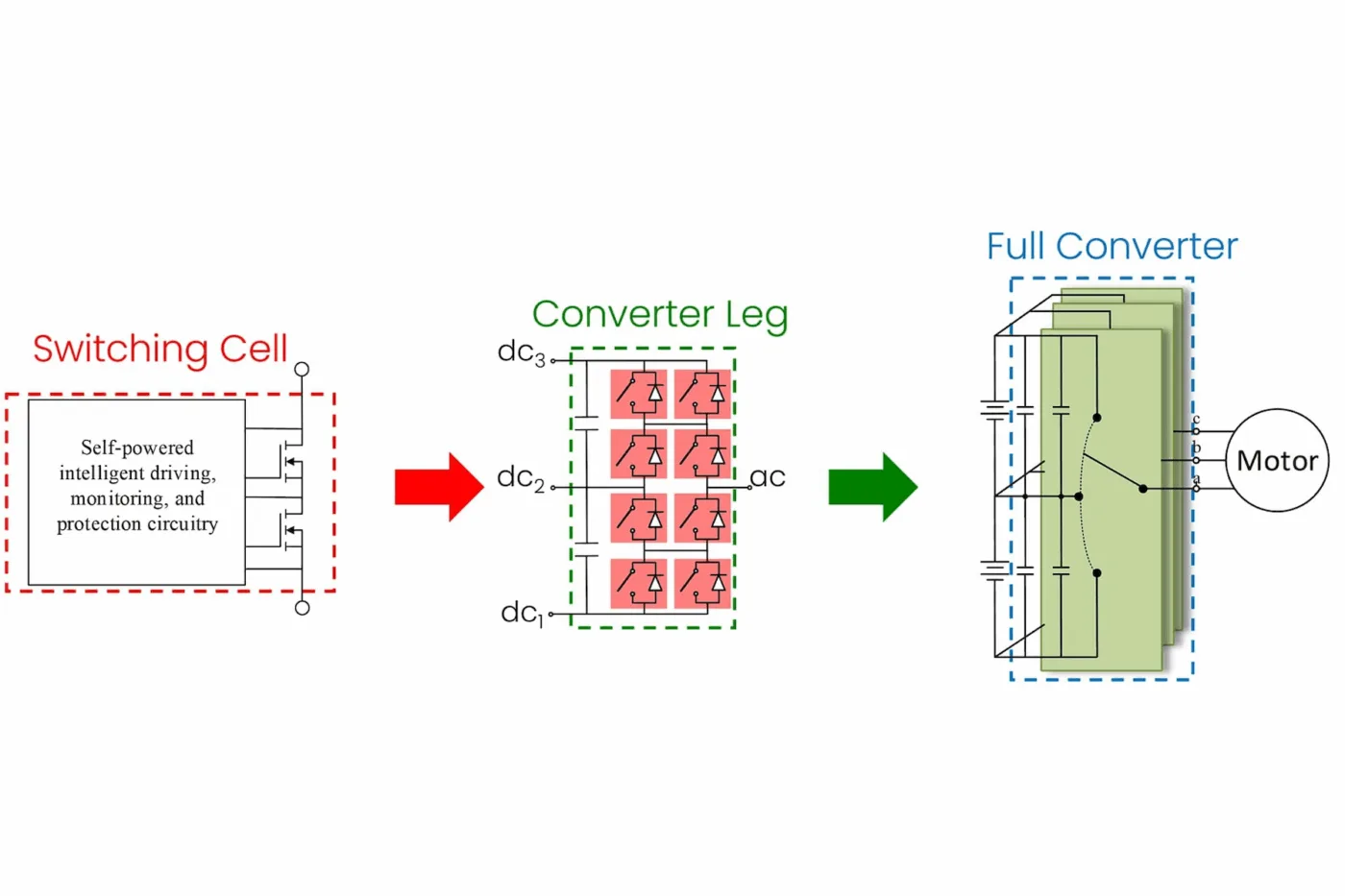
SCAPE’s approach centres on modular “switching cells,” standardised building blocks that integrate advanced semiconductor technology. These cells can be combined into converter strings and scaled for use in both small city cars and heavy-duty trucks, which the project says could lower development and manufacturing costs.
The consortium is also developing a combined unit that integrates an on-board charger with a traction inverter, aiming to simplify vehicle design, improve reliability, and reduce costs. A further focus is embedding chips directly into circuit boards, which SCAPE says reduces size, heat, and power loss. Early testing showed a 45% reduction in thermal resistance and an 85% reduction in stray inductance compared with conventional systems.
The project also uses a digital twin of the powertrain for predictive maintenance, enabling load redistribution between modules to maintain operation until servicing is performed.
SCAPE, which runs until June 2026, has a budget of about six million euros. Alongside IREC, participants include the University of Modena and Reggio Emilia in Italy, Deep Concept in France, and Austrian mobility technology firm AVL.