



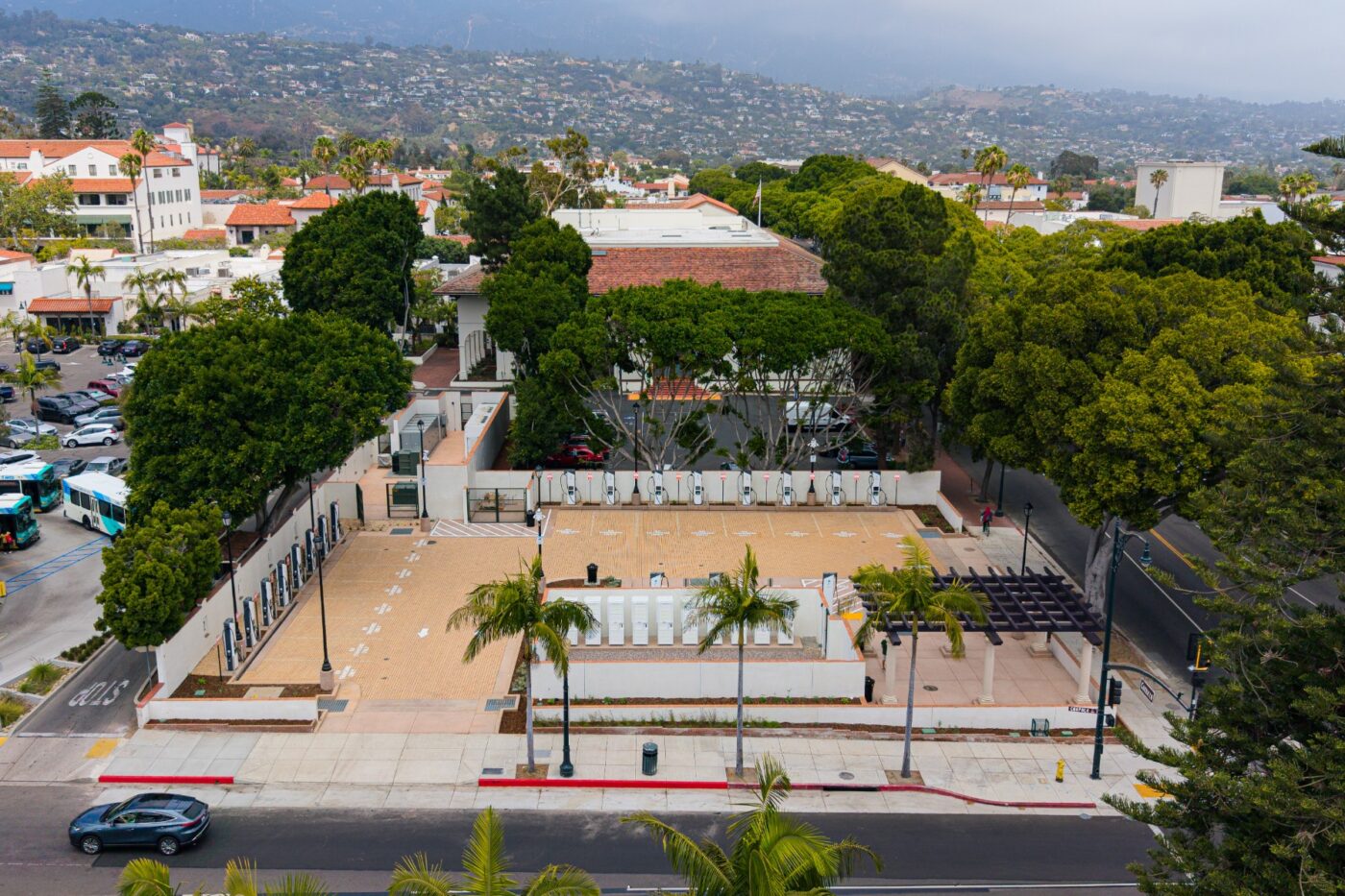
Electrify America has opened a new large-format electric vehicle charging hub in downtown Santa Barbara, California, featuring 20 high-power charging bays and an integrated battery energy storage system designed to enhance charging reliability and grid flexibility.
The new facility marks another step in the company’s strategy to develop larger charging locations capable of serving more drivers while reducing congestion and waiting times.
20 high-power charging bays
The Santa Barbara station offers 20 charging points with power outputs of up to 350 kW, enabling compatible electric vehicles to access ultra-fast charging.
The site becomes Electrify America’s second charging location in Santa Barbara and joins a growing portfolio of large-scale charging hubs across California, including installations in Santa Monica, San Diego and San Francisco.
The company has increasingly focused on developing stations with 20 or more charging bays to accommodate rising EV adoption and growing charging demand.
Largest battery storage deployment in the network
A key component of the new facility is its integrated 1.9 MW battery energy storage system (BESS), which Electrify America says is the largest public battery storage installation currently operating within its charging network.
The system stores electricity from the grid during periods of lower demand and when renewable energy generation is abundant.
Stored energy can then be discharged during peak charging periods to supplement available power, support charging operations and reduce pressure on the local electricity grid.
Supporting renewable energy integration
Electrify America said the battery storage system is designed to improve charging reliability while increasing the use of renewable electricity.
By shifting energy consumption away from peak demand periods and utilizing stored energy when required, the company aims to improve overall charging efficiency and reduce infrastructure constraints.
The approach also allows high-power charging services to be deployed in locations where grid capacity may otherwise be limited.
Next generation charging infrastructure
Rob Barrosa, President and Chief Executive Officer of Electrify America, said the project represents a new phase in EV charging development.
“This large-format station showcases the next evolution of charging infrastructure, combining high-power charging with integrated battery energy storage to deliver reliable capacity at scale.”
“By incorporating advanced storage technology, we’re able to bring Hyper-Fast charging to locations that have traditionally been difficult to serve, while making it easy for customers to integrate charging into their daily routines in the heart of downtown Santa Barbara.”
NACS support planned
At launch, all 20 charging bays are equipped with Combined Charging System (CCS) connectors.
However, Electrify America confirmed that several chargers will be converted to support the North American Charging Standard (NACS) later this summer as part of the company’s ongoing NACS deployment programme.
The move reflects the broader industry transition toward NACS compatibility across charging networks and vehicle manufacturers in North America.
Expanding charging capacity
The Santa Barbara installation highlights a growing trend among charging operators to combine large-scale fast-charging hubs with battery energy storage systems to improve utilization, support grid stability and accommodate future EV growth.
As electric vehicle adoption continues to accelerate across California and the United States, integrated charging and energy storage projects are expected to play an increasingly important role in expanding charging infrastructure while minimizing impacts on local power networks.