



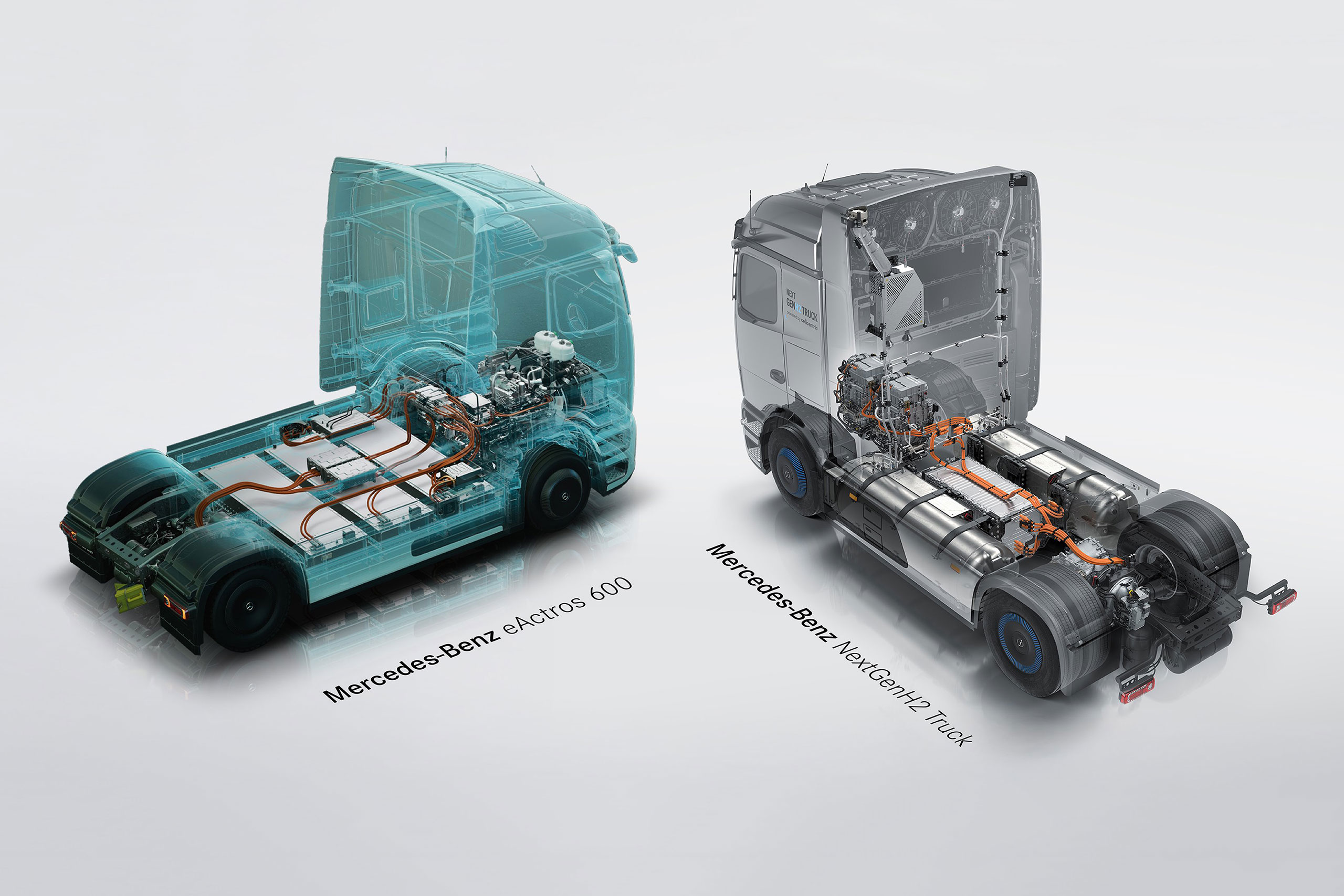
Daimler Truck has disclosed new technical details about its NextGenH2 Truck, highlighting the common architecture it shares with the battery-electric eActros 600 while reaffirming its view that battery-electric and hydrogen-powered vehicles will serve different long-haul transport applications.
The company said the fuel cell truck will enter small-series deployment from the end of 2026 and is designed to offer a driving range of more than 1,000 kilometers on a single refueling.
Shared Electric Drive Platform
The NextGenH2 Truck and the eActros 600 both utilize Mercedes-Benz Trucks’ in-house developed electric drive axle, which integrates electric motors, power electronics, and a four-speed transmission.
The two trucks also share the same ProCabin, cockpit design, and driver assistance systems, creating a common operating environment regardless of propulsion technology.
Daimler Truck said the shared architecture allows it to leverage common technologies across multiple vehicle platforms while supporting different operational requirements.
Battery and Hydrogen Approaches
The battery-electric eActros 600 is equipped with three lithium iron phosphate (LFP) battery packs providing a total installed capacity of 621 kWh.
According to the company, the truck can travel up to 500 kilometers without intermediate charging at a gross combination weight of around 40 tonnes.
The NextGenH2 Truck uses liquid hydrogen stored at minus 253 degrees Celsius. The vehicle can carry up to 85 kilograms of liquid hydrogen and utilizes onboard fuel cells to generate electricity for propulsion.
Daimler Truck said the vehicle is capable of achieving a range exceeding 1,000 kilometers while requiring approximately 10 to 15 minutes for refueling.
Different Technologies for Different Missions
The company maintains that battery-electric trucks are well suited for transport operations with predictable routes and access to scheduled charging opportunities.
Hydrogen-powered trucks, meanwhile, are intended for applications where long driving distances, limited charging infrastructure, and minimal downtime requirements make battery-electric solutions less practical.
Daimler Truck said both technologies are needed to address the full spectrum of freight transport requirements and support the decarbonization of road logistics.
Focus on Long-Haul Transport
The NextGenH2 Truck forms part of Daimler Truck’s broader strategy to develop zero-emission solutions for long-distance freight transport.
While the eActros 600 has already entered series production and customer operation, the hydrogen-powered truck remains in a demonstration and early deployment phase as supporting hydrogen infrastructure continues to develop.
The company said fuel cell technology offers potential advantages in applications requiring extended operating range and rapid energy replenishment, particularly in long-haul transport corridors where vehicle utilization rates are critical.
Daimler Truck has previously stated that it expects battery-electric vehicles to play a leading role in freight decarbonization while fuel cell trucks could serve complementary use cases where operational demands exceed the capabilities of current battery technologies.


