




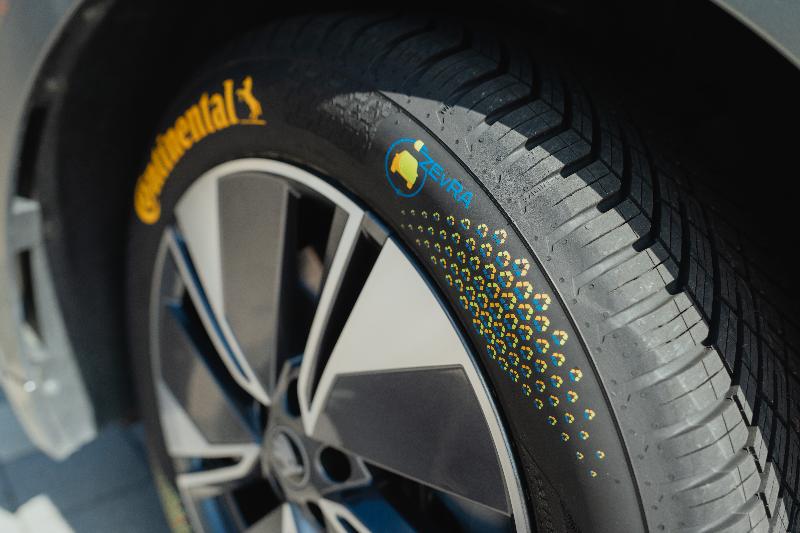
Continental has developed a concept tyre containing around 43% recycled materials as part of the European Union’s ZEvRA project, with the design also focused on reducing rolling resistance and improving electric vehicle efficiency.
Recycled Materials
The tyre was developed under ZEvRA, or Zero Emission Electric Vehicles Enabled by Harmonised Circularity, an EU-funded project focused on advancing circular economy principles across the electric vehicle value chain.
Continental Develops Ultra-Low Rolling Resistance Tire for Renault EVs
Continental said it is the only tyre manufacturer among the project’s 28 partners.
More than 80% of the materials used in the concept tyre come from recycled, renewable or mass-balance-certified sources.
The recycled portion includes steel, rubber recovered from end-of-life tyres, polyester yarn produced from PET bottles and recovered industrial carbon black.
EV Efficiency
Despite its recycled material content, Continental said the concept tyre achieves the highest rolling-resistance rating under the EU tyre labelling system.
Continental Integrates Seven Autonomous Mobile Robots at Hanover Plant to Automate Tire Transport
Low rolling resistance is particularly important for electric vehicles because reducing the energy required to overcome tyre resistance can lower electricity consumption and potentially increase driving range.
Challenges to Commercialisation
Continental said several challenges must still be addressed before tyres with comparable material compositions can be brought into series production.
These include ensuring sufficient availability of high-quality recycled materials, scaling up recycling and manufacturing processes and establishing consistent regulatory definitions and standards.
The company nevertheless plans to increase the proportion of renewable and recycled materials across its tyre portfolio.
Continental to Highlight Autonomous Driving Tire Technologies at Tire Technology Expo
Continental said the share reached 28% in 2025 and is targeted to increase to at least 40% by 2030.
The ZEvRA project is intended to support broader efforts to establish more circular electric vehicle supply chains, with tyre materials representing one component of that transition.