
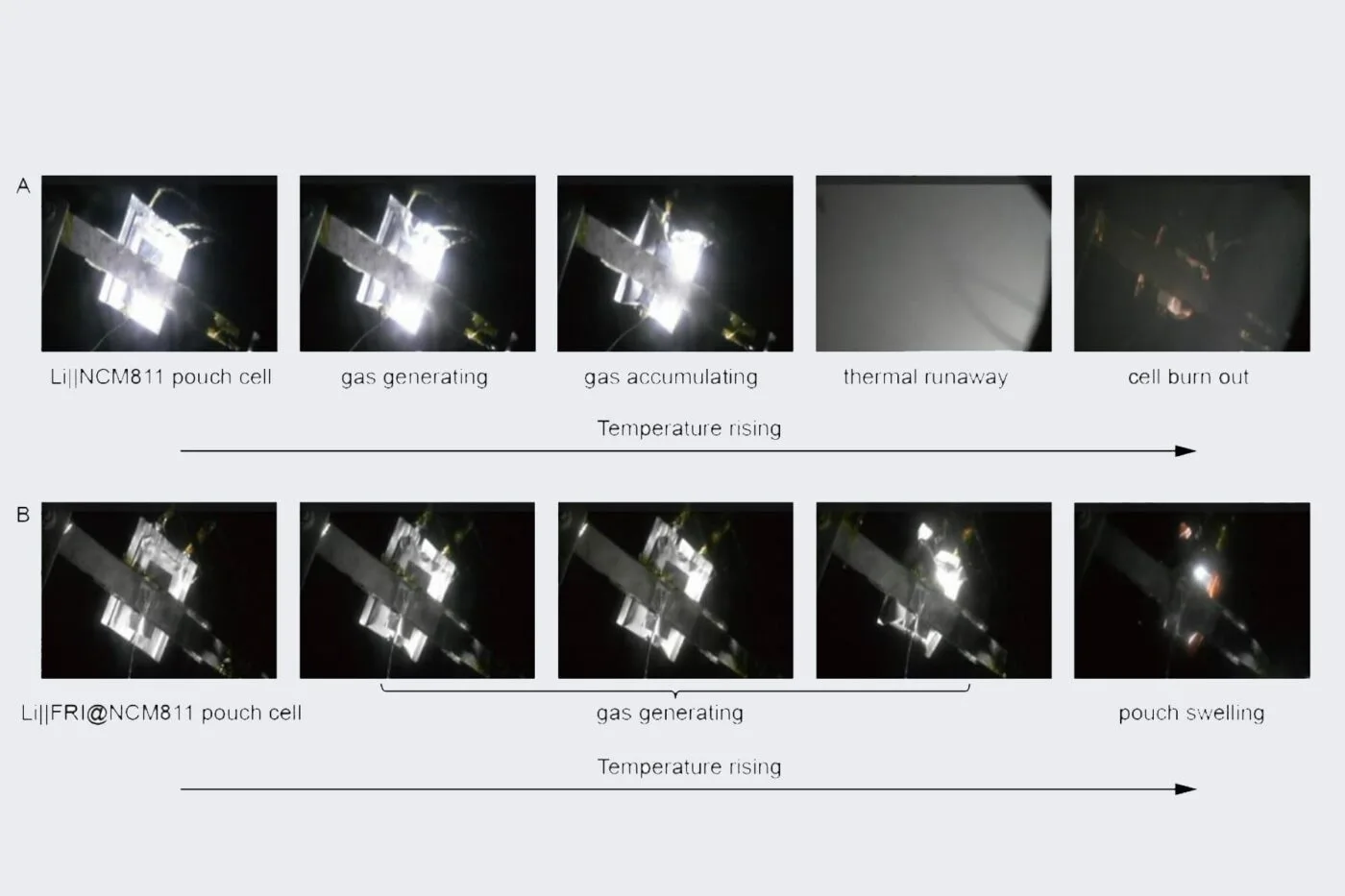
A team of scientists from the Institute of Chemistry at the Chinese Academy of Sciences has developed a lithium metal battery featuring a flame-retardant interface designed to prevent fires caused by overheating, according to findings published in the Proceedings of the National Academy of Sciences (PNAS).
Lithium metal batteries offer significantly higher energy density compared to conventional lithium-ion batteries but are prone to safety risks due to flammable gases produced during thermal runaway. The Chinese researchers addressed this by incorporating flame retardant interfaces (FRIs) into the battery’s cathode. These FRIs reduce oxygen release and modify the gas composition during thermal stress, helping to lower flammability.
“The self-heating rate of the improved cells is reduced by 4 orders of magnitude, achieving zero thermal runaway in pouch cells,” the research team reported. They added that their “smart gas management strategy” enhances both thermal safety and electrochemical stability, calling it a “transformative pathway to fire-safe Li metal batteries for advanced energy storage applications.”
Laboratory tests showed that the flame-retardant lithium metal cells could withstand temperatures up to 220°C without igniting—far exceeding the thermal limits of conventional lithium-ion batteries. The researchers also said their method can be applied with minimal changes to existing manufacturing processes, potentially making high-energy lithium metal batteries a safer and viable option for electric vehicle use.