
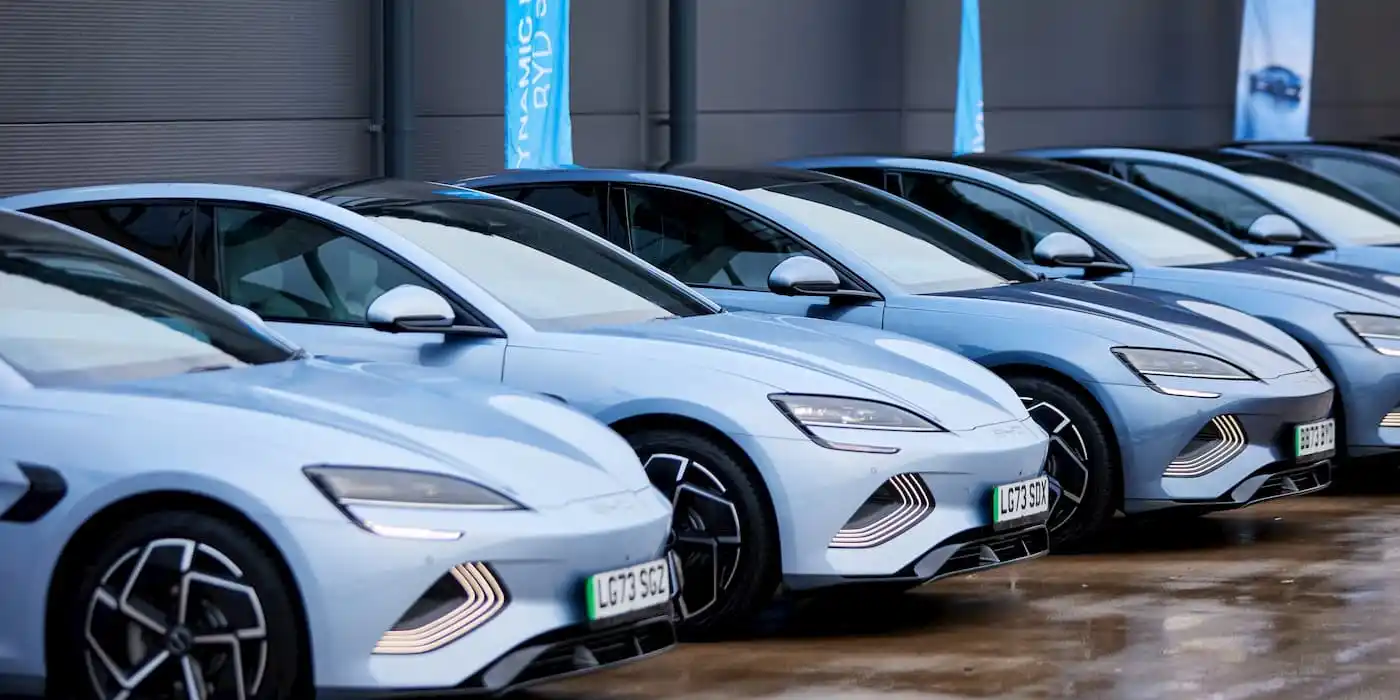
South Korea’s electric vehicle market is becoming increasingly dependent on vehicles manufactured in China, despite government efforts to tighten subsidy eligibility rules. Tesla’s Shanghai-built models and BYD’s expanding commercial presence have helped Chinese-produced vehicles strengthen their position, particularly in the passenger car segment, BusinessKorea reported.
Data from the Korea Automobile & Mobility Association (KAMA) showed that 43,455 of the 98,292 electric vehicles registered in South Korea during the third quarter were manufactured in China. That represented 44.2% of registrations, an increase of 6.8 percentage points compared with the same period a year earlier.
The shift is even more pronounced among imported passenger EVs. Chinese factories produced 84.9% of imported electric passenger vehicles registered in the country, illustrating how production networks in China are influencing competition in one of Asia’s established automotive markets.
BYD Builds Momentum Despite Losing Subsidy Access
BYD has emerged as one of the fastest-growing competitors in South Korea. Bloomberg Intelligence data indicated that the Chinese automaker sold around 18,000 vehicles in the country between January and August, roughly nine times its total for the corresponding period last year.
Hyundai Motor, by comparison, recorded approximately 139,000 sales over the same eight months, representing a 6% decline.
South Korea removed BYD vehicles from subsidy eligibility in July, but the company has continued to pursue buyers through marketing campaigns and manufacturer-funded incentives. Its average monthly registrations in the third quarter were 30% above the monthly average recorded during the first half of the year.
The figures suggest that government subsidies are only one factor shaping purchasing decisions. Pricing, product availability and promotional offers are also influencing demand, allowing some imported models to maintain their momentum after losing access to public support.
Tesla’s manufacturing base in Shanghai has added another dimension to the trend. Vehicles produced at the facility contribute to the growing proportion of Chinese-made EVs in South Korea, even though Tesla is an American automaker.
Commercial EVs Respond Differently to Tighter Rules
The impact of South Korea’s subsidy changes has varied significantly by vehicle category. Requirements covering battery energy density and after-sales service appear to have had a stronger effect on Chinese-made commercial vehicles than on passenger cars.
Chinese-manufactured electric trucks recorded no registrations from January through September this year, compared with 648 during the same period in 2025. Their position in the bus market also weakened, with their share falling from 34.6% to 21.6%.
Passenger EVs have proved more resilient. Imported electric cars continue to attract buyers, while Tesla and BYD have maintained a presence despite changes to subsidy eligibility.
This divergence raises questions about whether the current policy framework can achieve its intended results across the wider EV industry. Measures that restrict access to incentives for certain commercial vehicles have coincided with a substantial reduction in registrations, but they have not prevented Chinese-made passenger cars from expanding their share.
Hyundai Faces Pressure on Price and Design
The competitive shift is also creating challenges for South Korea’s established manufacturers. Hyundai Motor Group is facing growing pressure from Chinese brands that are competing on vehicle design, pricing and product development.
Lee Jae-gyu, a Hyundai Motor Group executive overseeing vehicle development, recently described the design quality and competitive prices of Chinese vehicles as leaving him with “a sense of despair.”
The remarks point to concerns that Chinese automakers are no longer competing solely through lower prices. Their products are also challenging established manufacturers on design and perceived value, potentially increasing pressure on both Korean and European brands.
Samsung Securities analyst Esther Lim said Hyundai Motor’s global sales could fall below 4 million vehicles this year, which would mark the company’s first annual total below that level since 2010.
For Hyundai, the challenge extends beyond defending its domestic market. Chinese manufacturers are expanding their international reach, increasing competition in markets where established automakers have traditionally held stronger positions.
Production Tax Credits Enter the Policy Debate
Some industry figures argue that South Korea should complement purchase subsidies with measures that encourage vehicles to be manufactured domestically.
Lee Ho-geun, a professor at Daeduk University, said production tax credits could offer a more direct incentive for automakers to maintain factory utilization and employment at domestic facilities.
A bill proposing amendments to the Restriction of Special Taxation Act to extend production tax credits to EVs has been introduced in the National Assembly.
Unlike purchase subsidies, which reduce the cost faced by consumers, production-based incentives would focus on supporting manufacturing activity. Advocates see them as a way to strengthen domestic production capacity and help local factories compete as imported EVs gain market share.
The proposal would represent a shift in emphasis toward the industrial effects of the EV transition, although its eventual impact would depend on the design of the incentives and the response from manufacturers.
Ownership Costs Could Shape the Next Phase of Competition
Chinese-made EVs have expanded rapidly, but sustaining that growth will depend partly on the ownership experience after purchase. Service coverage, repair expenses and resale values could influence how consumers assess these vehicles over time.
Brian Lee, a researcher at CLSA Securities, suggested that Chinese vehicles might become less attractive as the market matures and buyers gain a clearer understanding of maintenance costs.
These factors remain potential challenges rather than established barriers to future growth. As more vehicles enter service, consumer experience and the development of local repair networks may help determine whether Chinese brands can maintain their current momentum.
South Korea now faces a two-part challenge: designing policies that support domestic automotive manufacturing without unnecessarily slowing EV adoption, and ensuring that local manufacturers remain competitive as Chinese-built vehicles gain traction. The balance between consumer incentives, industrial support and long-term ownership considerations is likely to shape the market’s next stage.