




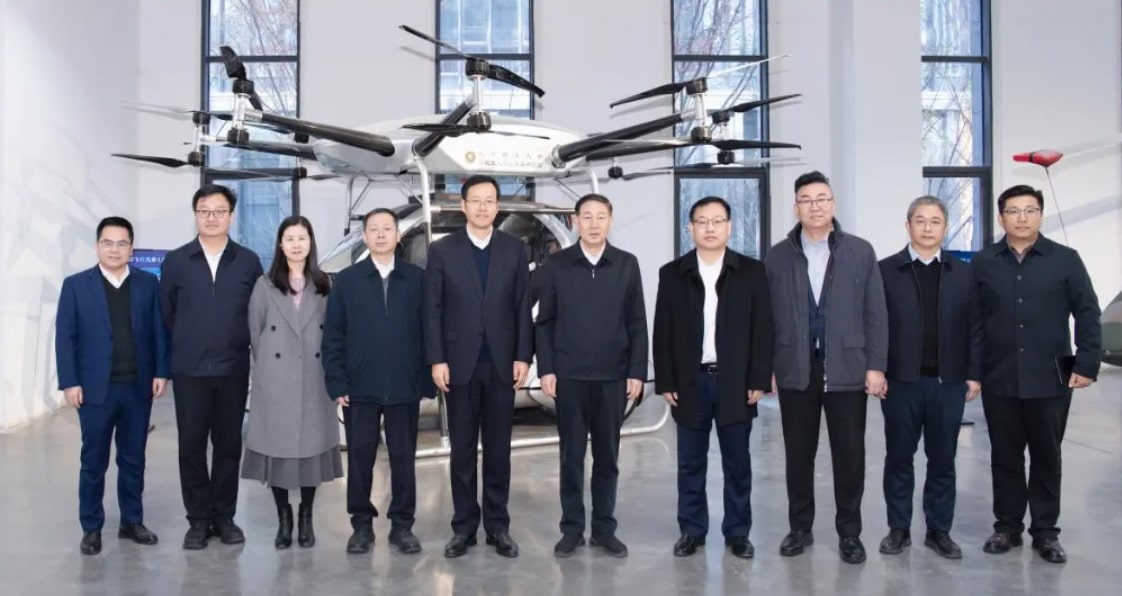
Anhui Jianghuai Automobile Group Corp (JAC) has formed a joint laboratory dedicated to flying car research, becoming the latest Chinese automaker to enter the emerging low-altitude mobility sector. The lab was established on December 9 in Hefei, Anhui, where JAC is headquartered, in collaboration with the Beijing Institute of Technology and IAT Automobile Technology.
JAC said China’s growing low-altitude economy has elevated flying cars to a “golden development period,” highlighting their potential in emergency response, cultural tourism and urban commuting. The company noted, however, that despite rapid interest, the industry still faces “a series of common challenges” related to core technologies, standards and operational models, requiring coordinated efforts across the supply chain.
See also: Autoflight Unveils Water-Based Vertiport for eVTOL Operations
The new laboratory will draw on JAC’s vehicle development expertise to support engineering of flying car products. The Beijing Institute of Technology brings experience in unmanned intelligent systems and aerospace engineering, having created the UAM650 modular flying car prototype in 2022. IAT will contribute its capabilities in vehicle platforms and core components, particularly in power distribution, structural design and electronic/electrical integration.
The Beijing Institute of Technology previously unveiled a two-seat, split-body flying car prototype in November 2022, capable of switching between ground driving and aerial flight. The autonomous aircraft features a maximum takeoff weight of 650 kg and a payload capacity of 280 kg, according to earlier reporting.
See also: Xpeng’s Aridge Completes First Flying Car Body, Marks Step Toward Mass Production
JAC said the joint laboratory will study flying car applications in scenic tourism, emergency rescue and low-altitude logistics. The move adds JAC to a growing list of Chinese companies pursuing flying car solutions. Specialist eVTOL manufacturers such as Ehang and Autoflight are already active, while automakers including Xpeng, Chery, GAC, Changan and FAW have launched their own development efforts. Xpeng’s flying car subsidiary, Aridge, aims to begin mass production and deliveries in 2026.
Industry expectations point to rapid expansion: China could have as many as 100,000 eVTOLs in households or deployed as air taxis by 2030, according to a report released in November 2024 by the China Low Altitude Economic Alliance.