
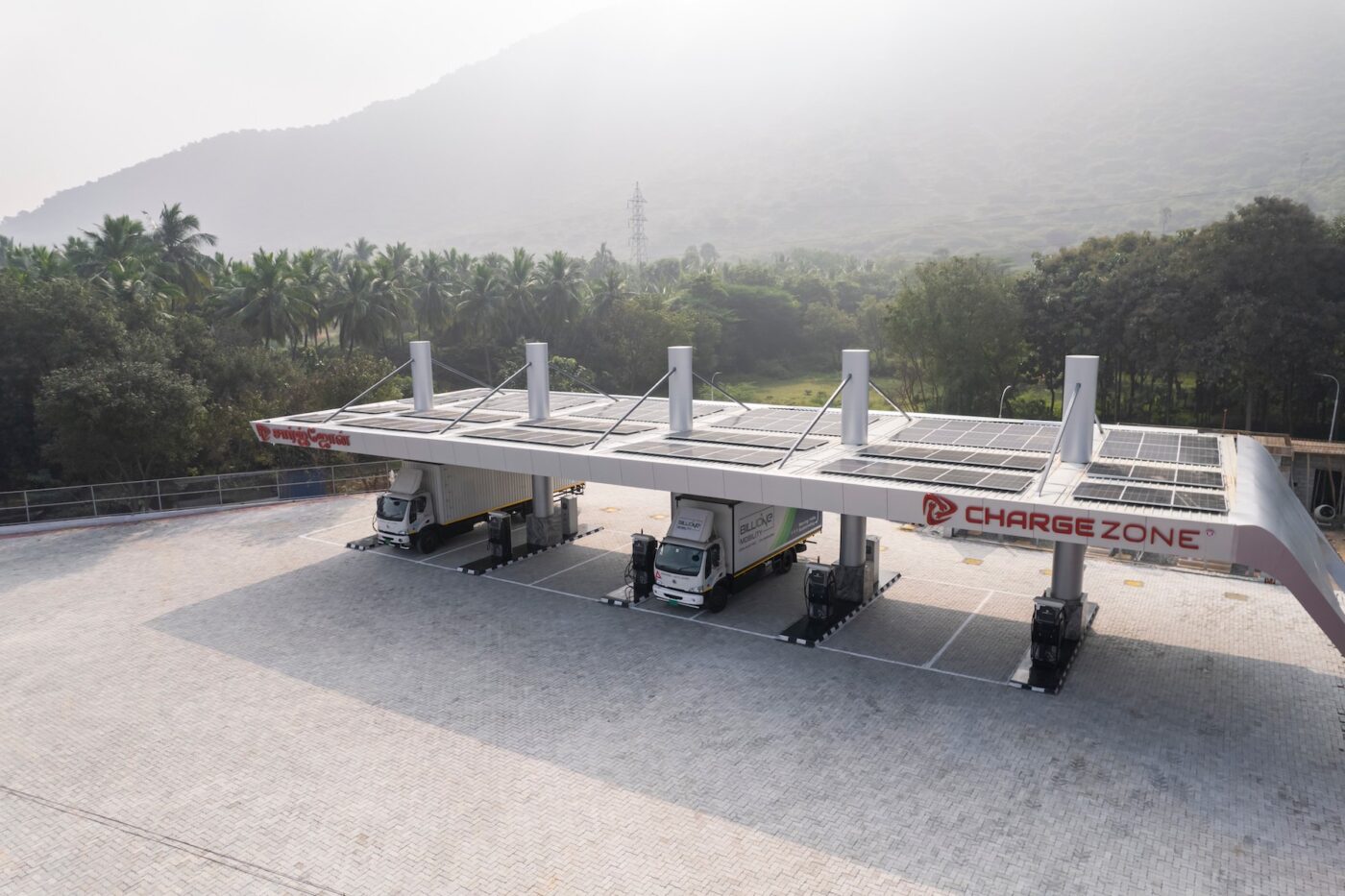
Indian charge point operator ChargeZone has announced plans to deploy more than 1,000 fast-charging stations along major national highway corridors, with completion targeted by March 2027.
The company said each site will require a minimum investment of 10 million rupees (around €92,500) and will be developed under a franchise-based Dealer Owned, Company Operated (DOCO) model. Under this structure, dealers—including landowners, entrepreneurs, businesses and institutions—will fund the installations, while ChargeZone will oversee development, commissioning and operations.
To support financing, ChargeZone has partnered with State Bank of India, which will provide loans ranging from 1 million to 100 million rupees through its EV Mitra scheme. The loans will be offered at subsidised rates with repayment periods of up to seven years, the company said.
The planned charging stations will have capacities between 500 kW and 1.5 MW, enabling support for both passenger electric vehicles and heavy-duty commercial vehicles such as buses and trucks. ChargeZone has already deployed charging infrastructure along several key routes, including Delhi–Mumbai, Delhi–Chandigarh, Bengaluru–Hyderabad, Bengaluru–Chennai, Mumbai–Hyderabad, Mumbai–Bengaluru and Vizag–Chennai corridors.
“As EV adoption in India expands beyond cities into highways and freight corridors, the need for high-capacity, reliable charging infrastructure is becoming more critical,” said Kartikey Hariyani.
“The DOCO (Dealer Owned, Company Operated) model allows us to accelerate this build-out by enabling wider participation, while ensuring consistent operations across the network,” he added.
Headquartered in Vadodara, ChargeZone operates one of India’s largest EV charging networks and has expanded internationally into the United Arab Emirates. The company said it currently manages more than 15,000 charging points across over 1,200 locations in the two countries.
The initiative reflects growing efforts to strengthen charging infrastructure along India’s highway network as electric mobility adoption expands into long-distance and commercial transport segments.