



CATL plans to establish approximately 36 battery swap stations across Hong Kong by the end of 2030 as the Chinese battery manufacturer expands its Choco battery swapping network beyond mainland China.
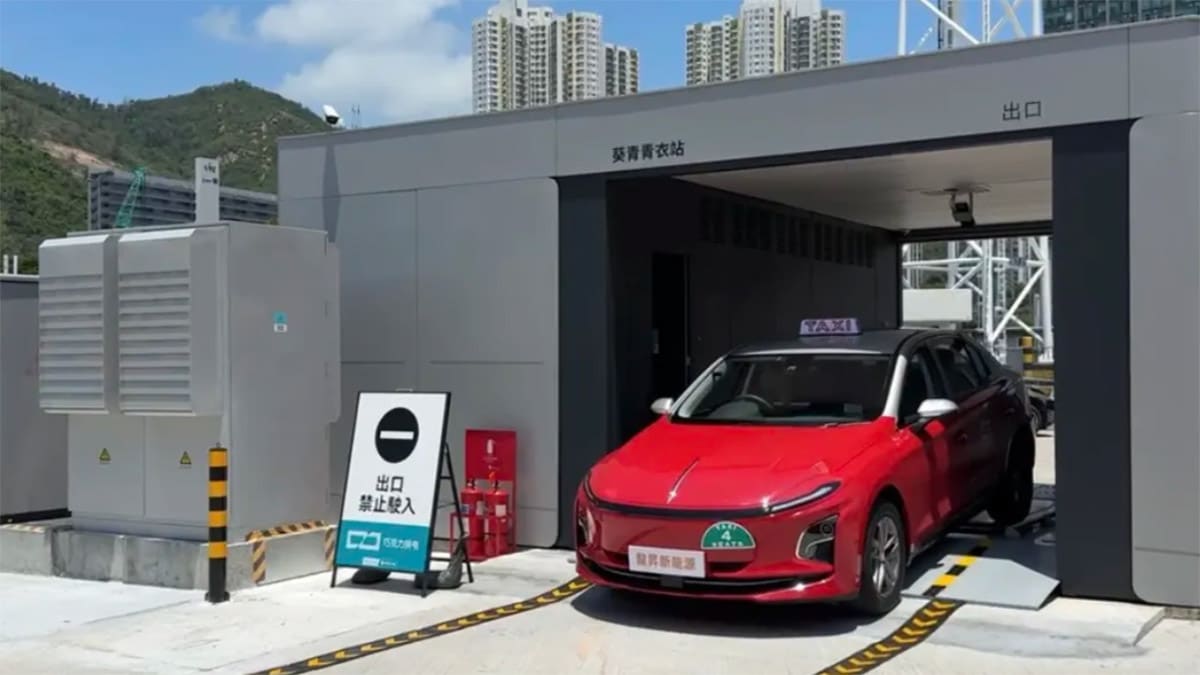
The company said two Choco battery swap stations are already operational in Hong Kong, with the first batch of battery swap-enabled taxis entering service, marking the start of commercial operations for the technology in the city.
Commercial Vehicle Network
The Choco swap stations will primarily support high-frequency commercial vehicles, including taxis, logistics vehicles and light commercial fleets.
CATL said it intends to gradually build a battery swap network covering major transport hubs across all districts of Hong Kong to support low-emission urban mobility.
The Hong Kong swap taxi fleet uses a right-hand-drive version of the Hongqi E-QM5, equipped with CATL’s Choco-SEB battery swapping technology.
According to the company, each battery exchange can be completed in approximately 99 seconds, reducing vehicle downtime and improving fleet utilisation.
CATL said battery swapping enables taxi and logistics operators to minimise charging delays, helping increase vehicle availability and operating revenue.
Designed for Dense Urban Areas
The company said Hong Kong’s mountainous terrain, dense urban development and limited land availability make battery swap stations particularly well suited to the city’s transport environment.
Compared with conventional charging infrastructure, battery swap stations occupy relatively small footprints and can be deployed more flexibly in constrained urban locations.
CATL believes the Hong Kong rollout could provide a model for battery swapping in other high-density international cities.
Expansion Continues
Hong Kong Chief Executive John Lee Ka-chiu visited CATL on 24 June, where he inspected Choco battery swap passenger cars, light trucks and vans, and experienced the battery swap taxi system.
Lee said Hong Kong continues to promote the development of the new energy industry while accelerating the deployment of green technologies, adding that he hopes to strengthen cooperation between Hong Kong and Fujian Province.
On the mainland, CATL’s battery swap network has expanded rapidly.
As of May 2026, the company had established 1,650 battery swap stations across 127 cities.
CATL plans to increase that network to more than 3,000 stations by the end of 2026, covering nearly 190 cities. Major metropolitan areas including Beijing, Guangzhou and Chongqing each already operate more than 50 battery swap stations.
The company said the high-density battery swap model being developed in Hong Kong could serve as a reference for future deployments in other international markets.


